
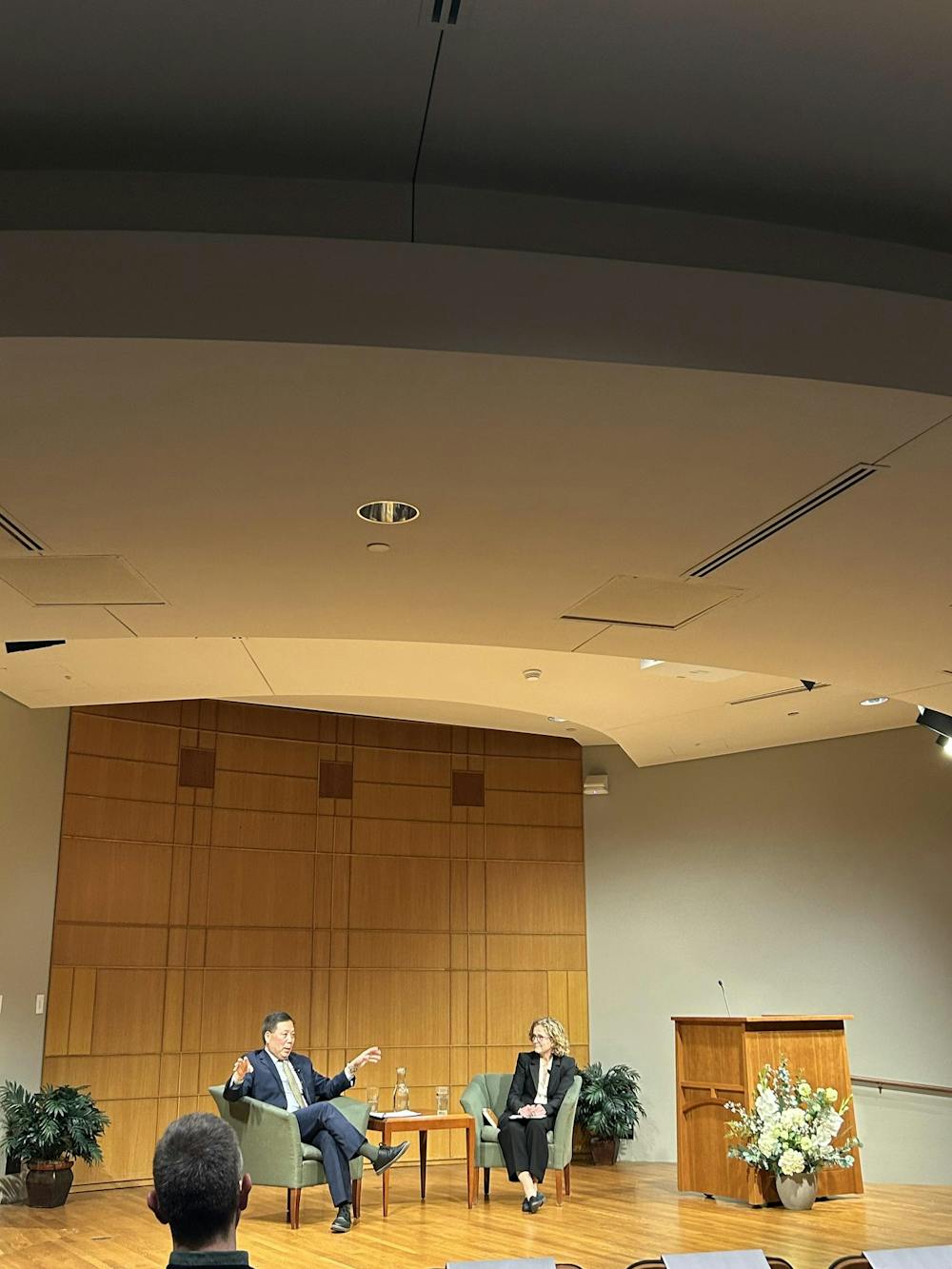
On Wednesday, from 5–6 p.m. in Hesburgh Auditorium, Chris Lu, former U.S. ambassador to the United Nations for Management and Reform, spoke on the state of American democracy in conversation with Mary Gallagher, Marilyn Keough dean of the Keough School of Global Affairs at the University of Notre Dame. The talk was facilitated by Notre Dame’s Democracy Initiative, the Kellogg Institute for International Studies and the Liu Institute for Asia and Asian Studies. Throughout the discussion, Lu offered insight into the reality of government interaction with higher education, the rise of China and the prevalence of checks and balances.
Gallagher prompted a talk on federal involvement in higher education initiatives with a brief discussion of the role of civil society in maintaining democracy. She stated that universities, lawyers, media and nonprofit organizations play a role in maintaining a functioning American democracy. This led to a question on how outside organizations are seen and how they become part of democracies.
Lu responded by discussing the importance of higher education in maintaining democracy. He mentioned the relevance of First Amendment rights such as free press, free speech and academic freedom being fundamental to both American democracy and to American universities.
“We need a free press that is a check on all powers in government and we need [a] civil society that can advocate for people who don’t have a voice. I think all of those are under attack in this country," Lu said.
Gallagher inquired on the history of federal funding to universities for political leverage. Lu said that while the federal government does have the authority to release grants to higher education institutions, recent interactions between the federal government and Harvard University may have overexerted governmental authority in the area of higher education funding.
“Look at what the government has asked Harvard to do. They are saying we have the ability to go into each one of your schools, to each one of your programs, to look at the professors, look at the students, look at the diversity of viewpoints. I mean that cuts right into the heart of academic freedom,” Lu said.
Gallagher shifted the conversation toward an international angle drawing from Lu’s experience with the United Nations. Gallagher inquired on other nations’ perceptions of the United States — wondering how closely foreign countries watch American actions.
“The lifeblood of the UN is conversations,” Lu said. He went on to discuss the reality of foreign knowledge of the United States, saying, “They know keenly what is happening in our country on a day-to-day basis. They know minutia about our country in the way that we know.”
He explained how the detailed knowledge held by foreign governments on American politics and society contributes to an interconnectedness amongst the worlds’ greatest foreign powers. This sharing of knowledge allows for the citing of many national successes but also many national failures — prompting both comparison and competition.
In regard to heightened tension between the United States and China, Gallagher asked, “How has the increase in competition between the United States and China affected democracy in the United States?”
Lu responded by stating, “If there’s one bipartisan thing in Washington, it is distrust in its opposition to China. It’s absolutely the case that China is our greatest competitor at this period of time.” Lu expanded on the negative history of China throughout American history, attributing this as a factor in the nations’ tense relationship.
Lu went back to his previous talk on higher education and drew important connections between American universities and the rise of China.
“It is the case that American universities are the soft underbelly. It is absolutely the case that the Chinese are trying to obtain information from American research universities,” Lu said.
Lu also maintained his previous claim, emphasizing the danger of over-surveillance of American universities through the government. He discussed the fine line between protecting national security and engaging in over surveillance.
“We need to separate what the real danger is, but do that in a way that protects our civil liberties," Lu said.


