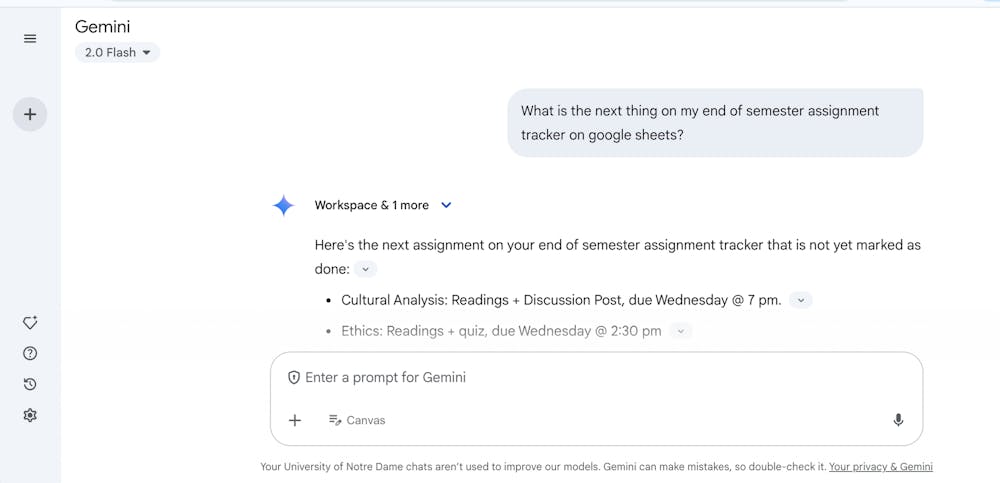
As students begin to prepare and study for finals, which begin in less than two weeks, they now have access to premium AI tools directly through their Notre Dame Google accounts. On March 18, the Office of Information Technology sent a campus-wide email announcing student access to Google AI tools Gemini and NotebookLM.
Gemini is Google’s large language model (LLM), a generative AI resource similar to ChatGPT. NotebookLM, on the other hand, works directly with users’ documents, providing summaries and acting as a research assistant.
In her message to students, vice president of information technology and chief information officer Jane Livingston emphasized the benefits of these tools compared to the wide range of others on the market.
“When accessed via your Notre Dame account, both services offer the same data protection as Google Drive, meaning your data is never resold, shared, or used to train future AI models,” she wrote.
When researching how to roll out AI tools on a university-wide basis, the Office of Information Technology (OIT) focused heavily on privacy. Google’s data protection policy was originally limited to students’ Google Drive accounts, but the technology giant offered to extend that protection to AI use with no additional licensing fee.
“We do the same kind of due diligence all the time. Anytime we buy software, we want to make sure they’re using our data in a responsible way,” Brandon Rich, director of the AI enablement team, said. “But AI is a little bit different, because we know they want that data not just to sell or market to people, but to train models. We never want that to happen with private Notre Dame data.”
Notre Dame’s AI enablement team was formed after Notre Dame’s generative AI task force released a report last spring. According to their webpage, the task force “actively partners with groups across campus to advance AI literacy, promote responsible innovation, and provide foundational AI technology services to support the University’s strategic mission.”
Notre Dame students and faculty already have access to Google apps, as the University switched over to become a Google campus in 2013. The AI tools are already integrated with these apps. By typing the @ symbol into Gemini’s chat box, students can directly interact with whichever app they need.
“The ability to chat with your Gmail, chat with your calendar, ‘Hey, when’s my next meeting? Help me find this doc that I know is somewhere in my drive,’ that has been really cool,” Rich said.
Given Google’s existing relationship with the University, adding their AI services was more logical to Rich than finding another partner. But Gemini was not always an intriguing service to him, often outshined by other high-quality LLMs.
“A year ago, I would not have found [Gemini] very interesting,” Rich said. “What I’ve really been impressed with with Google is how they have updated and improved the service.”
By the time that Google reached out with their offer, Gemini could compete with the leaders in generative AI. Given the large jump in quality, Rich said he was excited for students to have access to the model.
“They had just released their 1.5 model, which was operating, maybe not quite on the level of what ChatGPT was doing at the time, but still pretty well,” Rich said. “Gemini 1.0, Gemini 2.0 were all right, but it was visibly not as good as the ChatGPT version. With significant improvements to the newest model, Gemini 2.5 experimental, I’m pretty sure it’s out there beating everybody on the leaderboards.”
With all the capabilities that high-powered LLMs provide, the decision to open up access to Gemini and NotebookLM was not taken lightly. While the actual rollout only required the flip of a digital switch on an administrative panel, the planning process reached from OIT to the provost’s office, student government and beyond.
“This is an AI tool that we are making available to students in a climate where there are legitimate concerns about academic integrity and what AI is doing to transform the classroom experience, for good and maybe not so good,” Rich said.
Ardea Russo, the director of the Office of Academic Standards, was one of the individuals with a significant role in the discussions about Gemini. She noted that the University’s policy on AI use in the classroom is rather broad, leaving it up to individual professors.
“Obviously, a professor of writing and rhetoric will have different ideas for what’s appropriate than a computer science professor,” Russo said. “The only thing is you can’t turn in any work as your own that is produced by AI, and you can’t use AI to complete your coursework unless the professor tells you to.”
She shared that one of the main benefits of opening up access to Gemini and NotebookLM is that it puts all students on a level playing field.
However, she noted, as AI has become more widely available over the past two and a half years, honor code violations have also increased. Around 35% of all honor code violations are related to AI.
“My first reaction was to be very nervous about providing AI,” Russo said. “[But] it’s not like students weren’t using it before.”
The rollout of Gemini has come with a major communication effort by OIT and other offices to make University policies on AI more clear and to inform students on how to use AI safely and responsibly. However, Russo says there is still work to be done.
“Ideally, most professors will say what they want students to do,” she said. “I do feel worried that there’s still too much mystery, and I want professors to be really clear. I would love it if professors had more specific policies or were more specific about what their policy is.”
While Gemini is now available to all students, Rich acknowledges that not everyone will switch over. He said one of his goals for the future is to continue to push University policy to keep up with the leading edge of AI innovation. Faculty and staff received access to Gemini slightly earlier than students, which might repeat itself as more AI companies partner with the University.
“For staff and faculty, we’re rolling out the ability to pay into an enterprise version of ChatGPT, so that will give us the ability to have that same data protection [as with Google’s tools], but on that platform,” he said. “Google is closing this gap in some ways, but ChatGPT is still a huge leader in the space.”