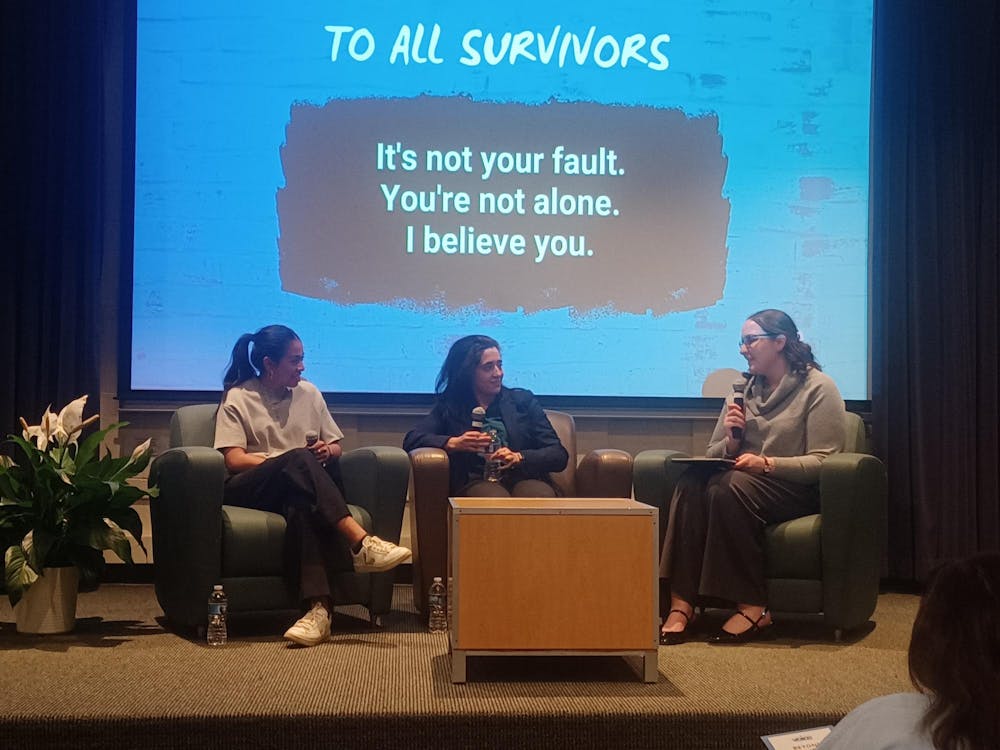
The annual Raise Your Voice Symposium concluded with a keynote address Monday night from Andrea L. Pino-Silva, co-author of “We Believe You” and co-founder of End Rape on Campus.
Pino-Silva discussed how her work has been impacted by her identity and experiences as a survivor of sexual violence.
Press interview
Prior to the address, a press interview was held with Pino-Silva for the event with media organizations for in-depth information on her appearance and her sexual violence prevention advocacy.
As a previous keynote speaker for the 2015 symposium, Pino-Silva discussed her decision to return to Saint Mary's.
“I came to Saint Mary's ten years ago and I was really inspired by the community's commitment to supporting survivors, so I was really excited to be invited back. I was really inspired by the goal of the event and to talk about this issue authentically, to shine a light on the issue of sexual violence and how Saint Mary's is grappling with it and to also give a platform to survivors,” she said.
Pino-Silva discussed the importance of her identity as a daughter of Cuban refugees, a queer woman and a first-generation college student, sharing that while she was actively figuring out her own identity, she had to navigate a new label of being a survivor. She noted how this experience led her to see inequity on college campuses.
“I think that the journey, it was messy … because it was at the same time of me navigating what it was like to be a survivor activist, it all kind of happened at the same time. There were a lot of changes, but I think that going through that messiness made me a better activist, because it made me have more grace for myself and for other survivors,” Pino-Silva said.
Pino-Silva described how she felt more isolated than expected from both institutions and the people she considered to be her support system, specifically due to her advocacy work.
In 2013, Pino-Silva was one of five students that filed a Title IX complaint against the University of North Carolina at Chapel Hill (UNC- Chapel Hill). She shared that, after examining lawyer Catherine McKinnon’s work on Title IX laws, she was able to see how sexual harassment and assault work as barriers to a student’s education.
She decided to stand up with other survivors. “I thought, what if we combine our personal stories, our activism, we put it out there, we use this vehicle and we put them together? … Our strategy was to not just file the complaint, but to do it openly and to also encourage other students to follow us. And that was really the birth of our movement,” Pino-Silva stated.
Through this action and their outreach encouraging students to file Title IX complaints at the same time, Pino-Silva and the other students were able to create a national movement across college campuses, from Dartmouth College to University of California, Berkeley. Pino-Silva said that this allowed the media to “see this issue as being a more of a nationwide problem, rather than just an individual campus and individual survivors.”
She noted the differences in conversations surrounding sexual violence on college campuses 10 years later.
“When I was an undergrad in 2010 people didn’t talk about sexual violence. There weren't Title IX Coordinators and there weren't support offices. I think that the pressure of the movement and the demands the students have done through their activism and through their passion for their campuses has made it to the universities as a priority,” Pino-Silva said.
She then discussed how Saint Mary’s has continuously recognized the life of Lizzy Seeberg, a Saint Mary's student who died by suicide after coming forward with allegations of sexual assault against a Notre Dame student, and created a conversation on the impact of sexual violence with her in mind.
“I think that it would have been very easy for Saint Mary's to forget Lizzy Seeberg but the campus continues to talk about her. I mean, Lizzy Seeberg [would be] my age... I will tell you that I've been to many college campuses, and people don't talk about what happened … Even at UNC, people don't really talk about the complaint anymore and it's been a real source of sadness for those of us that are activists, because the students are sometimes lonely and lost,” Pino-Silva explained.
Keynote Address
Students and faculty were able to visit a variety of booths before the keynote, where organizations including the Indiana Coalition to End Sexual Assault, Family Justice Center of St. Joseph County, BAVO, Saint Joseph Health System, Health and Counseling Center, St Joseph County Prosecutor’s Office and the Young Women’s Christian Association (YWCA) of North Central Indiana were present.
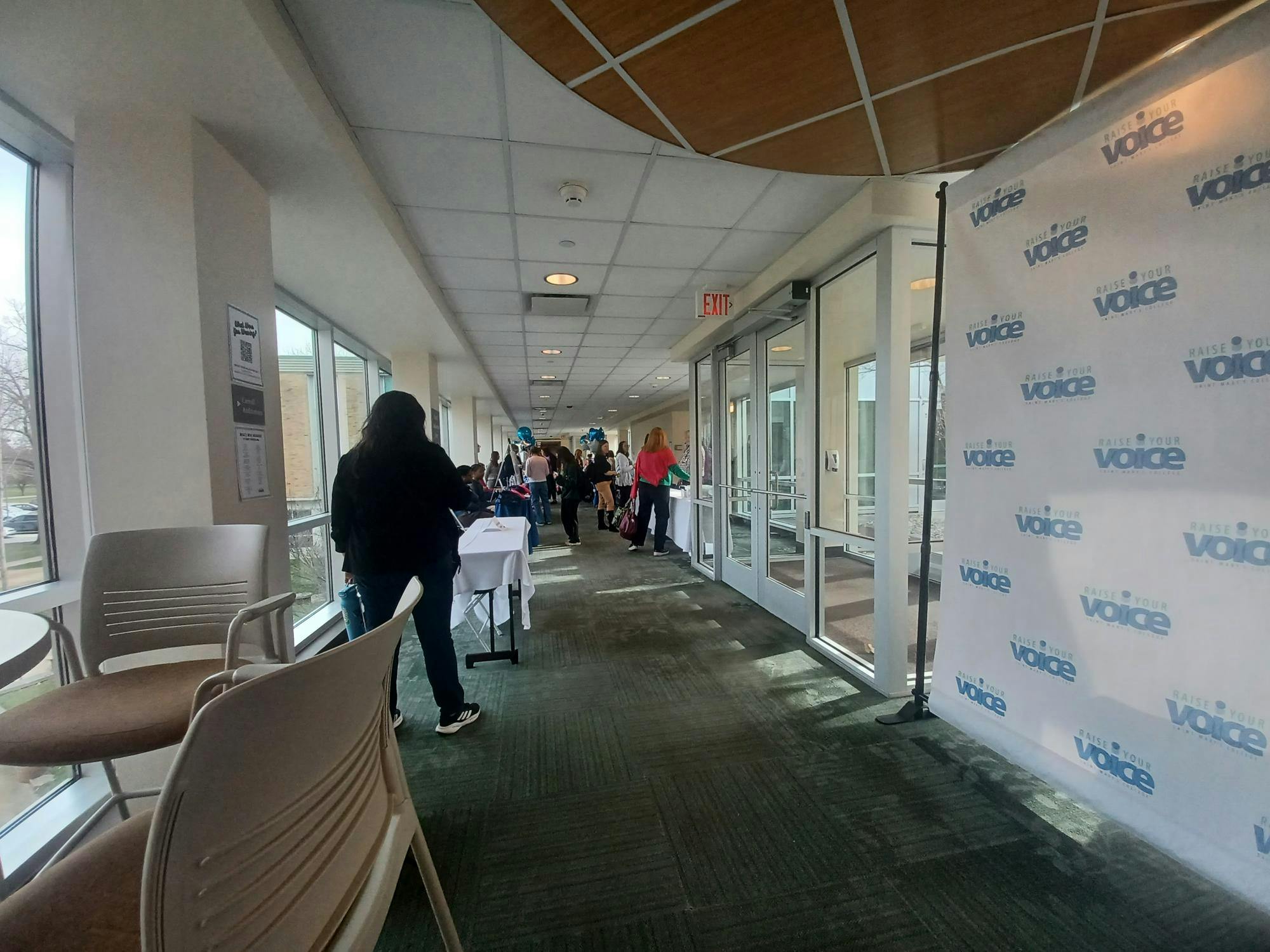
Breanna Fitzhugh, the community outreach advocate of YWCA, shared that “this is our second year and we were asked to come back … A lot of people don't know exactly what the YWCA is or what we do, so we love to be out and explain a little bit more and be out in the community.”
The keynote address, “Beyond Resilience: Building Movements that Work for Survivors” began at 6 p.m. with president Katie Conboy introducing Pino-Silva to the stage with a discussion of her background and advocacy work.
Pino-Silva then discussed childhood, her family and what stepping into college was like as a first-generation student. She spoke about the aftermath following the incident, including being deeply involved with Title IX and her work seeking to begin a movement.
“I think when we were a bunch of students having these conversations, we didn't think this would be anything. After having these months and months of difficult conversations around the epidemic of sexual violence in our campus, we had to think we were thinking of what could change we had done,” Pino-Silva said.
She then discussed how there are still inequalities within the system and a “cycle of activism” that doesn’t achieve as much for the survivor.
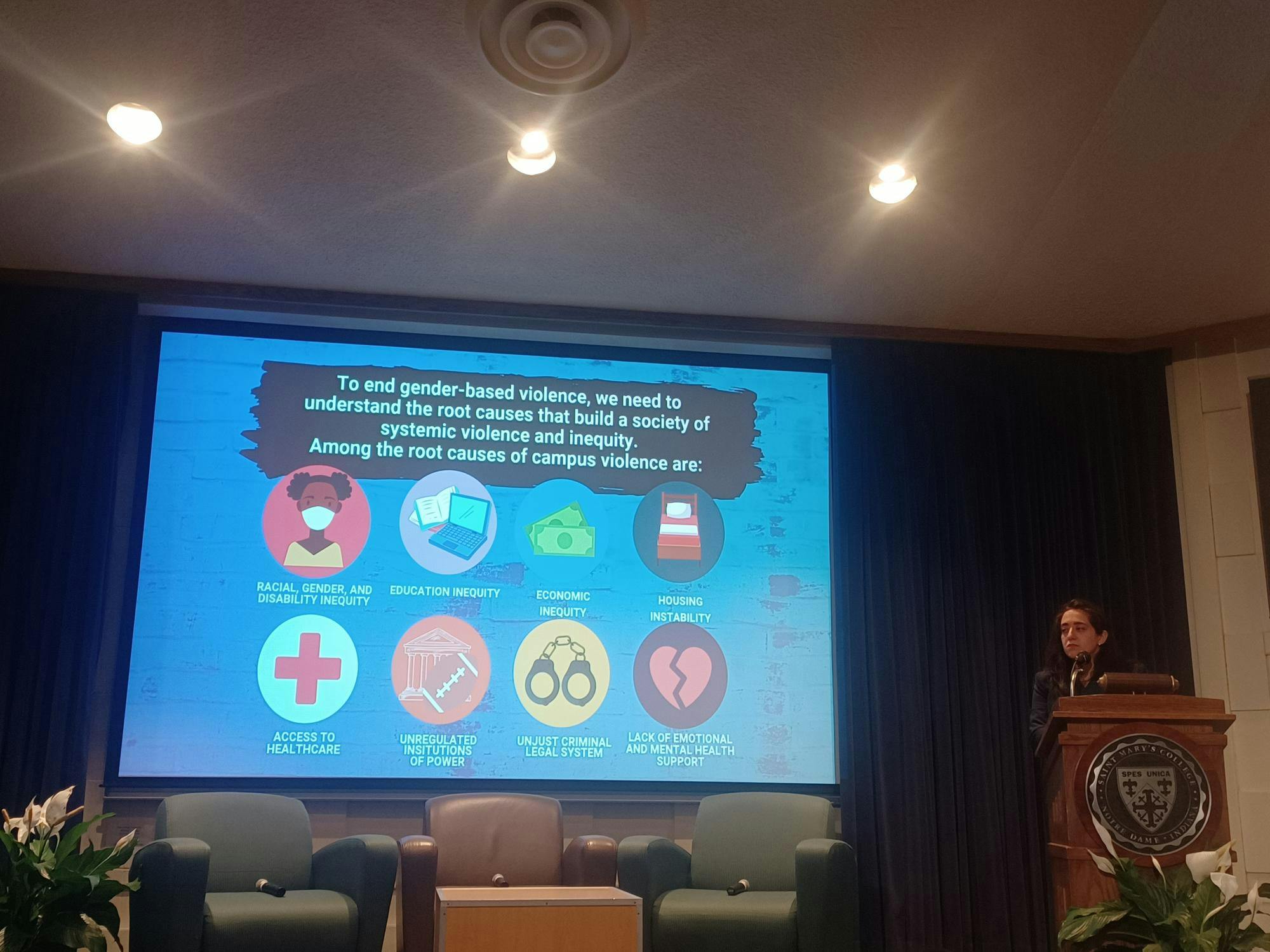
Two panelists, seniors Katelyn Sizemore and Valentino Rubio, facilitated questions regarding Pino-Silva’s work.
When asked by the panelists what it looks like to start the conversation of sexual violence on college campuses, Pino-Silva said, “Nobody thought to bring in the LGBT office, no one thought to bring in our religious leaders [and] nobody thought to bring in our accessibility services. They learned about it through students [and] they weren't invited to the conversation. In states and universities … you already have experts of color on your campus, you just have to treat them as experts.”
A book signing for Pino-Silva’s book “We Believe You” followed the address.