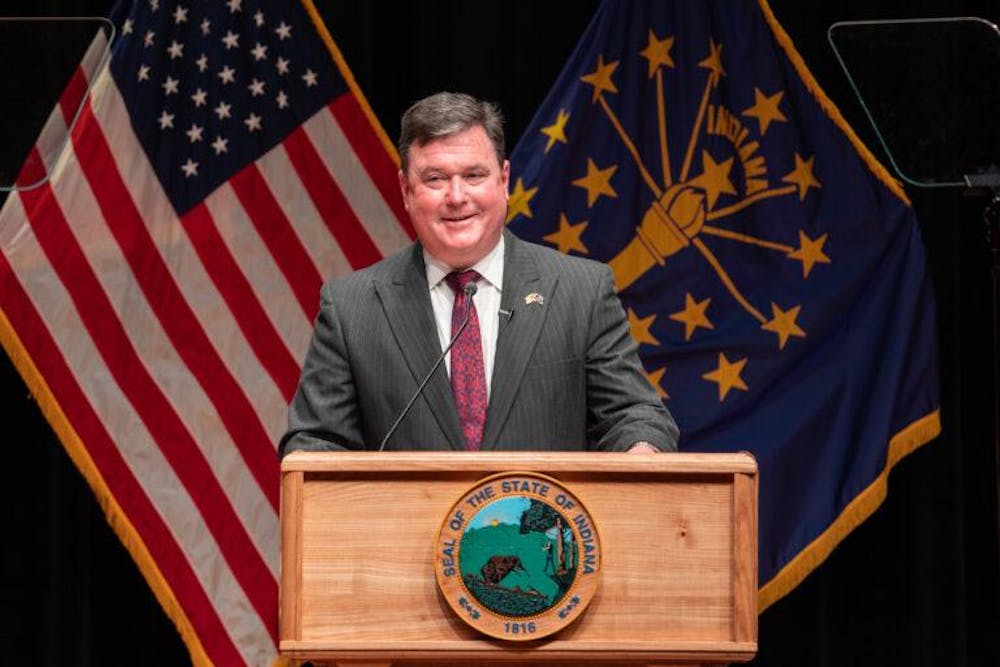
Indiana attorney general Todd Rokita has expanded an investigation into Notre Dame’s diversity, equity and inclusion practices to determine whether the University is in compliance with civil rights laws and an Indiana statute regulating nonprofits.
Rokita first issued a letter to University President Fr. Robert Dowd on May 9 stating that, “Publicly available materials suggest that various aspects of Notre Dame’s operations may be governed by University policies that treat individuals—including students, prospective students, faculty, staff, and job applicants—differently based on the individuals’ race or ethnicity; employ race in a negative manner; or utilize racial stereotyping.” Rokita warned that such policies could be in violation of Indiana laws and result in legal action against the University.
In that same letter, Rokita alleged that Notre Dame may not be in full compliance with “Students for Fair Admissions, Inc v. President and Fellows of Harvard College,” the landmark Supreme Court case which overturned affirmative action.
“Students for Fair Admissions marked a watershed moment in the advancement of civil rights in this country by making perfectly clear that no form of racial discrimination can be license in our higher education system. Yet it seems the University of Notre Dame may have met that moment and the Court’s decision with evasion, circumvention, and obstruction, rather than a good faith desire to respect the civil rights of students and faculty,” Rokita wrote.
Rokita specifically referenced Notre Dame’s 2033 Strategic Framework, which in part outlined the University’s commitment to diversity and inclusion.
“[T]he Framework stresses that ‘more needs to be done to recruit underrepresented students’ and that, while Students for Fair Admissions will ‘complicate’ the University’s efforts, it will ‘not deter’ the University from pursuing its goal of achieving what it considers to be the proper level of diverse representation,” Rokita wrote.
Rokita asked Notre Dame to respond by June 9 to ten questions at the end of his letter regarding the University’s admissions and hiring processes, along with other diversity, equity and inclusion practices.
Rokita shared in an interview with WSBT that the University responded to his letter by his deadline of June 9.
The attorney general’s office announced in a press release Thursday that on Aug. 6, Rokita issued a second letter to Notre Dame, in which he stated that he found the University’s response to his previous letter insufficient.
“It is not an adequate response to my inquiry to offer an assurance that Notre Dame complies with civil rights laws but not to produce any of the materials requested by my letter that would allow for an independent assessment by my office of the University’s compliance,” Rokita wrote.
Rokita also singled out specific practices he said Notre Dame failed to explain, including “racially segregated graduation ceremonies at Notre Dame and efforts to recruit faculty of a certain race.”
He made various allusions to religion which suggest that Notre Dame’s response to his inquiry referenced the University’s religious mission. Both Rokita’s office and the University did not respond to requests to share the contents of Notre Dame’s letter. Rokita’s office also did not respond to a request for comment.
“Notre Dame’s religious mission does not grant the University a license to discriminate on the basis of race,” he wrote.
In that same letter, Rokita said he had directed his office to prepare a civil investigative demand (CID), an administrative subpoena that can be issued before a lawsuit is filed and without court approval, to formally request information regarding Notre Dame’s DEI practices.
Rokita confirmed in the press release that a CID had been issued to Notre Dame and said that the University had “failed to provide anything meaningful” in response to his May 9 letter.
In a statement to The Observer, University spokesperson Erin Blasko wrote, “As a faith-based institution driven by its religious values, Notre Dame strives to treat every member of our community in a manner consistent with our firmly held Catholic beliefs. At the heart of these beliefs is the recognition that we are all children of God, deserving of dignity and respect from one another. We are likewise committed to the rule of law. Accordingly, Notre Dame does not discriminate based on race or ethnicity. We are in receipt of the attorney general's letter and will respond in due course.”
Rokita’s office is also investigating DEI practices at Butler University and DePauw University.