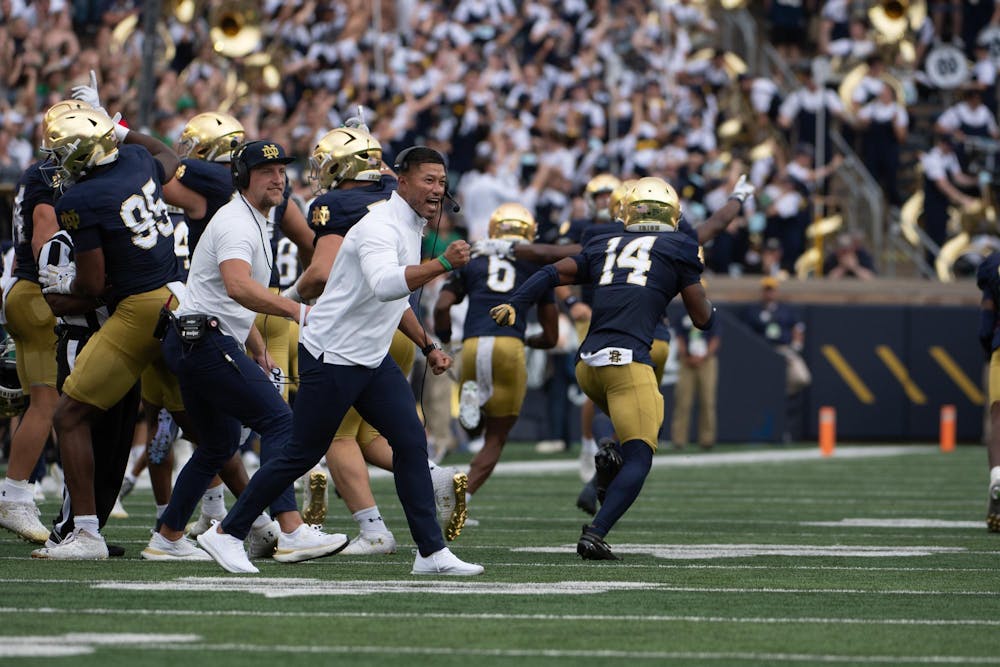
Marcus Freeman held an “uncomfortable” meeting for the Irish defensive staff on Tuesday following the 56-30 win against Purdue. Knowing the challenge and stakes of the next contest against a top-five offense in Arkansas, Freeman’s meeting was aimed at unifying the staff and belief in the system. Addressing the group, Freeman said, “We’ve got one of two options. We’re going to do this and get our guys better and believe in what we’re doing, or we’ll separate. And if we separate, it’s not going to be good for anybody.”
This statement might seem harsh considering the Irish won by 26 and lost to two top-10 schools by a combined four points, but it is necessary if the Irish want to have success this season. Giving up over 30 points per game is reminiscent of the teams in 2007 and 2016, who won a combined seven games and were simply not good enough. The standard from a Marcus Freeman defense is significantly higher than a ranking of 117th in scoring defense and 101st in total defense. So where can the Irish improve heading on the road to Fayetteville, Arkansas, for a critical game to keep Playoff hopes alive?
First, in passing defense. The Irish are giving up 289 yards per game passing and 8 yards per pass, ranking 119th and 99th, respectively. They have given up everything from the big play to 75% of fourth-down attempts this season. First-year defensive coordinator Chris Ash has been criticized for the permeable zone coverage and suspect blitzing efforts, but the problem goes beyond simply play-calling. Ash will have to help inspire the unit to tighten everything from coverage to sloppy tackling up against a lethal Arkansas offense ranked 10th in yards per pass in the country at 9.6 per attempt.
Additionally, Ash’s defense has been virtually unable to generate pressure against opposing quarterbacks to make throwing uncomfortable, ranking 114th in sack percentage. Three of the four total sacks for the season came against Purdue, showing the real struggles in the first two games against experienced offensive lines. Arkansas has the fifth-ranked offensive line in pass protection, ranking significantly higher than any previous opponent to make the task even more challenging. The Irish can start by providing better blitz packages with the edge-rushers in sophomores Boubacar Traore and Bryce Young, who have three of the four sacks. Traore recorded four sacks against Miami (Ohio) a season ago before suffering a season-ending injury and has the potential to be a force off the edge.
Injuries are already starting to hurt the Irish this year in the secondary as sophomore cornerback Leonard Moore was hurt against Purdue and is now questionable for Arkansas alongside senior nickelback DeVonta Smith. Moore’s absence was felt in a 300-yard, three-passing touchdown game for the Boilermakers, and the Irish hope to have him available against the Razorbacks. If he does not play, the top cornerback responsibilities will be assumed by junior Christian Gray.
Next, the Irish can improve in generating takeaways. In 2024, Al Golden’s unit ranked first in the country in this category and even made a name for themselves throughout the playoffs with physical man coverage, which notably resulted in a Christian Gray interception to help Mitch Jeter kick the winning field goal in the College Football Playoff semifinal. This season, amid the tough starting schedule, they have only forced four turnovers. Arkansas gives the ball away twice per game, which can be a major opportunity for the defense to help set up freshman quarterback CJ Carr and the offense on the road.
While some critics of the defense hoped Marcus Freeman might take on more future responsibility for defensive play-calling, they were mistaken, at least right now. Marcus Freeman reinforced his belief in Ash’s system, saying, “It’s not what we’re calling or why we’re calling it. It’s why aren’t we executing. It still starts with a buy-in. Everybody’s got to believe that we have the answers. It’s not [that] Marcus Freeman should be calling the defense. We have the answers. We’ve got to all buy in and execute this the right way.”
His committed stance is consistent with the Notre Dame culture of accountability and toughness, but can the belief galvanize a strong enough defensive performance to win come Saturday?
How does Arkansas match up against the Irish defense?
Arkansas’ offense is the kind of explosive group that has given Ash’s defense fits so far. The Razorbacks have a top-five offense averaging 552 yards per game, and deeper than yards, the Razorbacks rank a shocking fifth in pass protection. Led by dual-threat quarterback Taylen Green, this group has been dynamic on the ground and through the air. Green alone is accounting for 313 yards through the air and 90 on the ground per game.
Despite being 2-2, Arkansas has scored over 30 points in every game this season. This unit is one of the most potent combinations of a passing and rushing attack in the entire country, ranking second in yards per carry and 10th in passing yards per play. Freeman said, “The challenge for the defense doesn’t get any easier [with Arkansas].”
The Notre Dame rushing defense has been the only reliable part of the unit this season, giving up just over 100 yards per game and only 3.3 yards per carry. The Irish have consistently schemed well facing dual-threat quarterbacks over the last few seasons, notably against second-round pick Tyler Shough of Louisville and Blake Horvath of Navy, who ran for 1,200 yards and 17 touchdowns last season. If the Irish can manage to hold Arkansas near 100 yards rushing and less than 5 yards per carry, it will seriously limit the threat of play action and give the defense better opportunities to blitz.
Chris Ash’s defense is facing significant pressure on the road in Fayetteville to help support the surging Irish offense behind Mike Denbrock. This is a make-or-break opportunity for Notre Dame’s season, where a loss virtually guarantees missing out on the Playoff. Can Marcus Freeman light a fire in the defense, or will the flame smolder and burn out against the hungry Hogs?