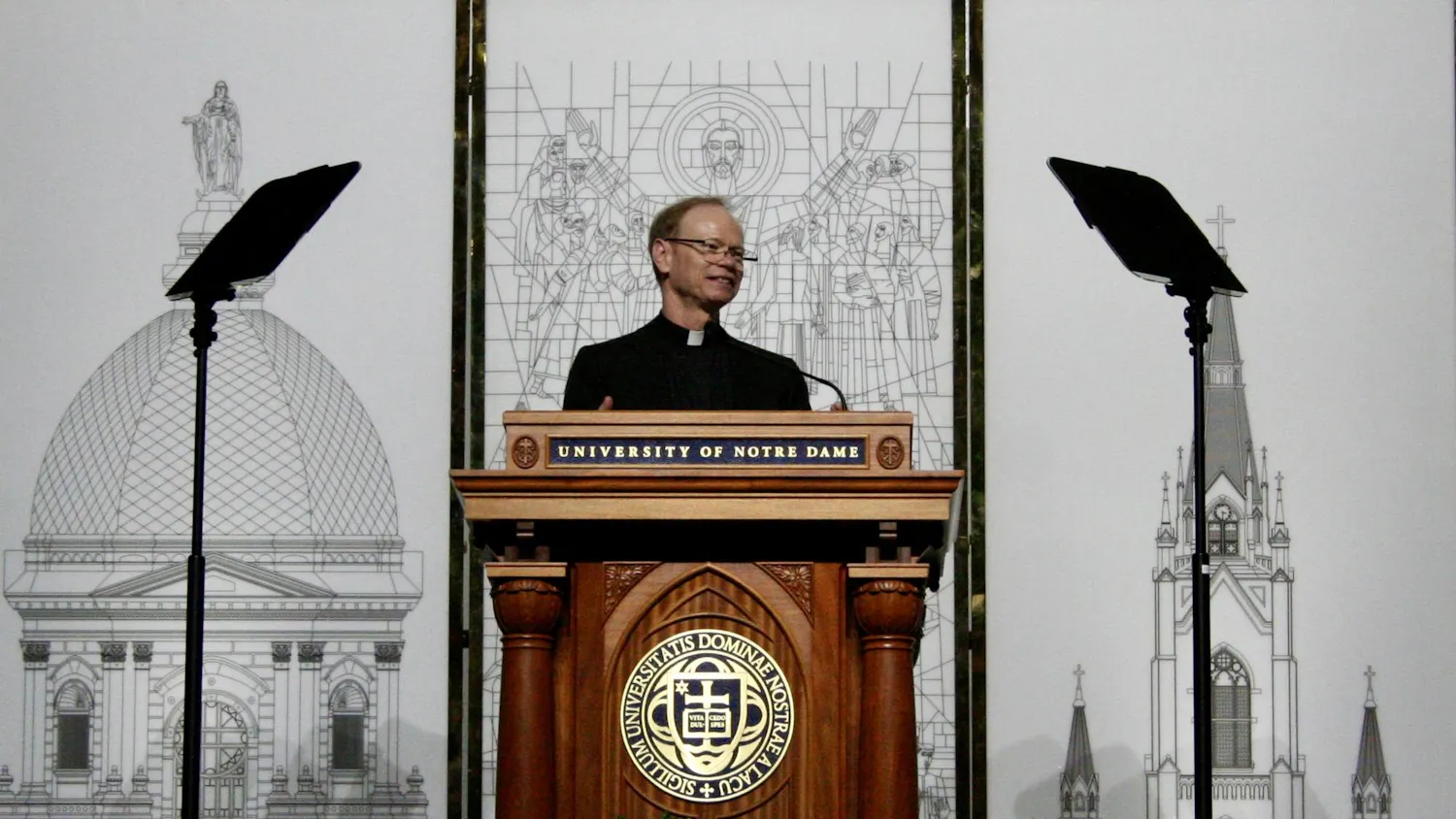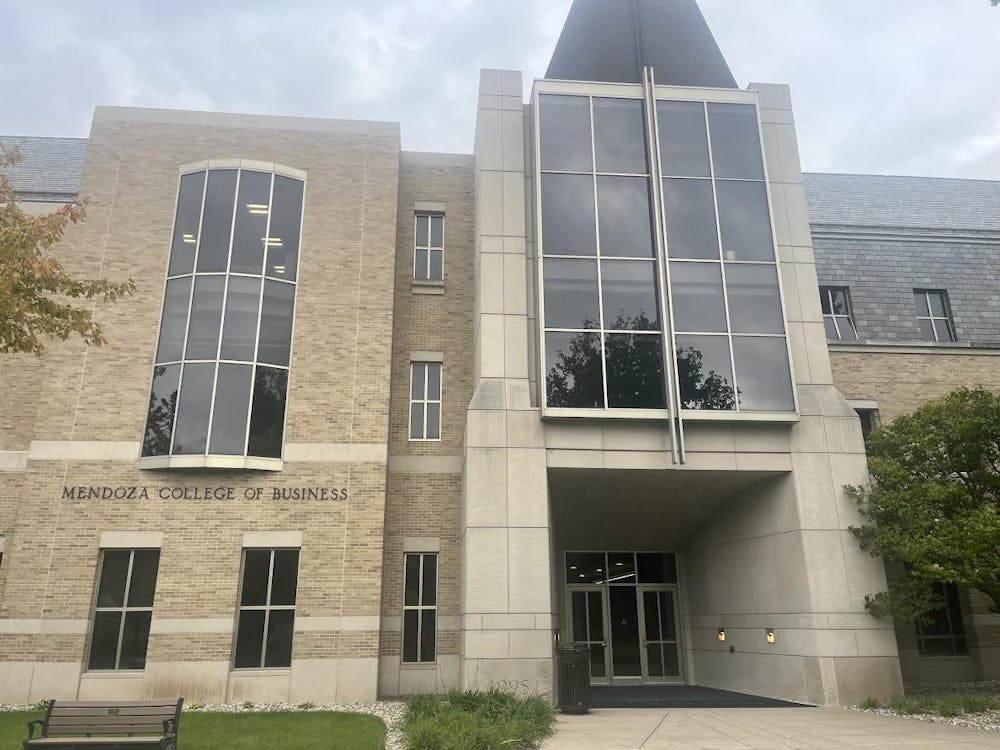
On Thursday evening, Notre Dame’s Mendoza College of Business hosted former congressman and senator Phil Gramm to discuss his new book, “The Triumph of Economic Freedom.”
As he introduced Gramm, Terrence Keeley, a 1981 graduate of Notre Dame, touted Gramm as “perhaps the most important voice in history for the concept of economic freedom.”
Keeley went on to explain that when Gramm was in Congress, economic growth was at 3.77% as opposed to the current 2.1%. He noted that this means that had Gramm’s percentage held strong in the years since he left Congress, our economy would be $3.7 trillion larger than it is now.
Gramm’s lecture centered largely upon his book, co-authored by Donald Boudreaux, the premise of which is debunking “the seven great myths of American capitalism.”
As Gramm spoke, he explained what he believed limited people’s understanding of capitalism while he was in office.
“What I discovered in trying to convince people was that people hold the views they hold because of their perception of how the world works, the perception that’s often based on little bits and pieces of information that give them a perspective, and then from that perspective, they assess various policy issues,” Gramm said.
He later went on to explain the harm in staying set in one’s perception of capitalism, using sentiment towards the industrial revolution as an example of capitalism’s success. “Per capita wages skyrocketed, literacy dramatically increased. The quality improved the mortality rate, the amount of time people lived, increased at a rate never equaled again in American history by every economic measure,” he said.
He continued to explain that many people believe a false narrative that the industrial revolution and the development of capitalism created poverty. He did this by drawing from Charles Dickens’ novel, “A Christmas Carol.”
“Charles Dickens, as he looked at the world, he could only see the past, not the future. And so to him, the only way poor people could be helped was charity. And so he saw the doom coming from ignorance and poverty,” Gramm said.
Gramm pointed out Dickens’ lack of awareness of the future by noting how Britain from 1820 to 1900 had a faster growing quality of life improvement. The reason for the increase in awareness of poverty was that “London went from 1 million to 7 million people in 40 years, suddenly, you saw poor people everywhere,” he said. There was also fear of loss of livelihood through the increase in machinery, making the British population reflect overwhelmingly negatively upon the economy.
Gramm compared the industrial revolution to the current perception of artificial intelligence. He claimed that turning a blind eye to the improvements present in our current climate has led Americans to become “obsessed with the 4,050 millionaires that they totally turned a blind eye to 77 million Americans who had their standard of living grow faster than any people who has ever lived on the face of the Earth.”
Encouraging Americans to see the positives, Gramm noted, “today we have a worldwide market, we have technology that lets an idea be absorbed almost immediately and at a very low cost. And so as a result, you have a situation where people can become unimaginably rich almost instantaneously.”
This led to Gramm's final conclusion of his lecture, leaving students and faculty present with a question: “When you get a degree from Notre Dame, you’re going to in the first four or five years make twice as much as somebody who doesn't go to college ... Are you taking that from them? Are they poor because you came here and built your capital?” To Gramm, the answer was an emphatic “no.”
To conclude, Gramm emphasized the role of capitalism in fostering competition,
“I am all for opportunity but I want to be sure when we’re helping people, we’re not crushing their incentive to help themselves,” he said. “I want to help them so they can compete with me and be my equal.”