The Humanistic Studies department at Saint Mary’s College hosted their annual Francis A. McAnaney Humanities Lecture on Thursday at 7:30 p.m. in O’Laughlin Auditorium. Since 2006, the department has annually invited writers and historians to give a lecture at the College. This year, the lecture featured Julia Alvarez, a bestselling author and novelist who wrote, “How the Garcia Girls Lost Their Accents,” and “In the Time of the Butterflies.”
A pre-lecture reception was held by the Alumnae Association at 6:30 p.m., where students and alumni were able to gather and discuss the novels. Conversation slips were provided in jars with discussion prompts helping attendees to relate Alvarez’s work to how identity, culture and experience impact their own lives.
The lecture was introduced by Laura Williamson, professor of humanistic studies, who shared the history of the lecture series, formerly known as the Christian Culture Lecture.
“We have welcomed an array of remarkable writers, historians, theologians and thinkers who model the value of humanistic inquiry in solving problems and making meaning in this 21st century world,” she said.
She also recognized students from local high schools in Indiana and Michigan who were nominated by their teachers for their writing.
Ann Marie Short, dean of faculty and associate professor of English, spoke on behalf of College President Katie Conboy in her absence. She discussed how her personal experiences have related to Alvarez’s work.
Short also detailed Alvarez’s accomplishments, noting that she has taught English and creative writing at every level from elementary school to senior citizens. Alvarez currently serves as a writer in residence emerita.
Discussing where she gets her creativity from, Alvarez said, “The first thing I do is I pray seriously. Every day I sit down and write, I say a prayer that comes from the Mayan weavers before they begin their work. As they kneel before their looms without the benefit of a manual of instructions or a book of patterns, their prayer is: 'Grant me the intelligence and the patience to find the true pattern.' It's a good prayer for life as well as for writing the true pattern.”
Alongside this, she discussed what her formative years in the 1950s were like growing up in the Dominican Republic under the dictatorship of Rafael Trujillo, where censorship occurred across all communication mediums. She looked at how stories were preserved in her culture, despite the control of the government and secret police at the time.
“Ours was not a literary culture, but it was an oral culture, a storytelling culture. Stories, stories, what a wealth of stories, people told them all the time,” she said. “Years later, when I attended a graduate program in creative writing, I would realize that all I was being taught about character and plot and timing and rhythm and lyricism and metaphor, I had learned in my homeland. In many cases, by people who could not read or write.”
She also talked about how she took inspiration from the Mirabal sisters from the Dominican Republic in the 1950s, who went against Trujillo’s government. She shared that following their murder, their story spread and helped to inspire the overthrowing of the dictatorship and the sisters became posthumous international heroes and change-makers.
She gave the audience a homework assignment to find what stories guide and speak to them, regardless of the writer’s educational background or status. She asked them to find the stories that touch them personally and share them with one another for further fulfillment.
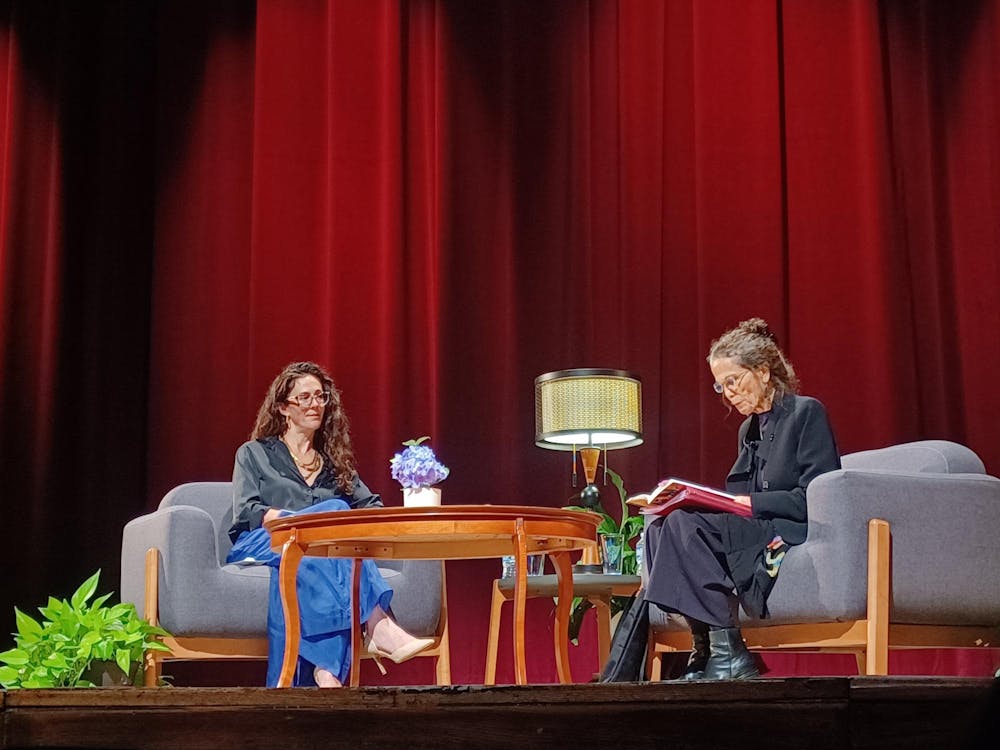
Following the speech, Williamson sat with Alvarez to ask previously submitted questions from the audience. Conboy’s question was read first, in which she asked about the feeling of living in between American culture and her background Alvarez discusses in her books and what this concept taught her about belonging. She asked Alvarez what advice she might give to students looking to navigate the same feeling.
“It is something that was difficult for me as an immigrant, because I was given the choice. It was either or, either assimilate and became American or you remain part of your culture. And it took me a long time to realize that I didn't have to change, that my richness came because I had this combination. When I was in high school, there were girls that were called the all American girls, at one point I thought, ‘No, I'm the all American girl,’” Alvarez said in response to this question.
A freshman at the College asked what piece of advice Alvarez would give to her younger self. Alvarez replied that she would say to embrace her identity rather than feel forced to choose between either aspect of it. She said the larger culture is often not always welcoming to that and has systems which instead prefer conformity.
Williamson also referenced the tour of the Sustainable Farm at Saint Mary’s that Alvarez did with her husband. When asked about the concept of “telling stories and tilling earth,” she replied, “Well, it is a form of sowing when you write. You're casting seeds out there in the form of stories or any poem with a lyric … I mean, a story is only half done until the reader takes it in. And if it moves them, then it fructifies, it blossoms, it thrives. And if you don't have that, it's just a dead story.”
She also discussed her work, including how she started a school on a small mountainous farm in the Dominican Republic to help with reading and writing literacy. She also reflected on her previous film adaptation, “In the Time of the Butterflies,” where she expressed difficulty in working with people who didn’t know a lot about Caribbean history and had to consistently readjust the script, but also looked at the impact of the movie and how it distributed the story to wider audiences.
She ended off the lecture by reading a verse from her poetry collection, “The Woman I Kept to Myself.” A book signing followed the lecture.
In an interview with The Observer, Alvarez further elaborated on the lecture and how she views herself and her impact as a writer.
She discussed why she chose to give a lecture at the College, citing her own personal background attending an all-women’s high school and two years of college in an all-women’s institution. To her, speaking at Saint Mary’s was a great experience.
“I couldn't have had a warmer welcome, smarter students, just really talented faculty members. It was really one of the high points of being on the road … I am so glad that I came to Saint Mary's, [the] only thing is … that I don't have another life so I can come back and be a student there I guess,” Alvarez said.
She also reflected upon her time teaching Black senior citizens in North Carolina storytelling and self expression through literature and the challenges that came along the way.
“What I found the most challenging ... is not the fact that they couldn’t read or write, but because they didn't feel invited to the table of literature,” Alvarez said in reference to the barriers the group faced. “Because they felt like that was for fancy people, people who had a big education and part of it was to convince them that their own storytelling roots, their own roots singing in churches, those songs, those parables, were part of the root system of literature, the storytelling.”
For college and graduate students, she mentioned that she has to teach them to unlearn the format of literature writing for them to be able to be free in their work. In comparison, she shared that younger kids are often enjoyable to teach because they allow their imagination to run in their writing.
She also discussed how reading different poets and writers impacted her own perspective and worldview.
“So my first book was a book of poems and it was the first section and it is called the housekeeping poems. It's all about dusting and sweeping and hanging out the wash and ironing their clothes as metaphors and so discovering my voice as a woman. And then reading the new writers that were coming up, like Maxine Hong Kingston, a Chinese American writer, and realizing, ‘Oh, she can write about her Chinese American family. I can write about my Dominican American family,’” Alvarez said.
She also elaborated on the importance of diversity and representation outside of western ideals. She explained that literature is about being expansive to different groups, cultures and experiences.
“I mean, if indeed literature is all about expanding our horizons, our imagination, capacity for compassion, our understanding of the human experience, why would we say only this little slice of the pie is what's going to teach us about all of humanity? … We’re doing a disservice even to people that feel comfortable reading within those parameters if we don't educate them globally,” Alvarez said.
She also discussed how her books bring a different narrative and perspective to historical events and spread their stories further.
“I find that historical fiction brings history and lives in a way that is the way we live history. In other words, when I'm living this moment, I’m not living facts. I’m living within a body, mind, a point of view, a setting where I live, in Vermont, and I'm experiencing history in a way through the elements fiction uses,” Alvarez said.