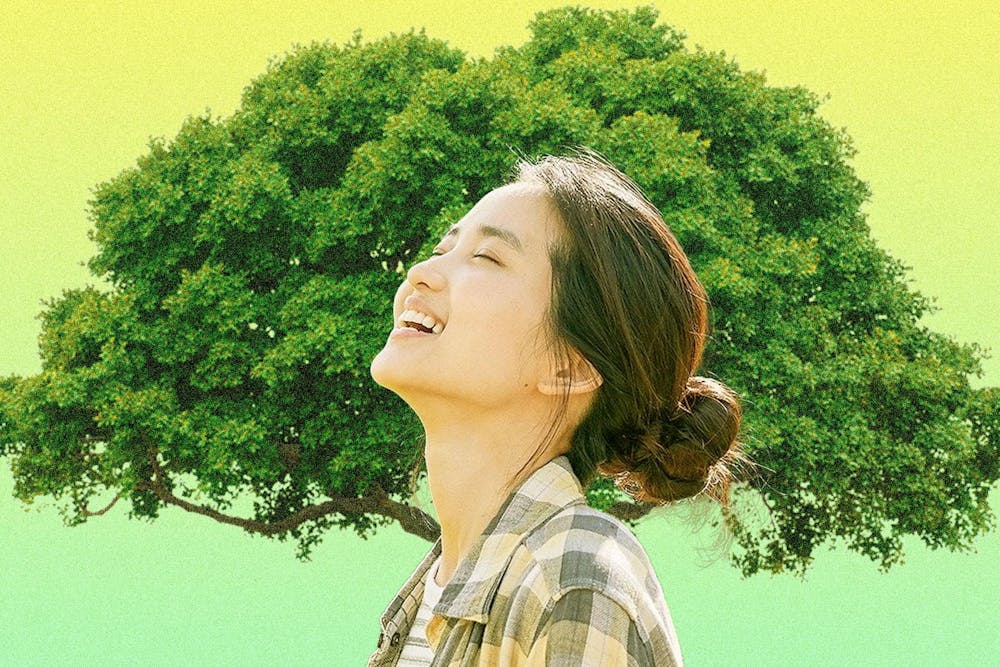
Burnout may be a feeling that we are all familiar with, but what if we all had our own “little forest,” an area holding significance to just us, enabling us to seek refuge from societal pressures? Director Yim Soon-rye ponders this question in the 2018 film “Little Forest.”
Originally based on a Japanese manga series, the film centers around protagonist Hye-won, played by actress Kim Tae-ri, who after struggling with the pressures of city life returns to her rural hometown to reconnect with her roots. There, she finds comfort and healing in the changing seasons, the food she prepares and the relationships she rekindles with childhood friends. Through cooking and nature, she rediscovers herself and explores the bond between family, memory and tradition.
Yim, considered one of the few leading female auteurs of Korean New Wave cinema, visited the DeBartolo Performing Arts Center (DPAC) on Sept. 25 for a screening presented as part of the “Learning Beyond the Classics: Voicing Intergenerational Trauma in Postwar Korea and Japan through Contemporary Cinema” program. She shared that the motivation behind this particular film was to capture the realities of Korea’s demanding work culture while also offering a counter-narrative for younger generations. Through her storytelling, she hopes to remind audiences that they are not bound to the relentless pace of society and that choosing to slow down and reflect is a valid and powerful act.
As a Korean who grew up watching this film, witnessing an audience engage with a story that was told entirely in Korean and filled with our cultural dishes deepened my gratitude for the power of media to bridge cultural gaps. It was moving to witness non-Korean viewers resonate with the themes of family, belonging and self-discovery through something as universal as food. At the same time, it reminded me of the importance of preserving and sharing the nuances of Korean culture beyond cliches or stereotypes.
During the Q & A session, Yim explained that she deliberately avoided including stereotypical foods such as kimchi, since Korean audiences were already too familiar with them. She said she did not expect her film global hit. Instead, she highlighted dishes that underscored the intimate bond between Hye-won and food, a connection meant to mirror the relationship between Hye-won and her mother. Even so, I found myself wishing for more glimpses of that mother-daughter relationship, a core thread within the narrative. While the absence itself speaks to the themes of uncertainty and distance, further exploration could have deepened the audience’s understanding of how food and memory intertwine in their bond. Still, the restraint in storytelling perhaps mirrors the unspoken nature of many parent-child relationships, where silence and absence can be just as powerful as dialogue.
The film’s quiet pace and the focus on everyday rituals emphasize the beauty of simplicity. Most of the dialogue was done through voiceovers, perhaps reflecting on how the plot is meant to center around Hye-won alone and her journey to rediscover her roots. In an age where attention spans are shrinking and cinema increasingly relies on spectacle and visual effects, this minimalist approach cultivates a deeper emotional resonance. Watching Hye-won return to the rhythms of country life invites audiences to slow down with her, experiencing a sense of healing and renewal alongside her journey. For Yim, the story is not a call to retreat into the countryside, but an invitation for each of us to cultivate our own “little forest,” wherever that may be. The film suggests that healing is not found in drastic escapes but in ordinary moments we often overlook. By encouraging us to value slowness, presence and sincerity, Yim’s work ultimately gestures toward a universal need: to reclaim small sanctuaries in an otherwise hurried world.