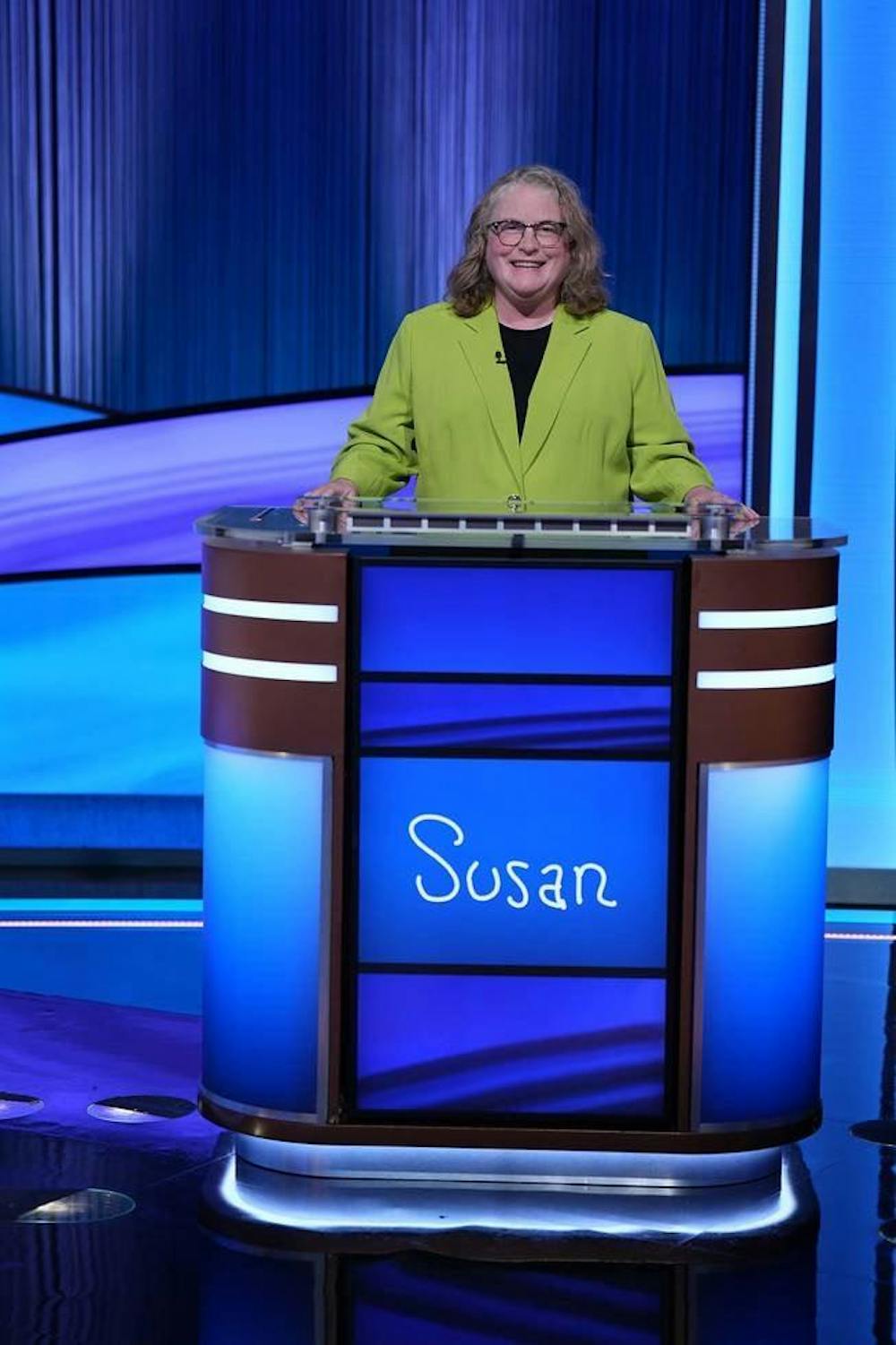
When Notre Dame English professor Susan Harris found herself behind a “Jeopardy!” podium at Sony Studios in Los Angeles, she was tasked with navigating a different type of text: a glowing gameboard of trivia clues. Her episode, taped on Aug. 7, 2025, aired this past Tuesday. She ultimately came in third place.
For Harris, “Jeopardy!” carried a special nostalgia long before she stood at the contestant podium. As an undergraduate in the late 1980s, she and her friends would gather in a campus dining hall TV lounge to watch Alex Trebek’s nightly broadcast.
“It was a cultural high-water mark,” she said. “We would sit in the TV room, yell answers at the screen and make a ritual out of it.”
That memory came full circle when, in Dec. 2023, Harris received an unexpected email from an associate producer inviting her to take the “Anytime Test,” the show’s entrance exam. Initially skeptical — “I thought, is this a hoax?,” Harris said — she soon learned the selection process was very real.
After taking the “Anytime Test” and completing Zoom audition and a mock test, she entered the contestant pool, where she remained for nearly two years before being called as an alternate in Aug. 2025.
Harris and other contestants began their day on set in a windowless green room, where phones were banned. This environment encourages camaraderie amongst, at first, merely strangers and competitors. “You’re all there competing against each other, but you don’t know who you’ll actually face,” Harris said. “We were all nerds together, just talking and hanging out.”
From there came orientation, rehearsals with buzzers and the random assignment of podiums. Harris remembers small details — the “weird little corner” of the Sony parking garage, where a kind of “Smurf mobile” sat parked, looking “a bit cursed.” For her, those quirks became part of the larger blur of an experience where the pressure of buzzer timing eclipsed even the difficulty of the questions.
“A lot of winning at ‘Jeopardy!’ has to do with the buzzer,” Harris said. Unlike what audiences see on television, contestants must wait for the blue lights on the side of the board to signal when Ken Jennings has finished reading.
Ring in too early and you’re locked out. Wait too long and you miss your chance. Harris experimented with strategies in rehearsal, such as keying in on the lowest corner light, but in the heat of the game, “it was too hard to keep track of everything,” Harris said.
Despite being an English professor, Harris never drew a literature-focused category. Instead, she faced topics ranging from “European History” to “That’s Quite a Novel Synopsis” to “Revenge: A Dish Best Served Cold.”
But Harris pointed out that “Jeopardy!” is almost the opposite of a professor’s intentions. “In academia, we build deep knowledge in a narrow area. ‘Jeopardy!’ demands shallow knowledge across a huge range,” Harris said.
Still, Harris acknowledged that her years of reading and research equipped her with exactly the kind of cultural and historical fragments “Jeopardy!” is all about. “All the weird knowledge I’ve picked up as a scholar definitely helped,” she said.
Clues are often embedded with hints, and with enough context, contestants can work out answers even outside their specialties. “It’s a lot like close reading,” she said, specifying that she had to recognize patterns, make connections and interpret cues.
Her preparation was deliberately light. Beyond playing trivia games with her family and quizzing herself on a geography app, she trusted her lifetime of reading more than any cram session. “You have no way of knowing what the categories will be,” she said.
When the moment finally arrived, Harris found herself listening to host Ken Jennings attempt to calm her nerves. “He tries to make you feel better about the fact that you flew all the way out here, and two of you will lose,” she said. From there, everything moved quickly: lights, buzzers, questions and answers. “The show is all kind of a blur,” she said.
What remained most vivid wasn’t the competition itself, but the relationships formed in the green room. Contestants, cut off from phones and outside distractions, bonded over shared nerves and shared interests. “Honestly, my favorite thing about the experience was just hanging out with the other contestants,” Harris said. Those friendships have remained intact, with a WhatsApp group where alumni now share puzzles, games and trivia.
In the end, Harris treasures the experience not as an academic triumph or a personal victory but as an experience of connection, memory and joy.