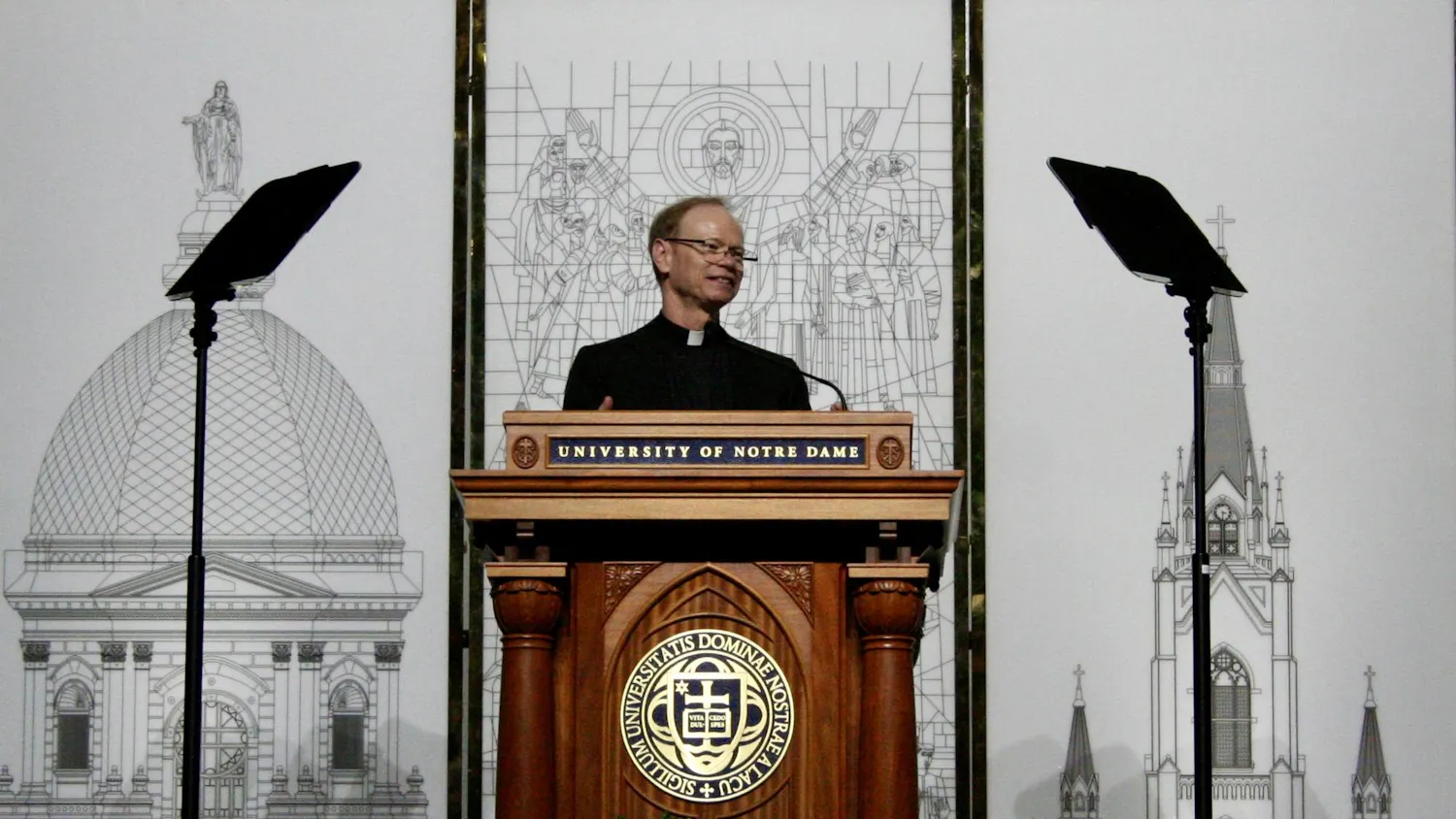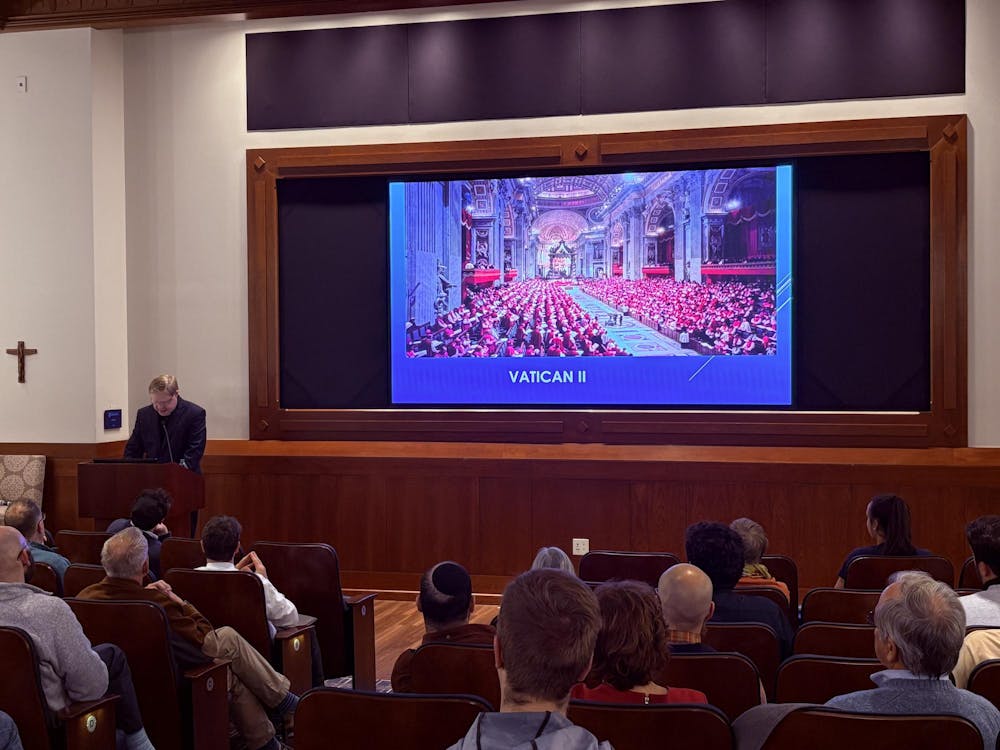
On Wednesday evening, Fr. Kevin Spicer C.S.C. held a lecture in the Eck Visitor Center Auditorium. The lecture was the seventh rendition of the annual Liss Lecture in Judaica, a series on Catholic-Jewish relations in the early 1900s.
Nostra Aetate is a landmark document from the Second Vatican Council in 1965 outlining the obligation of Catholics to respect those of other faiths.
The National Catholic Reporter wrote, “In its final form, Nostra Aetate explicitly rejects the claim that Jews as a whole are responsible for the death of Jesus and condemns antisemitism. It affirms the shared spiritual heritage between Christians and Jews and calls for mutual respect.”
Spicer dove into the reasoning behind the Catholic Church's opposition to the Nazi Party.
“In the Diocese of Mainz, early Catholic opposition to National Socialism concentrated selectively, if not exclusively, on the incompatibility of the Nazi party’s hatred of Jews with Catholic moral teaching on the inherent dignity of all human beings,” Spicer said.
Spicer focused his narrative on the work of Monsignor Philipp Jakob Mayer. Notably, Mayer advised that members of the Nazi Socialist party who had received the sacraments of the Church could have a church funeral, but people were not to attend wearing party uniforms.
Spicer explained that Fr. Heinrich Johann Henschke raised concerns about the separation of church and politics.
According to Spicer, Henschke said, “I cannot tolerate a funeral being misused for a political demonstration, which is to be feared under the present circumstances.”
Spicer offered that the National Socialist party push back on this, questioning the reasoning of Henschke, but Henschke defended his position.
“‘National Socialism is un-Christian because it preaches racial hatred and fights against the Jews, and because it is also a national religion that promotes ancient pagan German religion,’” Henschke said according to Spicer.
Over time, the relationship between Christians and the Nazi Party grew more distant.
Spicer said Meyer said, “‘Catholics could no longer be members of the Nazi Party, nor could they receive the sacraments if they remained in the party. He added that National Socialists were also not allowed to attend mass or funerals in uniform groups.’”
“Meyer also assured Catholics that they were neither excommunicated nor expelled from the Church if they remained in the national Socialist party. However, they could not receive the sacraments unless they withdrew from it. He stressed ‘the imposition of excommunication and the denial of the sacraments are not the same,’” Spicer said.
While Meyer conceded that excommunication and exclusion from the sacraments were different things, this forcible distance left a legacy.
Spicer added that the Church’s silence on antisemitism failed to foster Catholic-Jewish relations through the common enemy of the Nazi Party.
“It was as if they could find no path for themselves to condemn antisemitism except through silence,” Spicer said.
Spicer wrapped up his lecture with an overview of the struggle of reconciling the church's teachings with itself, emphasizing how this struggle led to the need for Nostra Aetate.
“Recent works have argued that it is anachronistic to expect the 1930s German Catholic Church to embrace universal human rights, rather than concentrate on the use-specific issues, first and foremost, the securing of freedom for the church to administer the sacraments,” he said. “The stance of Monsignor Meyer however, shows that at least one individual in the church hierarchy understood that the two points, love of neighbor and protection of church doctrine and teaching could not be separated and that for all practical purposes, they were theologically synonymous.”