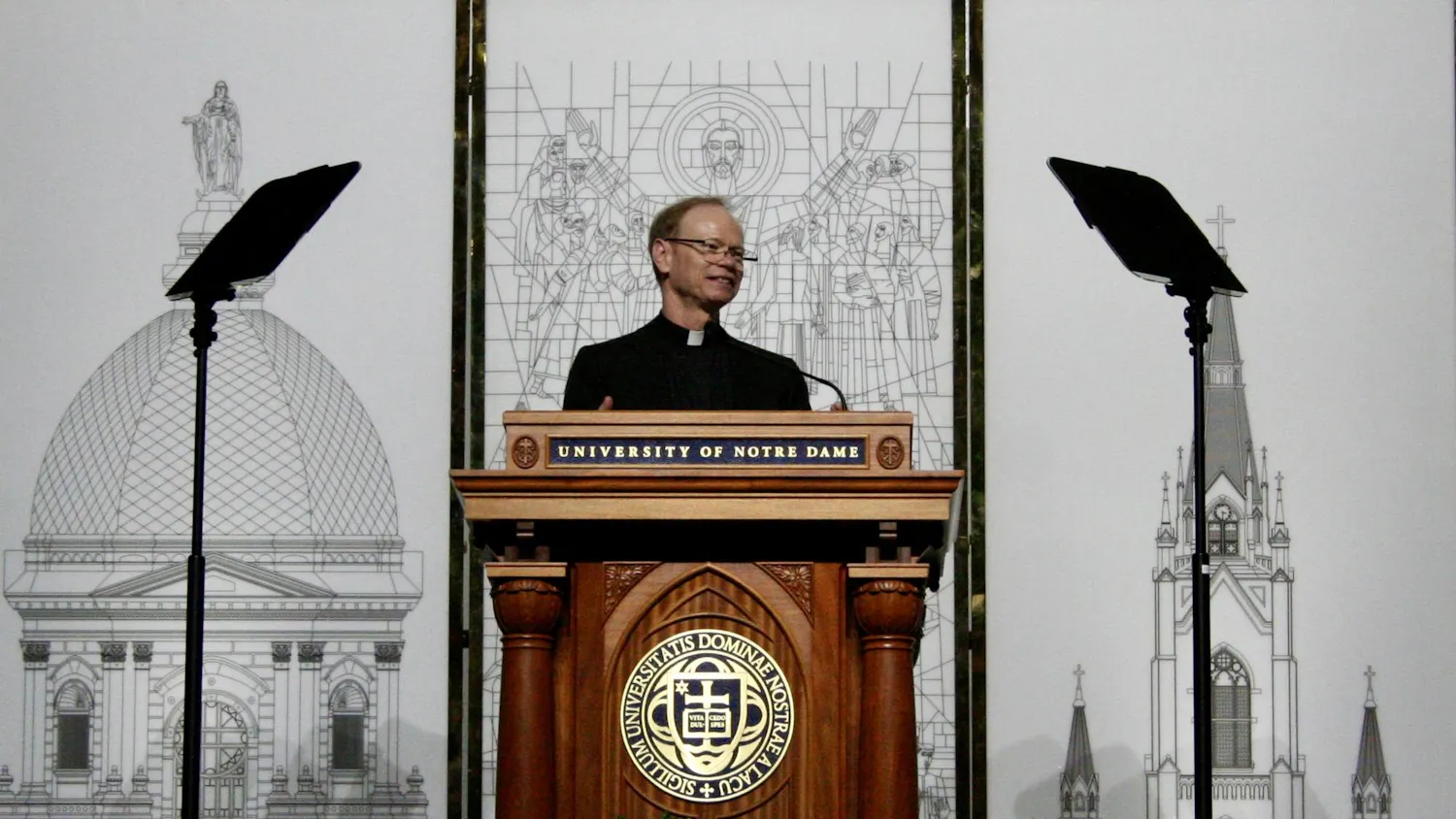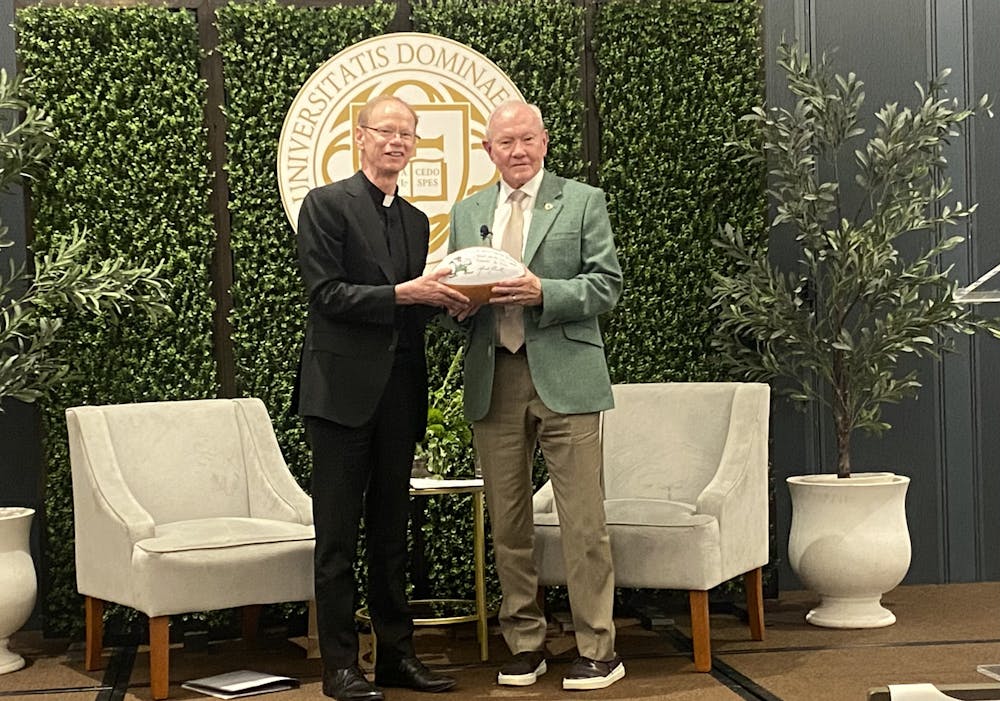
On Friday evening, retired general Martin Dempsey, who served as the 18th chairman of the Joint Chiefs of Staff, visited the University of Notre Dame for a lecture with University President Fr. Robert Dowd titled “Hope, Global Stability and the Role of the United States.”
Dempsey served in the military for 41 years, was the 37th chief of staff of the Army and led the Central Command. He has been awarded the Defense Distinguished Service Medal, the Legion of Merit and an honorary degree from Notre Dame in 2016. He currently teaches at Duke University, while serving as chairman of USA Basketball.
Dowd referred to Dempsey as “a man of character, a true servant leader and he values family very deeply.”
During his time at Notre Dame, Dempsey visited a class taught by University President Emeritus Fr. John Jenkins. He discussed how he felt that it is “young men and women who really set this place apart.”
The theme of the lecture was “cultivating hope,” inspired by the late Pope Francis’ Jubilee Year of Hope. Dempsey shared that while a military leader may seem to be an odd selection to discuss hope, he believes that, “There is a very definite relationship between hope and trust and in the military and I think in most walks of life, the success of leadership is in building trust among those entrusted to our care.”
Dempsey shared how both hope and trust are intertwined, as members of the military must trust their leaders in order to be able to follow orders, as well as to trust their fellow citizens so that their service is valued by them.
He referenced William Butler Yeats’ poem, which reads, “Tread carefully for I lay my dreams beneath your feet. Tread carefully, for you risk treading on my dreams.” While he said this may be a stretch to tie to leadership, he believes that it is the responsibility of a leader to think about those they are leading and to tread carefully over the dreams and ideas of all of those under them.
Asked by Dowd about a moment of grace that occurred in his career, Dempsey discussed an event that occurred when he was first appointed as a second lieutenant in 1975. At the time, he was stationed on the border of West Germany and Czechoslovakia, where his platoon’s job was to patrol 100 kilometers of the Czechoslovakian border. There, he met a nun, Sister Mary Cecilia, who came to the gate of the base with a request to pray with the soldiers. While Dempsey did not want her to meet with some of the “bad guys” in his platoon, she prayed with them anyway and told him not to give up on his soldiers.
Dempsey mentioned this as one of his greater lessons in leadership than anything he learned at West Point. He emphasized, “Don’t give up on people. Someone will give up on you, but don’t you give up on them.”
That evening, he recounted that he decided to play basketball with those men and was able to help several of them to recover and become better soldiers. 20 years later, as he was giving up command of his regiment at Fort Carson, he met one of these soldiers again, who had since been promoted to the rank of master sergeant. Regarding this moment, he said, “If you cultivate hope, people will respond.”
Dempsey also discussed modern geopolitics and his opinions on the current state of world affairs.
“The importance of United States engagement globally is far more important than it was even when I was chair.” He discussed the three nuclear powers: the United States, Russia and China, and how each of these powers functions differently.
The United States functions as a power with alliances such as NATO, Russia chooses to expand its sphere of influence by creating new trading partners close to it and China chooses to expand its influence based on its supply chain. He stated, “It’s about the pragmatics of how each of the three countries deals with its national security.”
In regard to global diplomacy and the role of the United States, Dempsey said that there are many instruments of national power, and the military is only one part in the vast machine of governance.
He shared, “It could be Ebola in West Africa or could be ISIS in Syria, we need to think about all the instruments of ours before we just start saying, ‘How many bombs can we drop in a 24-hour period?’”
Dempsey also discussed power imbalances, which he says exist positively through the international community. While he agrees that some things must be in moderation, his opinion of international relations is that those with power must not be reckless, that they must be both ambitious and humble.
“The more power you have, the more the responsibility to use it responsibly and in a way that can be imitated and that is seen as exemplary and productive and cultivates hope,” he said.
On political polarization, he explained the need to keep the military out of politics. He tied this idea back to hope and trust, where he believes in a military committed to not only making soldiers who are developed physically, but also developed emotionally and intellectually.
To him, the military is not to be seen as an organization that is “democratic, republican, red state, blue state. They look at us as representing America until we prove otherwise.”
By the military embracing a political ideology, he said that the American people would lose trust in the military and argued the politicization of certain members of the military has led to a widespread mistrust of generals and admirals.
In talking about his time in the Obama administration, he said the former president would say that the meetings were “too cordial.” When people came to meet the president, he would need inputs from his advisors to help him consider different solutions and ideas.
Dempsey discussed how one morning, after praying on how to console the members of a platoon in which one of the soldiers died, he found the words, “make it matter.”
“Make the sacrifice matter in the way you live your life, not just in combat, but in the way you live your life,” he said.
In Jenkins’ morning class, he reiterated the same sentiment on using remembrance toward action.
“You’ve all got somebody who got you here and you owe them a sense of appreciation and you need to make what you do in your life matter for the sacrifices they made,” he said.
When asked by a student in the audience about how to serve the goal of peace, he responded that while one can’t develop character today, the first job of people is to develop their skills as well as to “work just as hard on your character.”
On a similar note, he said that being a good leader begins by being a good follower, where you can put yourself into the leader’s shoes, help them out and find your own moral courage.
When he first began as chairman of the Joint Chiefs of Staff, he recounted that Colin Powell, former United States secretary of state, told him, “Every morning when you wake, don’t be afraid to be fired today ... If you worry too much about your job, you’re not going to be giving the kind of advice you need to give.”
Leaving with one final piece of advice, which he told Marcus Freeman, the Fighting Irish football coach that morning, he said, “Trust your instinct.”