It’s a question asked many times: What movie should I watch on Halloween night? Personally, I like something that matches the vibe of the holiday, a film exuding classic Halloween energy. One may be drawn to the original “Halloween” from 1978. Yes, the film is a great choice for spooky season, but if you want a story about the holiday and not merely set on it, jump ahead a few installments to 1982’s “Halloween III: Season of the Witch.” It’s weird, genuinely scary and severely underrated.
Directed by Tommy Lee Wallace, “Season of the Witch” is remembered as the “Halloween” movie without Michael Myers. John Carpenter, director of the first film, wanted the franchise to become an anthology series, where each year’s installment was a standalone story centered around the holiday. Myers’ storyline seemed to end with his death in “Halloween II,” and the filmmakers wanted to preserve it and pilot the anthology approach; however, fans weren’t happy, and the Shape returned in “Halloween 4.”
Now, to be clear, I am not demeaning the original 1978 “Halloween.” I love the film and find it to be frightening and revolutionary. The image of Myers’ mask and the iconic theme are both inseparable aspects of October. However, if you step back and look at the movie critically, it doesn’t scream Halloween, and this is not only because Haddonfield, Illinois, in October looks suspiciously like Southern California in summer. You could take the story and place it on any other calendar day. Swap pumpkins for sparklers, call the film “July Fourth,” and it would still work. The formula for vintage slasher flicks lends itself to replicability for any season. In contrast, “Season of the Witch” can only happen on Halloween.
The film follows Dr. Challis (Tom Atkins), who, after being cryptically warned about Halloween masks by a patient who mysteriously dies, investigates Silver Shamrock Novelties, makers of the season’s most popular children’s masks. Challis uncovers the evil truth behind the company and its founder, Conal Cochran (Dan O’Herlihy), who intends to initiate a widescale, gruesome Samhain child sacrifice on Halloween night, when a television broadcast activates electronic chips in the masks which contain pieces of Stonehenge and cast a deadly spell. Challis races against the clock to stop the broadcast, battling killer androids and electronic sorcery along the way.
If this plot sounds crazy, it is, but that’s part of the film’s uniqueness. Slasher movies are a staple of the horror genre, but they can get predictable and dull. “Halloween III” is not dull by any means. As fantasy horror, the film explores some of the Celtic origins of Halloween and attempts to modernize witchcraft with 1980s technology, a strange combination that oddly works, leading to some grisly kills. Cochran wants to honor the ancient Celtic festival of Samhain which celebrates the beginning of the darker half of the year. Allegedly, this is the night when the veil between the land of the living and dead is thinnest. According to Celtic tradition, this is why costumes were worn — to scare away the dead.
The movie’s most infamous scene has to be when the mask’s deadly powers are revealed, targeting an unknowing family. The spell causes the masks’ chips, when the “magic pumpkin” advert is broadcast, to produce bugs and snakes that kill the wearer and anyone nearby. It’s a disturbing sequence and quite uncomfortable to watch but truly illustrates Cochran’s evil. Worse, the scene is scored by a goofy jingle, and the juxtaposition is unnerving. Shortly after, there’s a montage of children trick-or-treating all across the country in the masks scored by an iteration of the jingle that encourages them to go and watch their TVs. This is arguably one of the most chilling scenes in the “Halloween” series, especially given that children don’t have plot armor in this flick.
The ending to “Season of the Witch” is infuriating and highly debated in horror cinema. Challis frantically calls the TV networks to cancel the Silver Shamrock broadcast, and he successfully convinces all but one. He watches the magic pumpkin in fear and begs the station to “Stop it!” Suddenly, the credits roll without a resolution. The original credits featured screaming voices, but Wallace felt this was too dark and wanted to leave some hope that Challis was victorious.
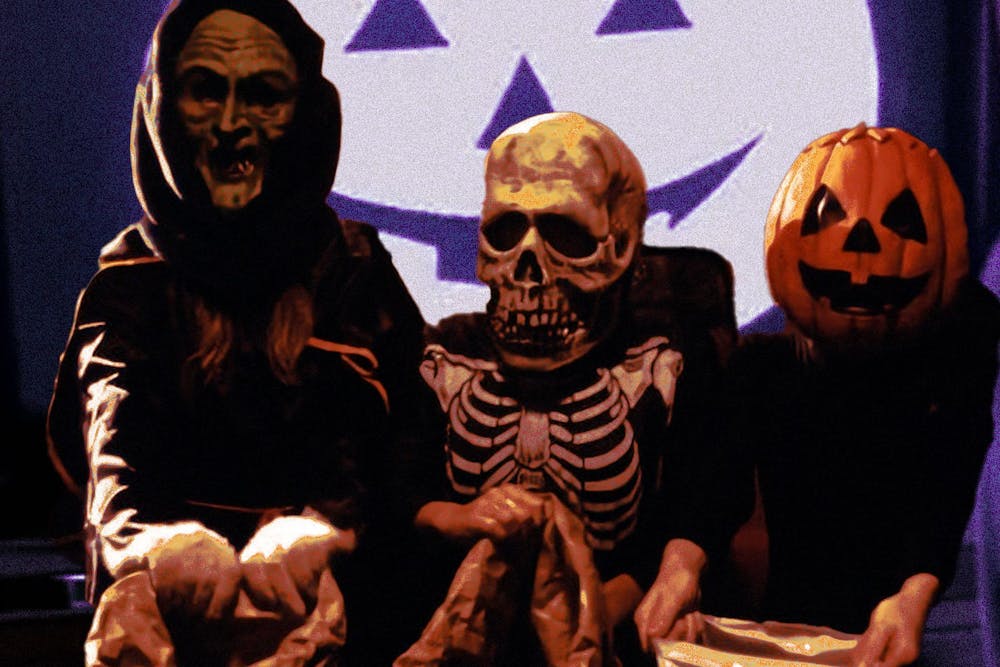
It’s easy to see how Halloween imagery haunts the entire film, especially compared to its predecessors. From the opening credits showing the magic pumpkin, to the countless trick-or-treaters, to infusion of folklore and Samhain, to the three masks — a jack-o-lantern, witch and skeleton — it’s quintessentially Halloween. But don’t be fooled! “Halloween III: Season of the Witch” is not for the faint-hearted or squeamish. It’s legitimately scary and gross with dark content matter. If you think you can stomach it and dare to view it on Halloween night, go ahead. Put on your mask and watch.