
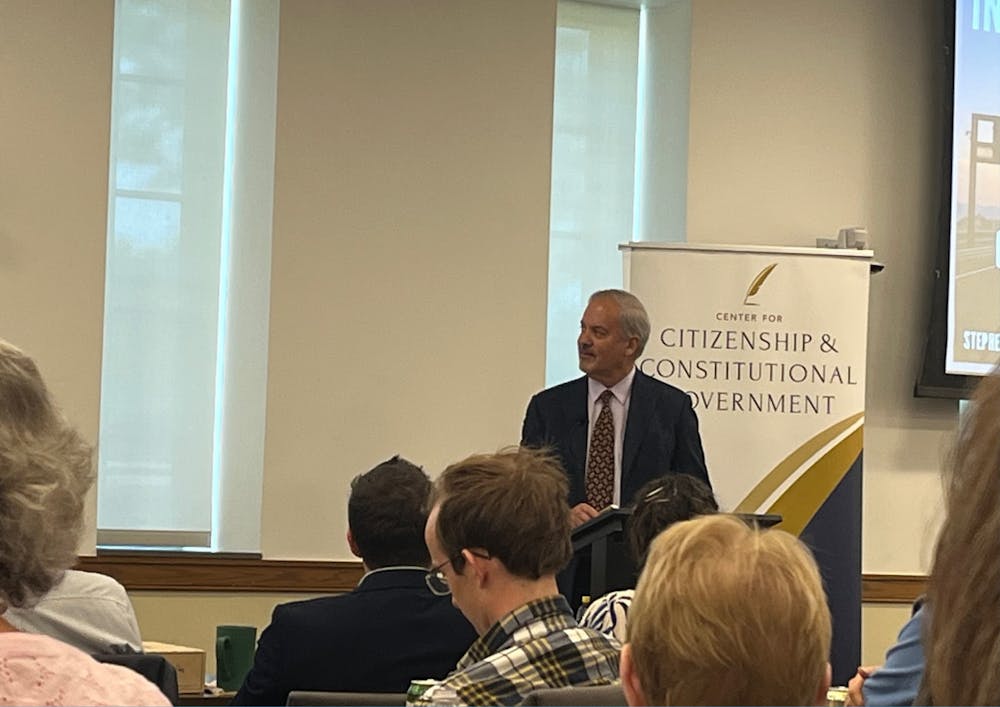
On Friday, at 3:30 p.m. in Jenkins-Nanovic Halls, the Center for Citizenship and Constitutional Government hosted a lecture by Stephen Macedo, professor of politics and former director of the University Center for Human Values at Princeton University. In the discussion, Macedo examined the ways in which various institutions and governments reacted to the COVID-19 pandemic, with his talk based on his newly released book, “In Covid’s Wake: Science, Liberal Democracy, and Elite Failure,” co-authored with political scientist Frances Lee.
Macedo provided a critical lens to examine how society handles truth and trust amidst a period of crisis.
Liberal democracies, he argued, depend on “truth-seeking departments,” such as science, universities and journalism, to be “insulated from, or capable of rising above partisan politics.” However, Macedo emphasized during the lecture that the COVID-19 pandemic politicized many institutions, which ultimately undermined the public’s trust in them and their mandates.
While Macedo recognized that the pandemic was perhaps the “biggest global crisis since World War II,” he also discussed how it was not entirely an unprecedented or unexpected event.
“There were actually a couple decades of documents planning for future pandemics,” he said. However, few of those plans were followed amidst the COVID-19 pandemic. Instead, governments adopted measures that were often improvised, frequently stifling dissent and limiting open dialogue on several COVID-related policies.
Macedo also discussed the varying responses to the coronavirus pandemic among individual states. One of the most significant examples of the political divide between states manifested itself in the debate over school closures.
By late March 2020, all public schools in the United States had shut down. While many Republican-led states reopened schools in fall 2020, following the model in many European countries, other states kept their schools closed for longer.
“Half of the U.S. public schools were still closed in March 2021,” Macedo said.
Significant emphasis was given during the lecture on whether or not the mandates imposed during the pandemic, such as school closures and mandatory masking, actually made a difference. By examining recent data, states with extended school closures were shown to lack a significant improvement in health outcomes over states that had more relaxed restrictions.
The lecture specifically focused on the impacts that the pandemic had on the educational and social well-being of students in the United States. Macedo discussed how many states saw a sharp drop in student-learning outcomes, particularly when it came to reading and math. In addition, chronic absenteeism increased during and in the aftermath of the pandemic to almost one-third of all K-12 students nationwide.
Macedo emphasized that these consequences particularly affected Black and Hispanic students, as well as those in high-poverty districts.
“We’re not arguing that the measures [taken during COVID] did not work. We are arguing that there is an absence of evidence to show that they did work,” Macedo said. “We’re supposed to learn from policy successes and policy failures. And the learning, so far, seems to have been pretty flat.”


