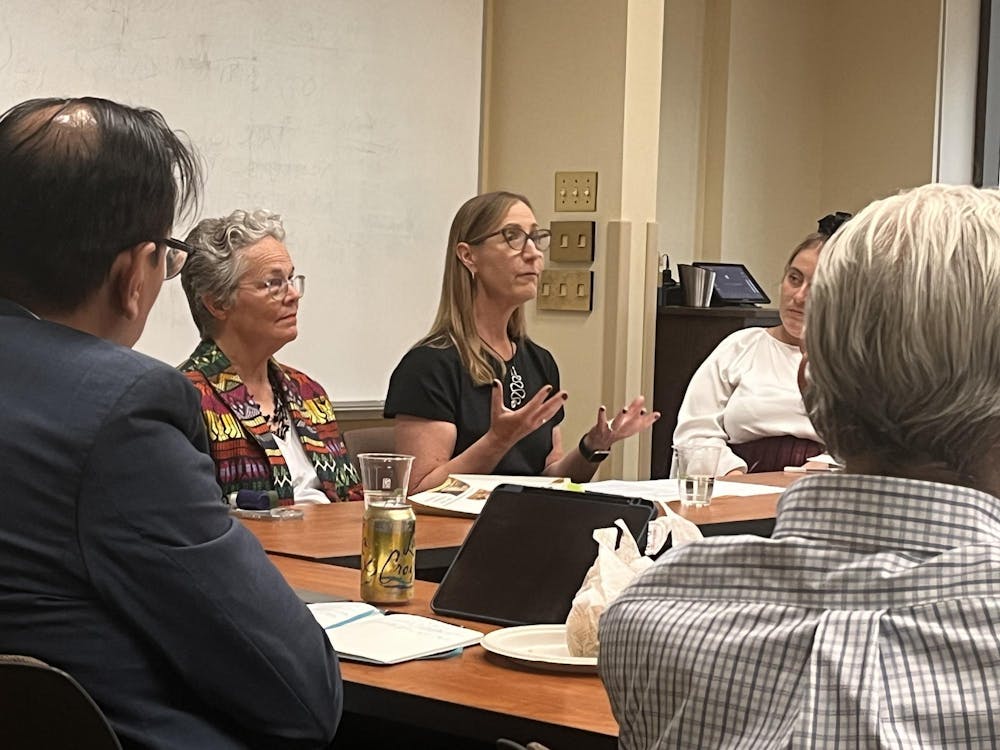
On Tuesday afternoon, the Kellogg Institute for International Studies and the Klau Institute for Civil and Human Rights hosted Michele Waslin, who holds a Ph.D. in government and international relations from Notre Dame, and her co-author Carol Cleaveland to discuss their book, “Private Violence: Latin American Women and the Struggle for Asylum.” The lecture was part of Graduate Student Appreciation Week.
The authors spoke about how the U.S. asylum system fails to protect Latin American women seeking gender-based asylum because the current legal system requires persecution to come from state actors rather than private individuals. They emphasized the resilience of both asylum-seekers and their advocates.
Cleaveland began research for the book when she was asked to ascertain the credibility of female Latin American gender-based asylum-seekers through psychological assessments. She interviewed 46 women whose stories inspired her to seek Waslin’s help in creating their book.
“I was hearing these really unbelievably terrible stories from women from El Salvador, Honduras, Guatemala [and] Mexico about what had happened to them that had forced them to come here to seek asylum. They described gang rapes by gang members,” Cleaveland said. “They described horrific gender-based violence and extortion threats … Then I started observing what happened in their court hearings, and those were very compelling moments, because I saw how difficult the journey is to convince an immigration judge that you meet all of the criteria to win asylum in the United States.”
The U.S. asylum system doesn’t consider domestic or private violence to be a form of persecution. Waslin believes this stems from the original intent of the refugee system, which was designed to protect a limited number of people fleeing from authoritarian or communist regimes, not large numbers of people looking for protection from non-state violence.
However, Waslin argues that the idea of private violence is misleading. “One of the points that we made in really great detail throughout, especially the first part of the book, was the social context that sent women who were suffering gang and domestic violence fleeing to the United States. And that was the fact that in all of these countries there was a great deal of political destabilization,” Waslin said. “There really is no such thing as private violence, right? All of this violence takes place because of public and state factors.”
As a result, Latin American women fleeing gender-based violence face many obstacles in receiving asylum. The co-authors explained how, in court, asylum-seekers need to prove that they fall into a specific, recognized social group, that they were persecuted because of that social group, and that their country fails to offer protection. On top of that evidence, they need to prove their credibility, which language and cultural barriers often make difficult.
No matter their reasons for crossing the border, many asylum-seekers are treated as criminals. “[The] consistent message, I think, that the American public hears is that these people are frauds, that they are trying to gain their way into the country, that they're trying to change the system, that they've received very specific instructions for what to say and how to get into the country,” Waslin said.
Waslin refuted this idea, saying that “the women we spoke to knew nothing of the sort, but they were literally fleeing for their lives in the middle of the night.”
Since their book was written before the 2024 presidential election, the co-authors wanted to contextualize it in light of recent political developments.
“Unfortunately, it seems so quaint those little ideas that we had for fixing the system, because so much has changed. Right, in the first Trump administration, they made it very clear that they had no interest in asylum generally and very specifically, gender-based cases. They completely shut the door on gender-based cases and made it clear that private violence was not a criteria for asylum,” Waslin said.
Waslin also expressed concern about the way women are treated if they are detained by United States Immigration and Customs Enforcement. “We know that pregnant women are being forced to give birth in detention. They're being separated from their children. I'm very concerned, but I'm also concerned about what is happening to U.S.-born American citizen women in this country under this administration. I think that they are starting with foreign-born women, because that is an easier target, but I think that they're coming for all women,” she said.
Despite these concerns, Cleaveland is hopeful that anger surrounding immigration policies can be harnessed. “I think people are getting really upset seeing people working on someone's lawn and being dragged away. I think we can build on that, and I think we just need to talk to people. I think we need to get the vote out in the next election,” she said.
“We’re going to have to just keep the faith and keep going until there is lightness. Luckily, we’ve survived dark periods in history before, but Michele’s right, this is an ugly time,” Cleaveland said.