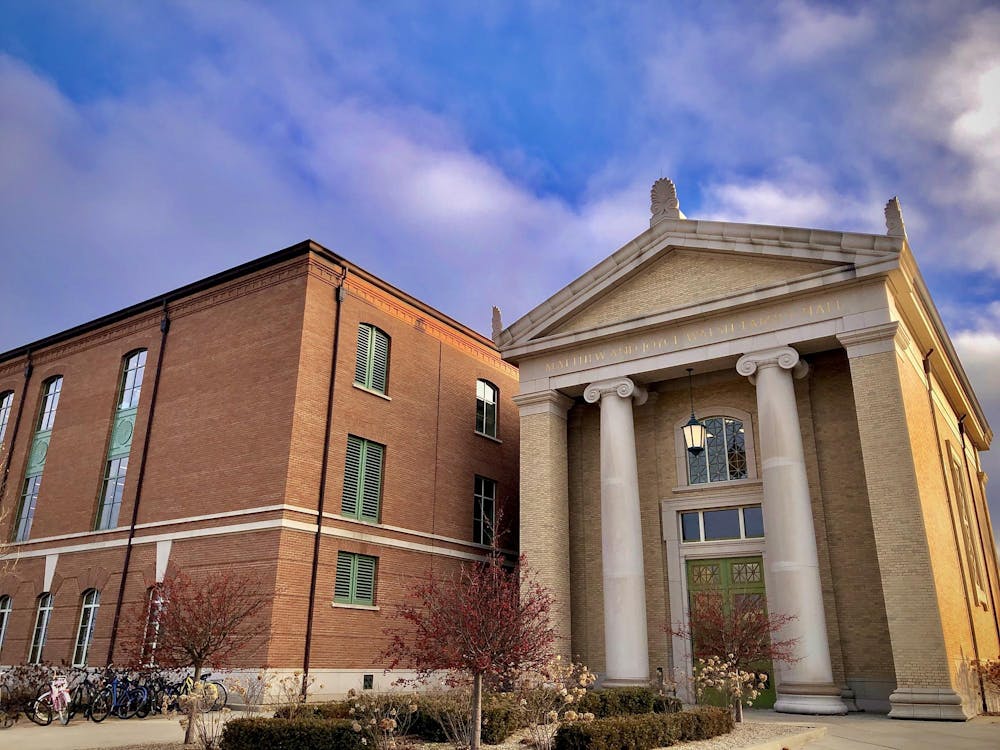
Last week, the School of Architecture announced that it received a $150 million donation from Matthew and Joyce Walsh. Matthew Walsh, a 1968 graduate from the University, chaired the School of Architecture Advisory Council from 2004 to 2021, according to a University press release.
With the couple’s donation, the school will be renamed the Matthew and Joyce Walsh School of Architecture at Notre Dame.
The Walsh family has a long history with Notre Dame’s School of Architecture.
“Joyce and I were introduced to the School of Architecture in 1996 by Andy McKenna Sr., then chairman of Notre Dame’s Board of Trustees,” Matthew Walsh said in press release. “Our now three-decade journey with the school, its deans, professors, students, and our Advisory Council peers has been transformational for both of us.”
Matthew Walsh hopes the gift will help further the mission of the aritecture program.
“Our goal in making this gift is to ensure that the Notre Dame School of Architecture continues to lead architecture across the world and the creation of world-class environments. Notre Dame architects have always been inspirational leaders. Our goal is to ensure that continues in perpetuity,“ he said in the press release.
Stefanos Polyzoides, the Francis and Kathleen Rooney dean of the School of Architecture, described this mission as a commitment to higher understanding and doing good.
“It’s a school of commitment to higher causes ... and better ways of understanding one’s discipline and profession and a greater commitment of improving the world,” he said. “That is a very, very key definition of what distinguishes the school, and perhaps something that the Walsh family might have been aware of when they gave us this gift … doing good in the world, it’s a daily thought that needs to be how we live.”
Polyzoides also voiced his appreciation for the Walsh family.
“They are very, very extraordinary human beings, and they’re profoundly important Catholics in the life of the University and in the life of the community,” he said. “[They are] interested in art and architecture and how the world is made, and in Notre Dame terms, who uses the world and what ends, and how to make a just world through architectural building … We’re completely indebted to them. We admire them, we love them.”
The School of Architecture opened in 1994, after it was separated into an independent school, instead of being a department. The first architecture course was taught at the University in 1889.
Polyzoides described the school as having “a unique pedagogy which is not being followed by any other one of 135 schools of architecture in the United States.”
“We’re the only school in the country and in the world that has held the line for 35 years, going on 40, with a single evolving pedagogy and not depending on any one person,” he said.
Polyzoides noted that since the 1950s, other architectural schools have focused on modern building practices and individualism, while Notre Dame has begun “to shift its curriculum away from fashion, self-expression, newness for newness’ sake towards its exact opposite … precedents, values, objectives, consequences and other things that people should worry about in their daily actions.”
The architecture curriculum will not change with this donation. Rather, the donation will “reinforce it and refine it and deepen it, and make it more effective in the world,” Polyzoides said.
Several years ago, during the For Good Campaign, the architecture program made requests for funding for a loan-free master’s program, a program in Preservation, Resilience, and Sustainability (for which they have since received a donation) and a Housing and Community Regeneration Initiative, which helps municipalities near Notre Dame to build and plan their city.
The school also requested funding for a program that involves “adaptive buildings and cities, which has to do with the scientific side or the technical side of one makes buildings that beautiful, adaptable and durable, as opposed to what’s going right now, [in] which buildings are ugly, temporary and inflexible,” Polyzoides said.
Finally, the school requested funding for the Mediterranean Studies Initiative, which would allow local faculty in Rome, “to both teach and research, outreaching to places around the Mediterranean basin, which are varied by culture, religion and otherwise, and helping people plan and build there,” Polyzoides said.
Polyzoides hopes that these programs, as well as new research opportunities, will be funded by the donation.
“We’re also trying to tie all of those activities with collegial enterprises and research throughout the University,” he said.