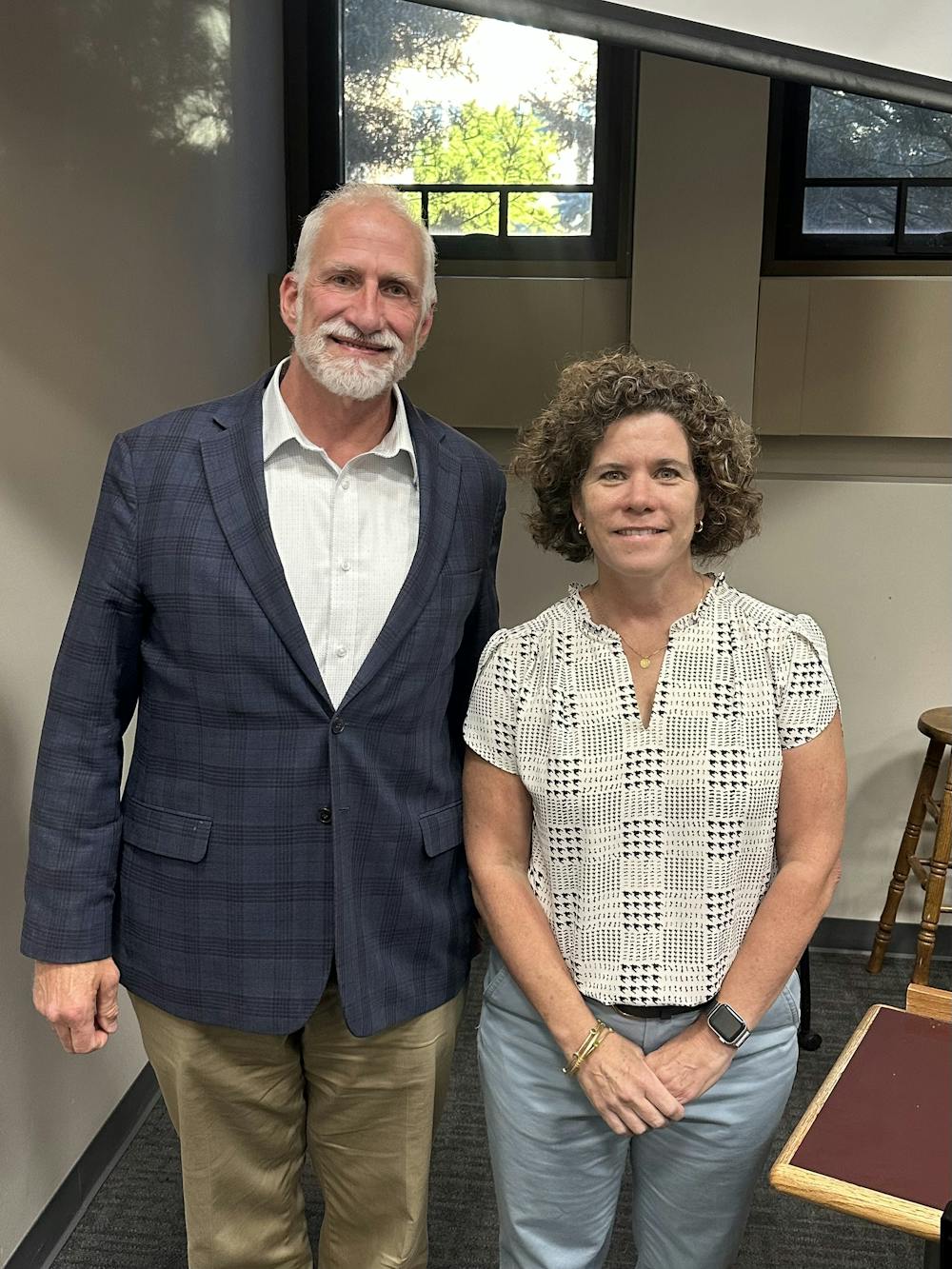
On Monday evening, the Technology and Digital Studies program in the College of Arts and Letters hosted the first lecture of a three-part series titled “AI and the Liberal Arts” in DeBartolo Hall. Melissa Summers, managing director at Accenture, delivered the lecture, speaking on her professional experience running the business of internal IT at Accenture and offering her perspective on the future of AI in various career industries.
Summers explained that technology prompting shifts in the workforce isn't a new phenomenon. Jobs have evolved over time, but that doesn’t mean they are disappearing.
“Everyone’s worried that AI is going to take over all the jobs, but it’s not,” Summers said.
She recommended everyone learn how to use AI, especially students. Citing a quote from Nvidia CEO Jensen Huang, Summers said, “AI is not going to take over your job. A person who uses AI is going to take over your job.”
Although she doesn't believe AI will replace jobs completely, Summers explained that workplace roles are requiring greater knowledge of AI.
“Coding is not the only relevant skill … so whether it’s data literacy, … or tool fluency, or just understanding the job that you’re applying for or working in … There’s so much information, [and] there are foundational skills that need to be put in place in order for AI to really yield the efficiency and productivity different companies are expecting to see,” Summers said.
To keep up with the changing workforce, Summers gave students tips to effectively leverage skills. First, she encouraged students to experiment with using AI to increase productivity. She suggested focusing on AI-driven skills like prompting, critical thinking, experimentation, responsible use, and generative and agentic AI foundational training.
“I think it’s good for developing skills, but it’s also good for preparing people to adapt to a little bit more advanced AI,” Summers said.
John Behrens, a professor of Technology and Digital Studies at Notre Dame, explained the difference between generative AI and agentic AI. “Gen AI is kind of like the decision node, but the agentic AI is also going to include tools, orchestration, action and persistence like memory,” he said. “So it’s more of an ecosystem in which gen AI is probably a part.”
Next, Summers discussed team-level optimization using AI. By creating foundational processes that incorporate AI, teams will increase productivity “and are able to free up extra time to work on other things,” Summers said.
Finally, Summers believes that applying AI to optimize revenues, reduce costs and drive innovation will create new cross functional ways of working. Companies are looking to blend AI with existing processes to speed up productivity. “The ability to cut something down into two weeks, for example, is really great,” she said.
Summers and Behrens described the permanent demand for the “six C’s” in the job force: creativity, critical thinking, communication, curiosity, compassion and collaboration. While the need for these human skills will be constant, Summers highlighted a few ways roles will evolve using AI, including drafting marketing content and developing strategic business recommendations.
Summers concluded her lecture by reminding students to stay curious, have a story to tell and be adaptable.
“I think Notre Dame students really have this always curious approach, and I think that’s really important [to be] open to opportunities once you get into a job … and start your career,” she said.
The Technology and Digital Studies program offers two additional lectures as a part of the “AI in the Liberal Arts” series. Lirio's Kevin O’Brien will deliver his lecture on Oct. 15 and Imagine Learning's Jason Fournier will speak on Nov. 19.