Recently, Scene Copy Editor Sheila-Marie Manyara wrote an article called “What’s working, and what isn’t, on Broadway,” which covered shows “Death Becomes Her,” the afternoon production of “Six” and “The Great Gatsby.” I had the chance to see two additional shows, “Wicked” and “Chicago,” along with the night production of “Six,” which gave me a new perspective on how important production and tech is on Broadway.
After joining theater as a sound designer and now being a board operator surrounded by tech and design of all sorts (lights, scenic, costume design, etc.), I got the opportunity to see all of this in action in New York City on a musical theater trip. I have so much to say about the tech side of theater and could write essays about each show and what impressed me, but I am limited to so many words, so I will do my best to keep it brief.
“Wicked”
“Wicked” was the first production I saw on the trip, and I adored the production aspect. As soon as I walked into the theater, the first most important thing, that was also unusual for “Wicked,” was a giant purple dragon. This dragon came to life in big scenes, such as in the beginning of the show and when Elphaba (Lencia Kebede) had her supernatural moments of spell casting.
This was not the only impressive part of the show. Another impressive part of the production that brought the show to life was the lighting. One moment that really portrayed the lighting was the transition from the school to the Ozdust Ballroom. When the characters entered the Ozdust, there were things such as small LED lights scattered not just on the stage, but on the walls in front of the proscenium. Another impressive moment was at the end of the iconic song “Defying Gravity.” As Elphaba hit the high note, the lighting, a mix of blues, purples, greens and reds, hit her from five different angles. This lighting emphasized Elphaba’s need for independence and her confidence in finding it.
My only issue with this show is that I have seen “Wicked” before (in movie theaters, not on Broadway). Watching it, in terms of plot line and how the characters acted on stage, was similar to what I saw prior. Other than that, the production brought the story to life.
“Chicago”
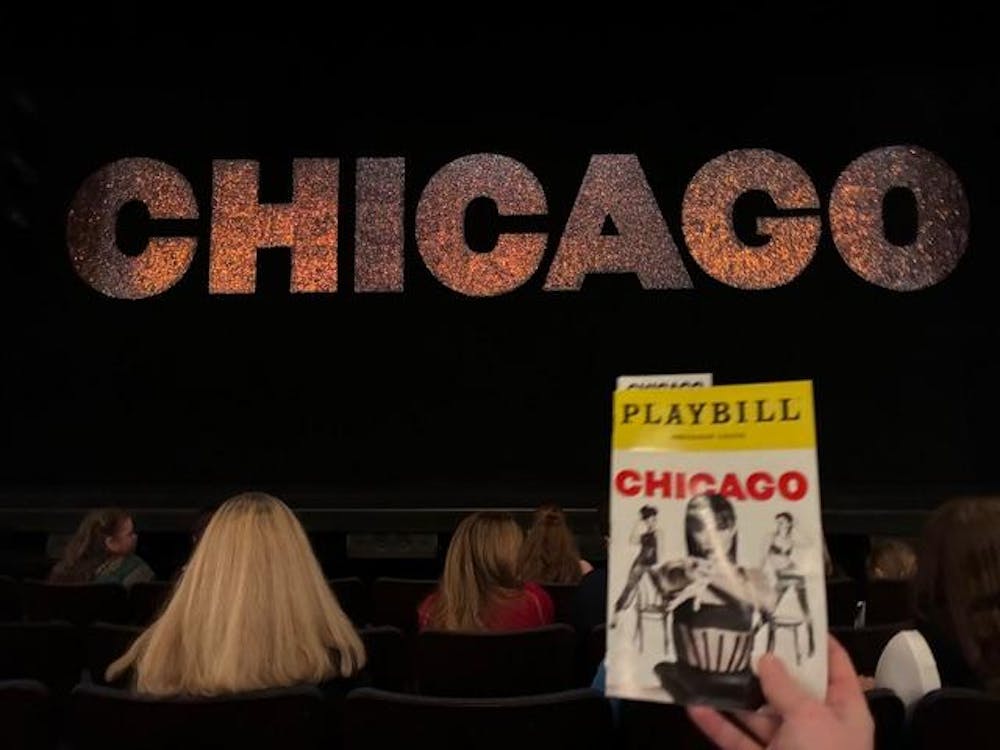
Saturday afternoon, I got to attend a 2:30 p.m. matinee of “Chicago.” “Chicago,” taking place in the 1920s, known to many as the Roaring ‘20s, features women who killed their husbands after they had wronged the women and is rather explicit compared to “Wicked.”
The show itself was much more complex than most musicals. It had a rather big set piece right in the middle of the stage, which was where the band sat. While I appreciated having an on-stage band, I believe the giant set piece made the stage crowded. As I was close to the stage, I could see the dancers having limited mobility as they moved around the giant piece, sometimes incorporating it into their dancing.
On the other hand, I rather enjoyed the lighting design. The use of a darker red, black and white at some points in the show really emphasized what the characters were feeling in the moment. In addition to this, the show also used brighter colors, especially near the end when Roxie Hart (Mira Sorvino) and Velma Kelly (Sophie Carmen-Jones) found their spotlight as they became famous in their duo show.
“Six”
The last show I got to see was on Saturday night, and it was the night production of “Six.” It was my absolute favorite. I believe seeing shows at night is always different as everyone is hyped up. It is the last show of the day, and performers are giving it their all. The “Six” performers did just that with the help of the production team.
First and foremost, the lighting was, in the only way possible to describe it, insane. Each one of the queens, if you will, had a specific design to highlight who they were and their personality. Some, such as Anne Boleyn (Gianna Yanelli), Anne of Cleves (Jana Larell Glover) and Catherine Howard (Kay Sibal) had more pop/rock songs which, in turn, used much more lighting. For example, Howard, who is known for wearing pink on stage, primarily had flashing pink lights to accompany her character and was always in the spotlight to emphasize her almost “playgirl” personality while Jane Seymour (Aryn Bohannon) had just a few spotlights on her as her song in the show was considerably calmer and less reckless.
Another part I appreciated about “Six” was that it didn’t require a lot of set design. There were some steps, like a small three-step staircase. The top of the stage featured three band players, a guitarist, percussionist and pianist, who, by themselves, supported the queens in their own special way. Not having a big set design, the six performers were able to put on what was almost a concert, interacting with each other and the audience.