Each year for the past five years, Notre Dame’s College of Science has held their annual Christmas Lecture. This year, the lecture featured Texas A&M professor Dr. Tatiana Erukhimova and was held at the Century Center in South Bend in order to encourage community engagement. Both Notre Dame students and local elementary school students were invited to listen to the lecture and explore stations with different science experiments.
Steven Corcelli, the interim dean of the College of Science, opened the lecture, calling it a “gift from the College of Science to share our love of the College of Science.”
Further elaborating on the lecture’s purpose following Erukhimova’s presentation, Corcelli said, “Tonight was all about bringing the fun and joy of science to the South Bend Community. It is our gift to bring science to the local community to inspire young folks and get them excited about science.”
Kate Biberdorf, a professor of chemistry in the College of Science known for her experiments on social media as “Kate the Chemist,” introduced Erukhimova.
Erukhimova, known to her fans and students as “Dr. Tatiana,” has been a physics professor at Texas A&M for the last two decades. Erukhimova shared that her love of physics developed early in life. She is the daughter of two physicists and said she grew up in a city where the physics education was, “superb,” which she said led her and many of her friends to become physicists. She even married a fellow physicist.
She attended the University of Nizhny Novgorod in Russia and received her Ph.D. from the Institute of Applied Physics at the Russian Academy of Sciences. Ultimately, Erukhimova came to the United States when her husband got a job at Texas A&M. She began teaching at the university as a postdoctoral research scientist and “realized how much I enjoyed it, so that turned into my career. I teach students, and walking into my class is always a highlight.”
She then began teaching upper-level classes to juniors but, after three years of teaching, decided to teach an introductory-level physics class. Walking into the class, she recalled, “they expected to see an Einstein-looking professor and they saw me. It did not go well. That’s how I learned the importance of making every class interactive and memorable … You must create this ‘wow’ factor for students to know that this is an exciting class for them to enjoy rather than be scared or bored.”
At Texas A&M, she works to make science more engaging through several projects. One is the Physics Festival, in which students share over 200 hands-on demonstrations with the general public.
Erukhimova also works on Discover, Explore, and Enjoy Physics and Engineering, an initiative which allows students to create their own hands-on demonstrations for the festival. “We invite everyone to celebrate physics with us,” she said.
This engagement, Erukhimova said, is important for both the public as well as the students, as students gain the opportunity develop presenting skills and gain recognition for their work.
In order to instill passion for science in children, Erukhimova said that the scientific community must “organize high-quality events or high-quality venues. It could be festivals. It could be videos, but you don’t want to dumb it down for people, but at the same time, you have to have the ability to explain concepts at the level that people understand and appreciate.”
Erukhimova said communication with students both inside and outside of the classroom is what makes her day, calling it, “an absolutely amazing experience. They are scientists by design.”
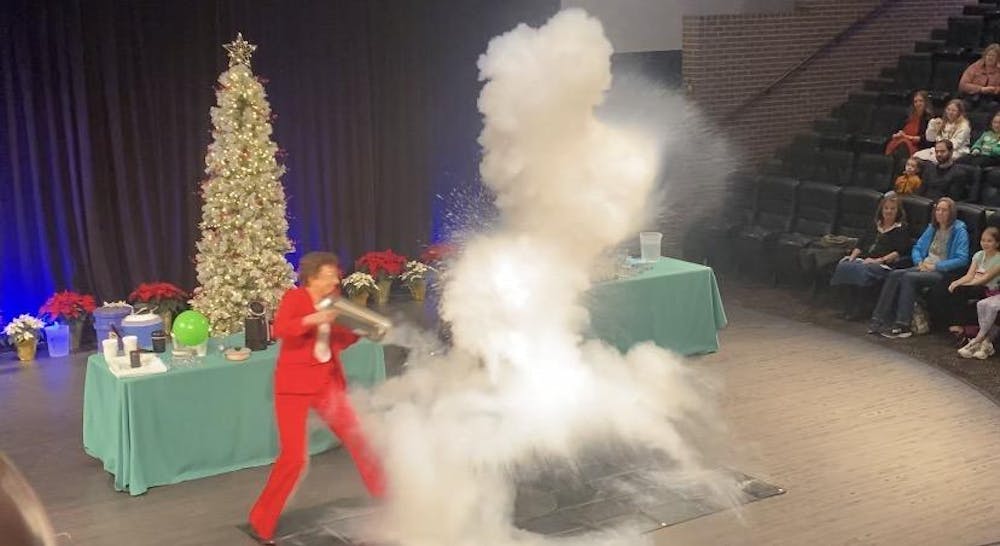
She proceeded to share her favorite experiments with those in attendance, from cloud explosions with liquid nitrogen to phase transitions, condensing the gases inside a balloon and freezing rubber using liquid nitrogen.
While conducting the experiments, she explained the concepts of paramagnetism, superconductors, Faraday’s Law and many others to the audience. With help from audience members, Erukhimova turned flowers brittle using liquid nitrogen and froze a magnet until it turned into a superconductor, which raced along a track.
Biberdorf offered her praise for the lecture.“Just as a fan, this was one of the most rewarding things in my life,” she said. “I have dedicated my life to doing what she does with physics, so this is one of the coolest things I’ve been a part of.”
Frank Qian, a lecture attendee and Notre Dame freshman, said, “It’s impressive how consecutive those experiments were – one followed by another, and I’m impressed by her passion for physics.”
Following the lecture, the children in attendance were encouraged to visit different tables dedicated to scientific topics. Some of the tables included the ‘take a bacteria table,’ the liquid nitrogen spinning disk, a flame made by the frequency and in the shape of a sine wave and magnetic breaking using a steel beam.
These tables were run by undergraduate students, graduate students and postdoctoral researchers, all eager to share science with the community. Joseph Derkin, a postdoctoral in Nuclear Physics, said, “I thought the event was great. I really like bringing physics out to people who have no idea what might happen and lifting up the hood to show them that it’s all just physics.”
Astrophysics graduate student Lauren Henderson echoed this, saying, “As a graduate student, doing activities like this makes me realize why I like science and why I’ll be doing this as a career.”
Chemistry graduate student, Marla Gravino, similarly offered her praise.
“Exposure is everything when it comes to encouraging young kids to pursue science,” she said. “It can only have a tangible impact, and we’re all here today to, hopefully, get some kids to pursue science.”