If your “For You” page looked anything like mine, the truth may be that the Louvre heist consumed it all. Keeping with that spirit, the DeBartolo Performing Arts Center screened Kelly Reichardt’s 2025 film “The Mastermind” on Nov. 14.
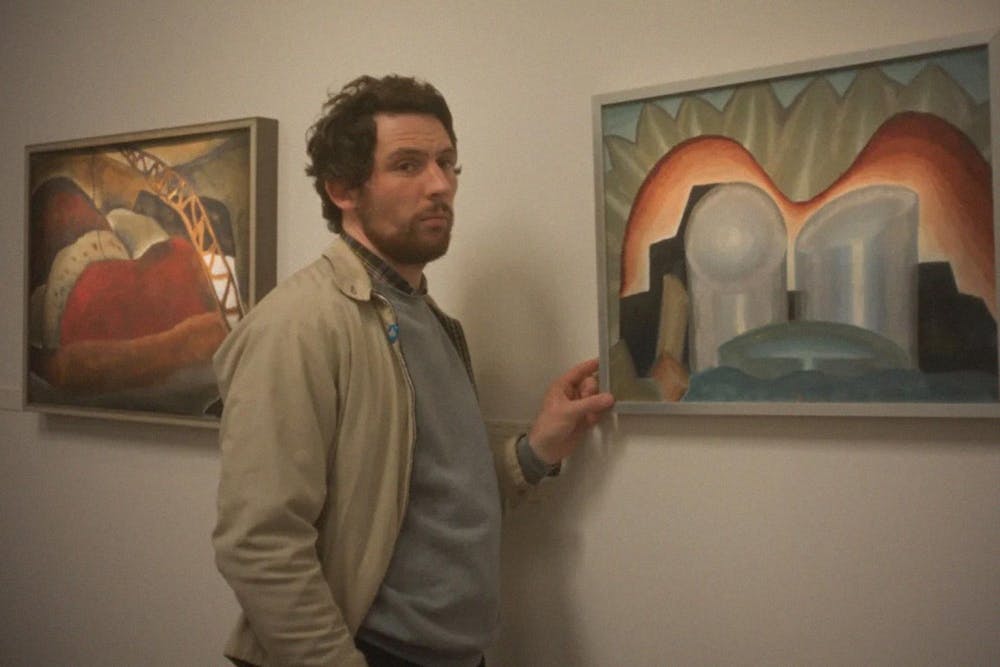
Despite what the title states, the film is not a heist movie in the traditional sense. There is no ocean of blueprints, choreographed acrobatics or glamorous criminal masterminds. Set in 1970s Framingham, Massachusetts, the film follows James “J.B.” Mooney (Josh O’Connor), an unemployed carpenter drawn into an ill-conceived plan to steal four Arthur Dove paintings from a local museum. From the outset, Reichardt favors atmosphere over action, foregrounding the weight of J.B.’s financial state, his parents’ disappointment and his quiet longing to be taken seriously.
The heist itself is almost deliberately unremarkable. J.B. ferries two petty criminals to the museum, where the theft devolves into a clumsy, unglamorous scramble. One thief assaults a student doing homework; another nearly bungles the art itself. Reichardt refuses to romanticize crime, instead situating it within the mundane pressures and small humiliations that shape J.B.’s life.
O’Connor’s performance is central to the film’s resonance. His J.B. is not a mastermind but an ordinary man out of his depth: ashamed, confused and unable to comprehend the chain reaction he sets in motion. While most heist narratives glamorize the ingenuity of the criminal, “The Mastermind” serves as a critique of that mythology. Reichardt cares less about the mechanics of the theft and more about the psychology behind it. J.B. becomes emblematic of working-class precarity, someone for whom risk-taking is not adventurous but desperate.
What ultimately grounds the film is Reichardt’s sensitive depiction of the emotional logic behind bad decisions. Instead of framing J.B.’s actions as the product of greed or thrill-seeking, the film shows how easily small resentments, wounded pride and a desire to be seen can calcify into something reckless. Reichardt captures the quiet humiliations that accumulate in J.B.’s life and suggests the heist is less an act of ambition than it is a misguided attempt to reclaim dignity. This psychological throughline gives the film a surprising intimacy, turning what could have been a conventional crime narrative into a study of how fragile identities fracture under pressure.
Yet the film’s meticulous restraint may challenge viewers expecting a more propulsive or genre-driven experience. The pacing drifts toward repetition as J.B. cycles through a series of failed escape attempts and tenuous connections. Several supporting characters appear briefly but disappear before their emotional significance can fully register. Even J.B.’s relationship with his wife, Terri — a relationship that could have grounded the film in deeper emotional stakes — remains frustratingly underexplored. At times, Reichardt’s commitment to ambiguity over catharsis reads less like intentional minimalism and more like missed opportunity.
Still, what Reichardt offers is a film defined by texture, tone and quiet observation rather than plot mechanics. Christopher Blauvelt’s cinematography renders the 1970s in grainy, muted hues, emphasizing bleak New England winters, cramped interiors and the physical smallness of J.B.’s world. Rob Mazurek’s score injects tension without overpowering the film’s steady, contemplative rhythm. The film becomes a study not of a crime, but of the emotional landscape that precedes and follows it: a meditation on failure, yearning and the fragile illusions by which people try to outrun their lives.
Rather than glamorizing the heist, Reichardt strips away genre conventions, crafting a deeply human study of failure, masculinity and the consequences of impulsive choices.
“The Mastermind” stands out not as a flashy crime film but as a character-driven exploration of how quickly a life can unravel. It is tender, darkly humorous and at times painfully realistic. The DPAC screening captured a movie that is sure to linger.