
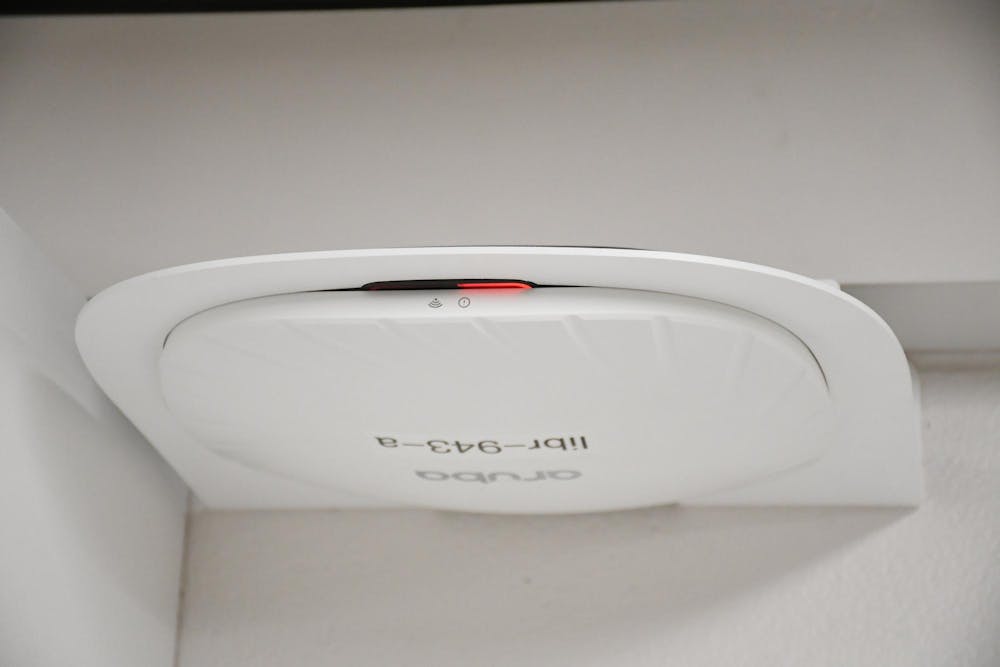
Students for Child-Oriented Policy (SCOP), a University-sponsored club, met twice this semester with Notre Dame officials to discuss implementing a pornography filter on campus Wi-Fi. The University denied the request for a blanket filter, but is adopting a SCOP effort to reintroduce an optional content censor.
In an interview with The Observer, SCOP vice president Theo Austin elaborated on the impetus of SCOP’s efforts to institute the filter.
“Our basic position is this is damaging. It’s against the teaching of the Church, which the University should uphold, and it’s in the University’s policy we ask that you enforce it,” he said.
The University’s Responsible Use of Data and Information Technology Resources policy, last updated in 2016, explicitly forbids “pornographic, sexually explicit or offensive material, except for officially approved, legitimate academic or University purposes.”
SCOP became a University-sponsored club in 2014. According to the organization’s website, they are unaffiliated with any political or religious group and are focused on multiple issues, including pornography. They host multiple events, including White Ribbon Against Pornography Week, which promotes conversations about pornography use and addiction through lectures and activities.
In 2018, the club sponsored a petition to institute a filter on Notre Dame Wi-Fi, gaining over 2,400 signatures and sparking coverage from multiple national news outlets. The next year, they met with former University President Fr. John Jenkins to discuss a filter. Jenkins denied the request for a mandatory campus-wide censor, but did offer to create a filter that users of the University network could manually approve.
An article by The Observer in April 2023 suggested the opt-in filter was still active. Today, it is not accessible.
Austin explained in an email to club members that the first meeting with administrators, held Sept. 26, was a result of an April 2025 petition to reignite a dialogue over the filter with University President Fr. Robert Dowd.
That petition garnered just 650 signatures. However, the 2025 petition was open for less time, and, according to Austin, one reason the University denied the petition in 2018 was because it was not exclusively reserved for students.
According to the email, the University was represented in the first meeting by Dowd, vice president and chief of staff Ann Firth and assistant vice president of Campus Ministry Fr. Pete McCormick. SCOP was represented by Austin and 2024-25 co-president Kate Apelian.
Austin said the discussion was an open dialogue, with both sides free to voice their opinions on the issue over the course of the 45 minute meeting. SCOP presented their argument that “by allowing pornography on our University Wi-Fi, we are partially complicit in its use and have not stood officially against porn in an effective manner.”
Austin said two options were presented to the University: a blanket filter over all pornographic content and a narrower filter that blocks only specific websites. Austin also clarified that the push for a filter was symbolic, as students could always access content via cellular networks.
“The University definitely were in agreement between the three representatives on how to approach the matter,” he said.
Ultimately, Austin said the University supported a continued pastoral approach, but denied the request because a campus-wide filter did not adequately prepare students for confronting pornography use outside of their time at the University.
“It’s easy to portray this as hostile or adversarial, but that’s not at all the climate of the conversations,” he said. “Yes, we wish the University would implement a blanket filter. We believe this is very helpful for our student body and representative of our Catholic character and enforcing our policies, but the University has been very recognizing of the damages of pornography and the need for healing among our students, and just disagrees on how that's best carried out.”
On Nov. 6, the same groups, minus Dowd, met again to work out what an opt-in filter would look like. The University presented SCOP with six options for a filter that the Office of Information Technology would then carry out.
Austin did not share the specific options, but said they included trade-offs over the breadth of control over the content, where in the system it would be implemented and the price of doing so.
“Is this Google settings or is this an independent filter site that collects certain data? Is this a filter that accidentally blocks other stuff as well?” Austin said.
A decision by SCOP was tentatively requested for the week after Thanksgiving break.
Erin Blasko provided a University statement to The Observer regarding pornography use.
“While Notre Dame does not view the implementation of a campus-wide filter as an appropriate means of addressing this issue, we are committed to working with and supporting students who are struggling with porn use and addiction, and have been in conversation with SCOP and other campus partners about how best to do so,” Blasko wrote.
The statement also included that “in keeping with its Catholic mission, the University has long condemned pornography, given the harm it causes both to those who view it and to many who are part of the industry.”
Fr. Terrence Ehrman, an assistant teaching professor in the Department of Theology and former SCOP speaker for a White Ribbon Against Pornography week lecture, elaborated on the Catholic perspective on pornography use and distribution.
“Sex is good, but there’s a certain time and place for it, so pornography is something that has a lust; it’s quite distinct from love,” he said. “There’s an inordinate desire for sex [that] is what lust is, so pornography incites that vice.”
When asked whether he would support a campus-wide pornography filter, Ehrman said he would, citing physiological, neurological and interpersonal effects.
“Why should the University be providing this for humans? If we think of sin as a poison, why should the University allow poison to be consumed on campus? Right, it doesn’t make any sense. We think this is poisonous for your soul. Why should we give you access to it?” Ehrman questioned.
Ehrman clarified that in circumstances where pornography is used in an academic or research setting, it should not be considered a sin. However, he said, to use this as an argument to remain without a campus-wide filter is flawed given the rarity of its use for these purposes.
The priest mentioned he had engaged in conversations with Notre Dame students that included concerns over an abuse of pornography, and that “on campus, it’s a widespread pastoral issue that I don’t think is adequately addressed.”
Blasko also shared current and potentially future approaches Notre Dame is taking regarding pornography use on campus.
“EthosND and Magdala are two campus organizations that currently provide support to those who are concerned about their use of pornography, and the University is exploring whether there are additional resources we can offer,” Blasko wrote.
The University did not directly respond to a request to confirm the content of the arguments given by either group toward or against a campus-wide filter.


