
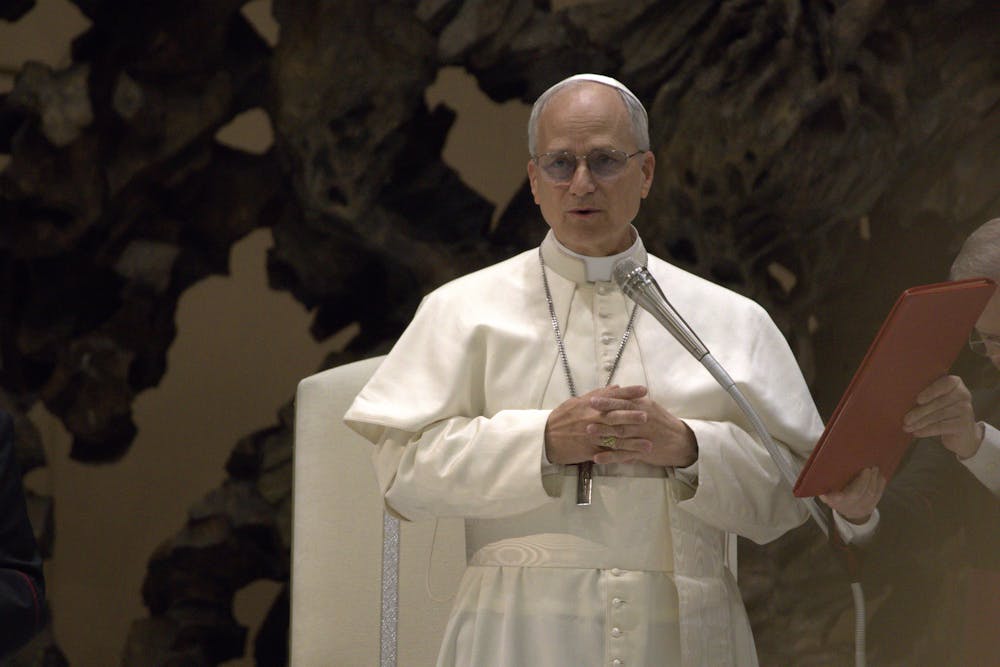
This past week, Pope Leo XIV made his first papal pilgrimage outside of Rome. His first stop was Turkey in order to celebrate the 1,700th anniversary of the Council of Nicaea, before continuing on to visit Lebanon.
Fr. Paul Kollman, C.S.C. a Holy Cross priest in residence in Welsh Family Hall and associate professor of theology, shared his belief that the visit to Lebanon was prompted by the visit to Turkey for this anniversary. Kollman noted the Council of Nicaea defined “that Jesus was fully God and fully human ... [and gave] us the Nicene Creed, which is central to almost every Christian group in the world.”
Daniel Philpott, professor of political science, shared why he sees Lebanon as in need of the Pope’s support and attention.
“[Lebanon] is a deeply divided and violent society on several different dimensions, but there is a lot of tension between the Christian community and the Muslim Community,” Philpott said. “Even to speak for the Muslim community is a little bit simplistic because the Muslims are divided between Shia Muslims and Sunni Muslims. The country is roughly one third Christian, Shia [Muslim] and Suni Muslim. For these communities to get along is a tall order.”
Holy Cross priest, professor of theology and global affairs, and associate provost for undergraduate education Fr. Daniel Groody said the country “is marked by a lot of political violence, economic instability and a tremendous influx of refugees especially from Syrian and Iraqi outflows.”
Philpott explained that in recent history, Lebanon was overrun with civil war, and there is still a strong presence of the Hezbollah group in the country, which is a Shia Muslim political militant community with an enormous amount of power but no official status.
“[Hezbollah] controls territory, it controls aspects of the economy, aspects of the government, but really through military force. It was formed in 1982 and produces an enormous amount of instability in Lebanon,” Philpott said.
In the face of this instability, Rashied Omar, associate teaching professor of Islamic studies and peacebuilding, stated his support of the pope’s visit.
“I welcome the visit of Pope Leo XIV to Lebanon at this critical moment in the country’s history,” Omar wrote. “His presence offers a profound opportunity to bear witness to the deep suffering of the Lebanese people, Christians and Muslims, citizens of every tradition, who continue to endure immense economic hardship, political paralysis and daily insecurity.”
Others echoed this sentiment of the immense power the presence of the pope brings.
“Popes have an ability to garner these massive crowds, massive followings in a way that few other world leaders or religious leaders do,” Philpott said.
Mark Mikhail, a student in O’Neill Family Hall, similarly praised the visit.
“That kind of stage in having a billion people following the pope and the Vatican and all the orders, it sets an opportunity for the pope to carry out peace and carry out what the church wants in terms of what Christ has asked the church to do,” he said.
Groody noted the need for the pope to connect with those of different religions.
“The word pontiff means ‘bridge builder,’ and I think that is really something that is to bring people together and to allow people to respond and relate to each other in ways that respects human freedom, respects human dignity and also in this case, respects other people's religions,” he said. “It is a universal mission, and I think in the same way that Paul is one the first apostles in the early church, it is a message and a mission that encompasses all people and encompasses all nations and in that sense, the pope is really an extension of that message and really is the most public face of that message in the contemporary world.”
Philpott noted that popes traveling is a relatively new phenomenon that began with Pope John Paul II.
Many are eagerly watching Leo’s actions to better understand his character as pope at the beginning of his tenure.
“He has shown already that he is a person who listens carefully and he listens extensively, and what I think he is listening to ultimately is where God is at work in the world, and also what are the pains and sufferings of the people,” Groody said.
The pope has urged young people to see hope, telling them in Lebanon Monday, “Dear young people — perhaps you regret inheriting a world torn apart by wars and disfigured by social injustice but there is hope and there is hope within you.”
Kollman emphasized the role of young people in the church saying, “Young people are the church, just like everybody else.”
Omar elaborated on the impact of Leo’s visit.
“This pilgrimage of solidarity can serve as a powerful moral call to the international community to act with urgency and unity in supporting a sustainable peace in Lebanon,” she said. “The world must not turn away from the people’s cries for dignity, justice and economic relief. Their resilience deserves global accompaniment, not neglect. May this visit rekindle hope and strengthen collective resolve toward justice, peace and human dignity for all the people of Lebanon.”


