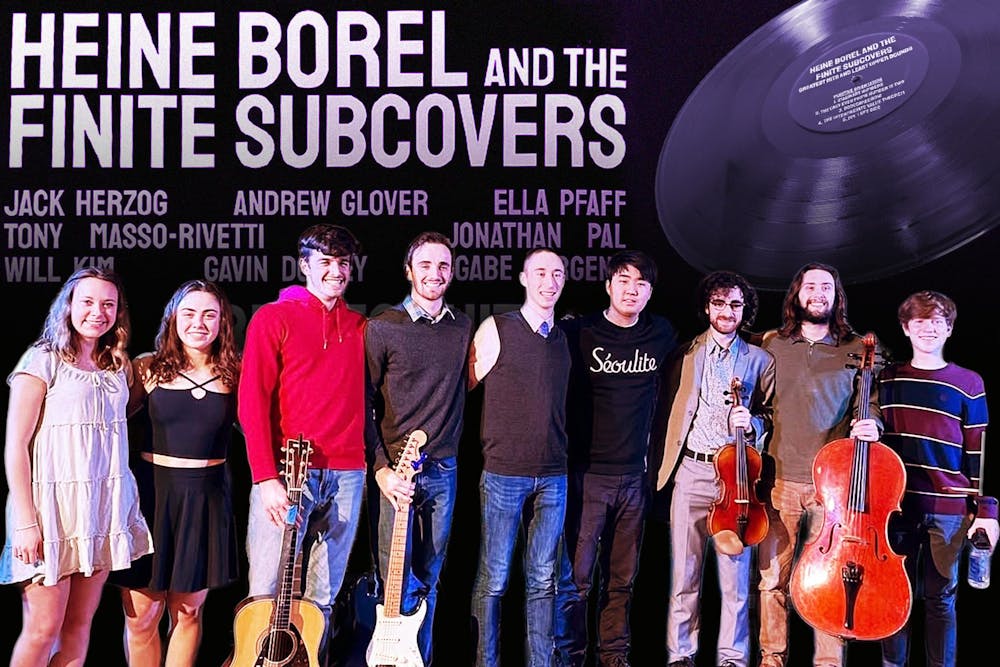
Heine Borel and the Finite Subcovers began in 2022 as a joke when a group of honors math majors were learning about the Heine-Borel theorem in a class during fall of their sophomore year. While hanging out outside of class, they realized they shared musical talents and joked about forming a band. In the spring semester, this dream became a reality.
Gavin Dooley, a band member and graduate student at Notre Dame, explained that the band’s name is a series of layered puns born from the group riffing to come up with a funny name.
“Heine Borel is not one person, so that is the first part of the joke. It is actually two people, but it sounds like one person. There is a theorem called the Heine-Borel theorem named after mathematicians Heine and Borel. They proved that any closed and bounded set of real numbers and any cover of that set admits a finite subcover, so the Heine-Borel theorem has to do with finite subcovers. Another pun is that we would play covers of songs and sometimes those covers would be shorter, so they were subcovers,” Dooley said.
Today, the group is not actively making more music due to their geographic distance, but their first full album, “Greatest Hits and Least Upper Bounds,” is newly out on vinyl.
Dooley explained that as graduation was approaching, the band members felt the need to record their music, doing so during their senior week.
“We are all novices when it comes to mixing, mastering and editing, so it took us over a year to actually produce the album. Finally, we got this printed up on vinyl a few months ago after a long period of further procrastination.”
For Dooley and Ella Pfaff, another band member and graduate student at Notre Dame, a particularly memorable performance was their second one, taking place in 2022 on Tuesday, Feb. 22 (“2/22/22”). The band led up to this performance with a countdown to 10:22 p.m., which is “22:22” in 24-hour time. In this performance, which took place in the basement of Hayes-Healy Hall, they performed a variety of songs with numbers in the title and replaced all of the numbers with “two.”
“‘If I Had $1000000’ [became] ‘If I Had $2,’” Pfaff said.
Dooley said, “A lot of our performances involved kicking out all these poor students who are trying to study in the basement [of Hayes-Healy] and then hijacking the basement and turning it into a concert venue.”
“Approved by the math department, of course,” added Pfaff.
Although united in favorite performance, Pfaff and Dooley have different favorite songs, and Pfaff’s favorite is not even on the album.
Dooley explained, “This was only the cream of the crop that made it on the album. My personal favorite might be ‘The Monster Math,’ which is also the one that I sing on … I am also partial to this one — ‘The Intermediate Value Theorem’ — because unlike some of the other songs, this one is actually mathematically accurate. A lot of our other songs are full of misinformation that would only confuse students.”
Pfaff noted, “I think my favorite is “Scooter Boy.” It is a parody of “Sk8er Boi” but obviously having to do with scooters and the scooter culture that used to exist here. But of course, it was mathematical too. I think it was our very first math parody. I still keep the lyrics on my phone and look at them, and it makes me laugh all the time.”
At this time, the album can be listened to on YouTube. The group is working to get it onto Spotify and Apple Music, but with the nature of it being parody, they are facing greater copyright challenges with these platforms.
In reminiscing over the founding of the band, Dooley shared that he thought there was an innate connection between mathematics and comedy music, citing the work of Tom Lehrer in the ‘50s and ‘60s and The Klein Four.
Dooley said, “If you are a mathematician, it is fairly normal to start writing songs about math.”
“Right, because math is so funny,” added Pfaff.
The Notre Dame math department reported on the group in 2022, giving an overview of its members: “The group consists of Gavin Dooley (cello, piano, vocals), Jack Herzog (vocals), Andrew Glover (guitar, vocals), Tony Masso-Rivetti (melodica, viola, vocals), Jonathan Pal (guitar, piano, vocals), Gabe Sargent (piano, melodica, vocals), Bill Kim (piano, melodica, vocals), Ella Pfaff (flute, vocals) and Madeline Kosobucki (manager, percussion). The members have individually been a part of other musical groups on campus, including folk choir, bagpipe band, and jazz band. To the group’s knowledge, they are the first and only math band at Notre Dame.”
William Kim is also a featured member of the band in this album.
Today, Kim works in consulting, Dooley and Pfaff are math Ph.D. students at Notre Dame, Herzog is a Holy Cross seminarian currently taking a vow of silence in the mountains of Colorado, and the other members are in graduate school around the country.
Dooley said, “Right now, there are no future plans to record more music, but I will always leave the door open to anything that might happen in the future … I think there is always the potential for a reunion concert … Notre Dame 15th or 20th reunion?”
For now, Dooley recommends listening to the officially recorded versions over videos of their live performances, noting that on the recordings they had percussion — usually missing from their live shows.
“Our live performances never fulfilled our vision because we were always scrambling to get everything done and trying to find people to play all the instruments, but in a studio, you are really able to do things the way they should be done,” Dooley said.