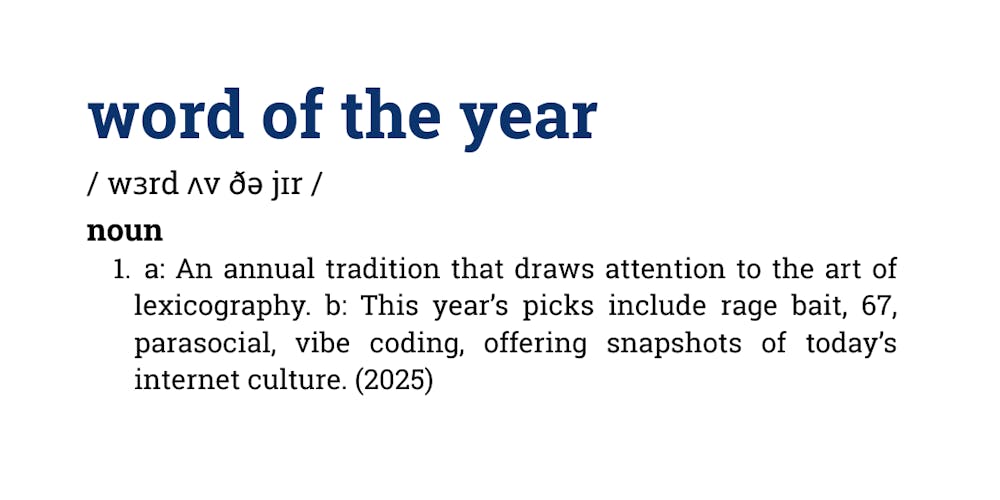
Multiple dictionaries have released their selection for 2025’s ”Word of the Year”. Time Magazine reported the top selection for each of the major dictionaries: “rage bait” from Oxford Dictionary, “AI slop” from Macquarie Dictionary, “parasocial” from Cambridge Dictionary, “vibe coding” from Collins Dictionary and “67” from Dictionary.com.
Merriam-Webster has not released their pick yet. The popular online dictionary’s last two selections, ”polarization” and “authentic,” were not considered slang at the time of their choosing, but 2022’s “gaslighting” was.
Opinions on the selections vary — some voices are indifferent, while others outright disapprove. A commenter on an online forum prompted by the New York Times wrote, “With all of the recent words of the year being popular online memes, like demure, brainrot and our most recent contender, ragebait, it feels like they aren’t taking this seriously.”
Another wrote, “It almost makes me feel like the Oxford Dictionary is running their own form of ‘Rage Bait.'" They noted that Oxford spelled their word of the year, known by the commenter as one word — ragebait — as “rage bait,” making it, technically, multiple words of the year.
The majority of the chosen words are considered slang, which has led to criticism over the distinction they now merit. Some words did not even include clear definitions for their meaning or usage, which critics argue defeats the purpose of their inclusion in the first place. Dictionary.com’s “67” describes the word as ”largely nonsensical,” and presents its definition by stating ”some argue it means ’so-so,’ or ‘maybe this, maybe that.’”
Some students joined other detractors in expressing their displeasure. Senior Evan Tionquiao said he used to follow the dictionaries’ selections “back when words had meaning, prior to ‘brain rot’ culture,” and now holds a more diminished interest.
“Since we have Urban Dictionary now, I feel like actual dictionaries just want to hop on the train,” he said, referring to the dictionary that allows any user to write a definition for a word, creating a repository for slang.
Not everyone on campus protested the development. senior Nguyen Nguyen said he started “paying attention to [word of the year] last year when it was brain rot, and the year before when it was rizz.”
The mixed opinions spark deeper questions surrounding the tradition, such as what the selection of the top words are based on.
While many may view dictionaries as pillars of linguistic consistency or intellectual integrity, Notre Dame professors view them differently.
Literature professor Tim Machan claimed dictionaries are financial endeavors as much as they are publications.
“It’s easy to think of dictionaries as the unimpeachable authorities on the ‘real’ language and to appeal to them for that purpose. But the thing is that dictionaries always have been businesses, they are books and enterprises meant to make money,” he said.
He referred to the troubled origins of the Oxford English Dictionary, which in the late 19th century struggled to balance comprehensiveness of the English language with a shorter list that would cost less to print.
“A dictionary is a still photograph of a perpetually moving picture. But that’s a tricky way to sell books, and it’s not what users want, they want certainty,” Machan said.
English professor Matthew Kilbane was more conciliatory, emphasizing the difficulties lexicographers face in classifying a word.
“Lexicographers are often trying to capture the language in its totality. But this is, of course, a totally impossible thing to do, in part because the language is just so vast, there are all these different corners of it,” he said.
Kilbane supported traditions like “Word of the Year” for what they reveal about contemporary culture.
“Almost all of the words — certainly, all the finalists — come from online ... the internet is our public sphere now,” he said.
Kilbane attributed this year’s selections to a shift in attitude toward technology. He classified rage-bait and “parasocial” as words that reveal “the ugliness of the internet.”
The methodology dictionaries use to choose their words as shifting as well. This year, social media polls and “personified campaigns,” in which words are given personas that people can vote for, challenges more traditional models that track publication in major outlets as proof of widespread usage and acceptability.
Nguyen acknowledged the odd words this year, but said he appreciates the new methods, which democratize the process of legitimizing words beyond the sole control of a “board or a round table room full of just Oxford Dictionary people.”
He made his own suggestions to improve the system in light of this year’s preponderance of slang terms.
“You’re putting agentic next to aura farming, but those two are completely different categories,” he said. He would instead categorize words into separate spheres, including a “tech word of the year” or a ”meme word of the year.”
Kilbane highlighted a humorous connection between the “Word of the Year” tradition and one of English's earliest lexicographers, Samuel Johnson.
“Under the heading of the word dull, when he uses that word in the sentence, he says, ‘to make dictionaries is dull work.’ So he’s poking fun at his own lexicographical labor,” Kilbane said. He stressed that a “Word of the Year” selection is one more decision dictionaries make to elevate that dullness and imbue some fun in their work.