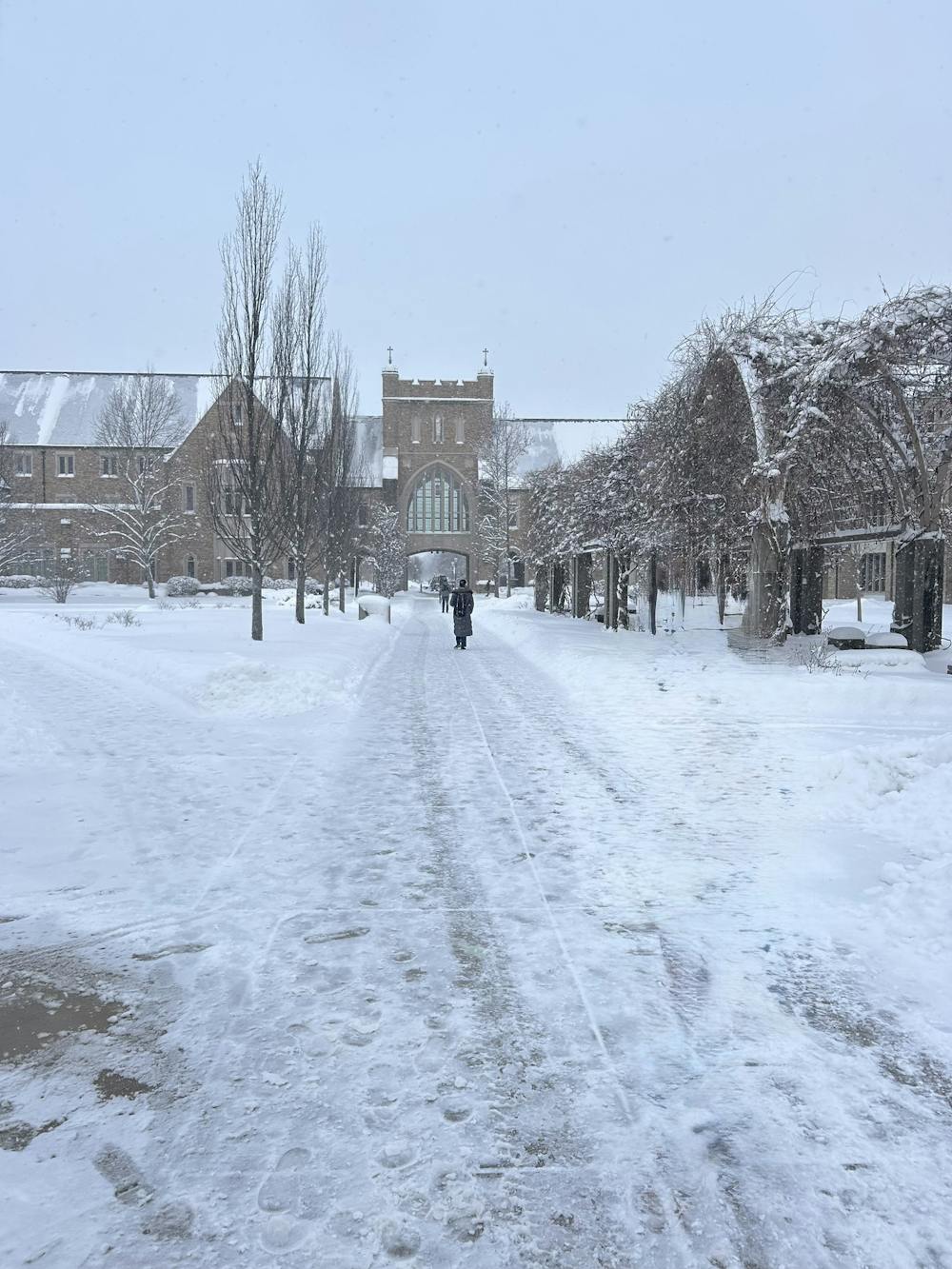
Since returning to campus in mid-January, students have grown used to trekking through the snow-covered sidewalks to get to classes, particularly within the past week. While the weather hasn’t been severe enough for Notre Dame to cancel classes (which the University hasn’t done since 2022), that doesn’t mean the snow hasn’t affected students’ ability to attend classes. For students with mobility aids, the accumulation of snow and slush on the University’s sidewalks has posed significant barriers.
The amount of snowfall paired with the frigid temperatures has made clearing sidewalks difficult for the University to keep up over the last week. A University spokesperson wrote in a statement that Notre Dame “is committed to fostering a safe and accessible campus for all, and snow and ice removal is a critical part of that commitment … [However] with 71 miles of sidewalks, 15 miles of roads and 94 acres of parking lots, this work can be challenging at times. During prolonged periods of extreme cold and heavy snow, ice can be particularly difficult to manage since salt, the most common substance for treating slippery roads and walkways, loses its effectiveness below a certain temperature.”
Though this amount of snow may seem to be a simple inconvenience to some, it can impact the capacity of students with physical disabilities to make it to class safely, as slush interferes with mobility aids and snow and ice present potential slipping hazards.
Freshman Grace Anne Doyle, a Chinese and economics major with cerebral palsy who has a mobility aid, described the significant impact the snow has had on her ability to get around campus. “I think that [the University] wants to help, but I also don't think that they totally know how or have the infrastructure resources to actually do so effectively. Overall, I would say it’s not been good because myself and other students have not been able to go to class, or have just had a much harder time getting around campus, getting to dining halls, that kind of thing. And I just feel like it makes us feel like we’re missing out on a lot of the university experience here,” Doyle said.
“I think that I’m more anxious about going places because I'm worried I’m going to slip. And getting to class, specifically, I have to leave so much earlier,” Doyle said.
For freshman Isabella Duarte-Crespo, a design major with spina bifida who uses a mobility aid, the effects of those few days of accumulating snow last even beyond when the sidewalks have cleared. “I’ve been having to walk a lot more to class. Initially, it wasn’t too bad. I kind of just had to adjust. But after a while, it was a huge toll on my body. Now I’m to the point where even though they’ve already shoveled and I could be using my scooter at least today, I can’t because I’m in too much pain, where I can’t even focus on what I’m working on,” Duarte-Crespo said.
Echoing Doyle’s worries about losing access to campus due to the weather, Duarte-Crespo said, “And it also makes me really worried, because I feel like I’m missing out on so much on campus and I’m going to have more work to catch up on compared to the students who [were] able to go to class.”
Though she understands that the University is facing extreme winter weather, Duarte-Crespo feels the University has not kept the promises it made to her regarding accessibility at Notre Dame.
“One of the main reasons why I came to [Notre Dame] is because they claim to have such good accessibility at the university. There’s so much representation here, and so many other students have had great experiences at the university, so it’s very disappointing to see how not very well they’re handling this,” Duarte-Crespo said, “I’ve never lived in snow, and that was honestly one of my top concerns when coming to Notre Dame for my mobility aid, but I thought it wouldn’t be as much of a problem, because I was promised that I would have priority snow plowing, ‘priority snow removal,’ they called it, which I didn’t really know what that meant, but I thought it would just be like they prioritize my route to class before main sidewalks. Clearly, that hasn’t been happening and they haven’t been plowing enough.”
In an attempt to address this issue, Notre Dame has offered students with mobility aids some resources. Sara Bea Accessibility Services is able to communicate with professors about absences on a student’s behalf. Students are also offered the option of having a note taker to ensure that they don’t fall behind in classwork. Students are able to send a friend or resident assistant to the dining hall to bring back a meal for them.
According to the University, certain routes and entrances are prioritized across campus when snowfall is higher than average. “To help navigate campus more effectively during inclement weather, those with mobility needs and/or concerns are encouraged to utilize the ‘Accessible Entrances’ and ‘Accessible Parking’ overlay features on the campus map. Using these features, students, faculty, and staff can more readily locate accessible doorways and various ADA parking spaces on campus,” a University spokesperson wrote in a statement.
However, both Duarte-Crespo and Doyle emphasized that these locations aren’t always as accessible as they should be. While that may simply be a result of sustained periods of snow, the prioritized routes still don’t always include the buildings that students with mobility aids need to access, notably the dorms near the Hesburgh Library. “I know that they have a map of where they do the main priority shoveling, and it misses large parts of campus, like almost the entirety of God Quad and northern parts of campus, like behind Hes, where there are a lot of dorms. That’s not a priority for them at all, and there are still students living there with disabilities who need to use their mobility aids, or who just have a harder time navigating the snow,” Doyle said.
For Duarte-Crespo, it feels like some students have been left on the sidelines. “We shouldn’t be barred from having the same education as everyone else just because of something outside of our control, which we were promised would not be an issue at this university. So it feels kind of like a betrayal of trust ... We should be able to go where everyone else is going. It’s like a fundamental right of ours. Why are we missing out [on] things when it’s something not even our fault, something completely out of our control?” she said.