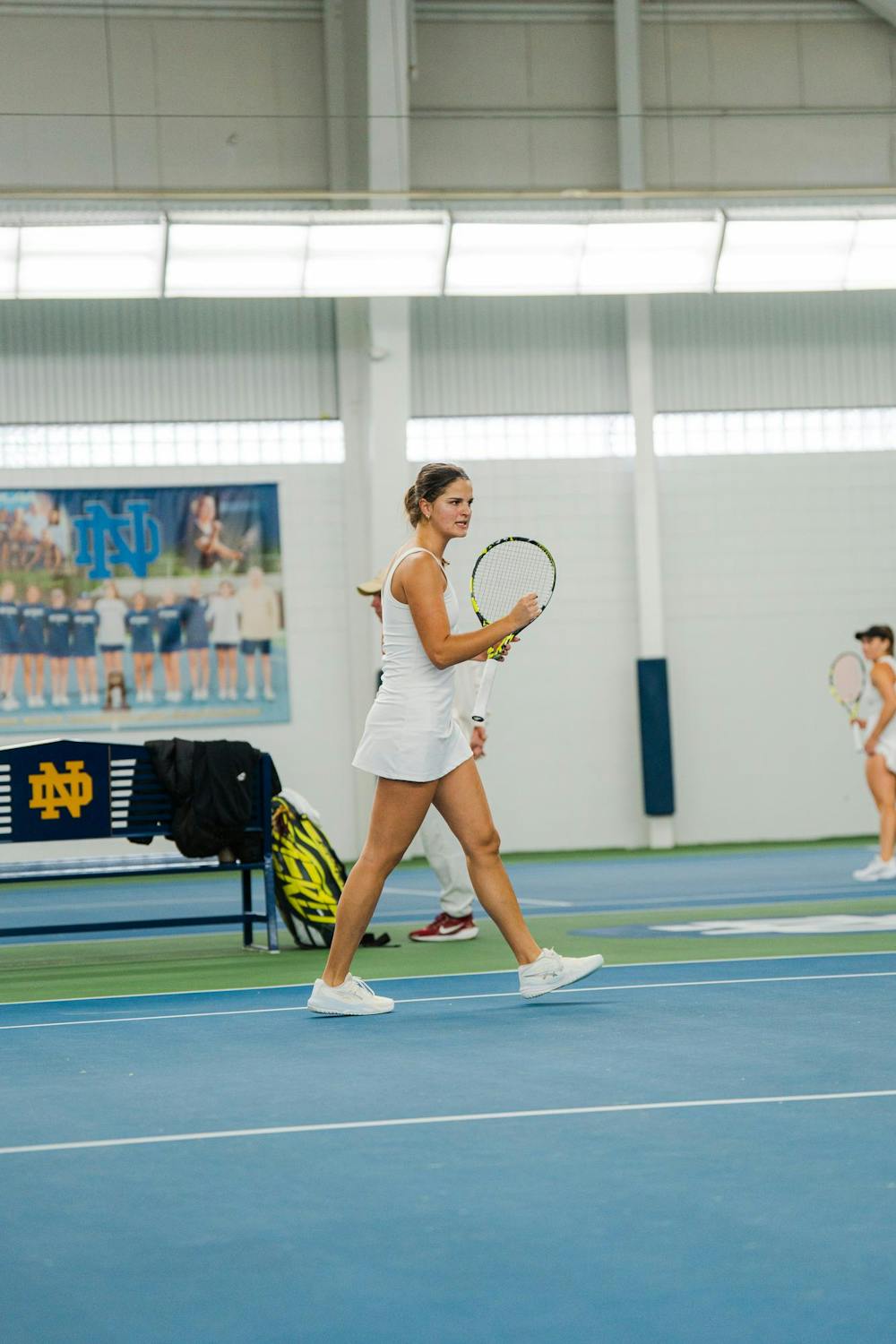
In the fall of 2024, Notre Dame freshman Bianca Molnar made her first appearance on the team college tennis circuit. Playing at the No. 4 singles spot, she led Ball State’s Sarah Shahbaz 7-6, 2-1 before the match was abandoned. In the following months, Molnar kept winning, accumulating a 24-14 singles record for the year and finishing an impressive 5-2 against ACC competition. Molnar looked like she was more than ready to step into the spotlight, which wasn’t surprising given her already monumental career accolades.
A California native, Molnar developed her game against some of the best competition found anywhere in the world. In 2023, Molnar claimed her first professional WTA singles and doubles points, defeating a top 400 women’s player in the process. A year later, she powered her way to the Junior Indian Wells doubles title, together with partner Alyssa Ahn, already cementing her name in what is widely known as “tennis paradise.”
Following her strong junior career, Molnar chose to continue her tennis journey at Notre Dame, both for its excellent athletics as well as its grounding in faith.
Currently midway through her sophomore season and preparing for the 2026 NCAA Championships, I sat down with Molnar to discuss the transition to college tennis, her game and the challenges ahead of her.
While there are never more than two opponents across the net, college tennis is an entirely different game than junior tennis. For one, junior tennis rarely involves dozens, if not hundreds, of fans screaming in between every point. In a sport traditionally known for its decorum, college tennis takes a complete turn, bringing those extra elements of fire and fervor to the game. College tennis also involves changes in lifestyle and practice schedule. While juniors tend to play tournaments more sparsely, often picking and choosing tournaments as they prefer, college tennis takes away that flexibility. Players often compete in two, sometimes three, duals a week, often participating in both singles and doubles. The fast-paced regimen of college tennis can be rewarding but also draining on both the mind and body in a way juniors is not.
Speaking on her experience making the switch, Molnar explained, “For me, the first few months were tough…getting used to the travel and higher intensity. What helped was relying on my teammates in tough moments. Whenever I was having a hard time adjusting, they were there to support, that’s what makes it [the college dynamic] so special.”
The team aspect is indeed the most prevalent difference between college tennis and any other format of the sport. Whereas individual players or pairs play mostly for themselves, college players represent their team and school, each of them a crucial component of an efficient machine. Along with the format comes pressure and greater expectations.
“Yeah, when I’m out there, I’m playing for myself, but also for my teammates. …You wanna make sure that you do your part week in and week out,” Molnar said.
While the added pressure often makes life difficult for college players, it makes wins all the more rewarding and prepares them for careers on tour.
When asked about whether the circumstances of college matches can better prepare players for the professional stage, Molnar said, “For sure, I think [the pressure] prepares you for big moments in the pros. Here, your team is counting on you, so maybe when you face an important point or tight moment at like 3-3 in the third [set], you’ll be much more used to that feeling.”
Both she and the team will be expecting to play some important points in the upcoming weeks, especially in this weekend’s ACC Championships. Notre Dame enters the tournament ranked No. 10 in a loaded field, while Molnar currently sits at No. 63 in the ITA rankings.
So far this season, Molnar has taken a step up, playing primarily at the top court for singles and partnering with senior Bojana Pozder at the No. 1 and No. 2 doubles spots. She has accumulated a 13-9 singles record, with her best win coming against Berkeley’s No. 16 ranked Johanne Svendsen, 7-5, 6-4.
Speaking about her game, Molnar said, “I love to be aggressive…big serve and forehand, stay on the front foot. A lot of serve-plus-one to finish the point early.”
Molnar will have to bring her A game if she wants to make a splash at the ACC Championship and the looming NCAA Championship.
“My personal goal is to become an All-American, which is awarded to the top 20 singles players and top 10 doubles teams at the end of the season,” she said.
Looking beyond this season, Molnar hopes to use her time at Notre Dame to grow as both a person and a player.
She said, “I definitely want to play professionally after college. That has always been a goal of mine, and it’s one of my motivations for playing.”
While the college circuit has become a factory for producing top 100 players in recent years, tennis is still one of the most challenging sports to play professionally. The nearly yearlong calendar, travel and coaching expenses, and mental fatigue all play a role in the difficulties pros encounter. To avoid burnout, it is important to have a deep passion for the game, as well as strong reasons to continue playing.
When I asked Molnar what she loves most about the sport, she told me, “I love competing…the thrill of winning a crazy point or a close match, that’s what keeps me going. Also, having these long-term goals like going pro helps.”
She again emphasized the importance of team culture in keeping her motivated, “It’s obviously a long season, so whenever I’m feeling burnt out or tired from matches, I lean on the team for support. In practice, sometimes we get super competitive, but the friendly rivalry keeps things fun.”
These next few weeks will be big ones for Molnar and Notre Dame women’s tennis. The season has been a bit of a roller coaster, but they currently sit at 17-8 and have all the capabilities to make multiple deep runs in the postseason. Individually, Molnar will likely relish the opportunity to take on the country’s best players, and, win or lose, her passion and dedication to the game ensure that her tennis future looks bright.