As the end of the semester approaches, Saint Mary’s College has opened its housing portal for students to select dormitories. However, new limitations within the system have changed the process for many students. Increased enrollment, combined with decisions by the Office of Residence Life to close off sections of housing, has created a more competitive environment for those entering the lottery system.
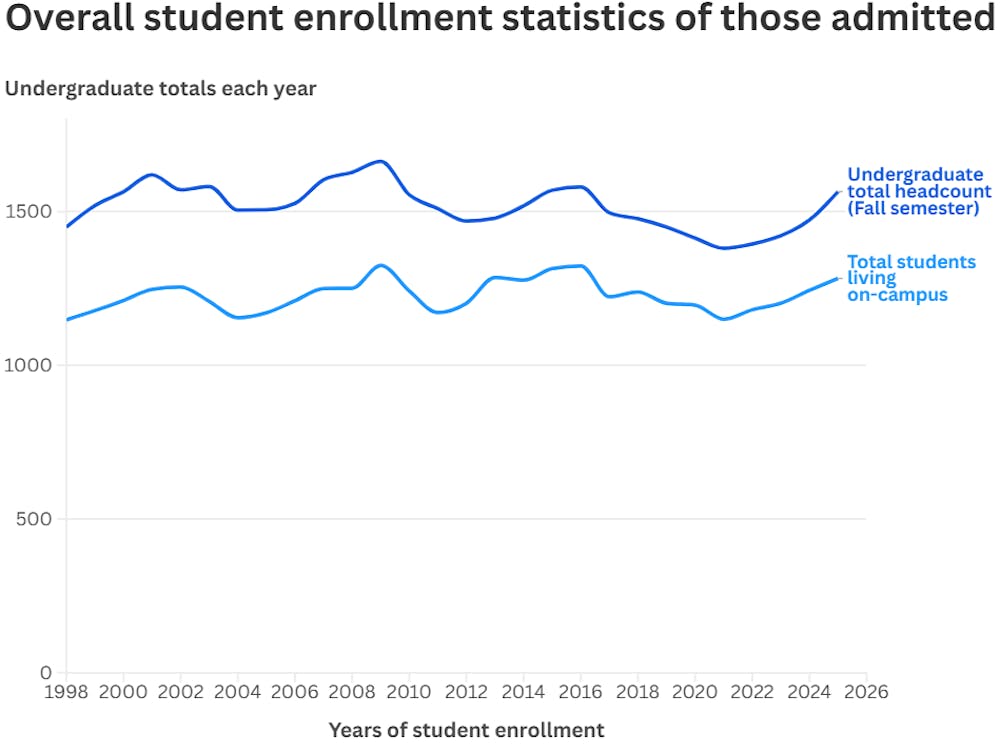
To better understand the College’s housing process, The Observer reviewed enrollment data from 1998 to 2025, focusing on total undergraduate enrollment each fall semester and the percentage of students living on campus. The data shows increases in both categories over the past five years.
The Observer also compiled data across the College’s five main residence halls — Le Mans Hall, Holy Cross Hall, McCandless Hall, Regina North and Regina South Halls — as well as housing designated for seniors, including Opus Hall and Lourdes Hall, which will open in fall 2026. The residence office is reallocating a significant amount of room for incoming freshmen in Le Mans Hall and McCandless Hall.
Increased Enrollment
According to the Saint Mary’s Fact Book, total enrollment has fluctuated over the past 30 years. As of 2025, the College’s undergraduate population reached 1,565 students, its highest level since 2016.
The Fact Book was accessible on the Saint Mary’s website when The Observer began its analysis. After The Observer contacted dean of enrollment management and marketing Sarah Gallagher Dvorak with a question referring to the Fact Book, the Fact Book was removed from the College’s website.
When asked about the removal, executive director of marketing and communications Charles Simpson said in a statement to The Observer that the College, “has been engaged in a multi-year plan to ensure we are removing outdated or archived content from our website that is not accessible to all readers.” The documents were previously available as PDFs. Simpson’s statement did not specify when the Fact Books would be restored to the website.
Total undergraduate enrollment has steadily increased since 2021, including a 5.8% increase in 2024 and a 6.2% increase in 2025. The freshman class of 2029 included 455 students in the fall of 2025, the largest freshman class since 2016. According to Dvorak, the College expects another large incoming class for the next academic year.
“Our enrollment looks strong for the Class of 2030. Our student enrollment has been growing the last four years,” Dvorak wrote in a statement to The Observer in mid-February. “Last year was a great year and we are running ahead of last year in accepts and deposits for the fall.”
The largest undergraduate student population Saint Mary’s hosted within the last 30 years was in 2009 with 1,664 students, 99 students more than in fall 2025. That year, the College also housed its greatest number of on-campus students, 1,325, which was 84.9% of the population.
The percentage of students living on campus has remained relatively consistent, ranging from 81% to 84% over the past 30 years. In fall 2025, 1,283 students lived on campus, 81.9% of the undergraduate population.
Housing Limitations
The Observer also compiled data on the total number of rooms and beds available for students living on campus. According to floor plans and housing data provided on the College’s website, Le Mans Hall, Holy Cross Hall, McCandless Hall and Regina North and Regina South Halls contain a combined 673 rooms with 1,295 beds. Freshmen, sophomores and juniors can only live in these five dorms and are required to live on campus unless granted commuter status.
Opus Hall and, beginning in fall 2026, Lourdes Hall are both designated for students with senior credit status or higher. These halls add a combined 68 rooms and 120 beds. Including these halls, the College will offer 741 rooms and 1,415 beds for the 2026-2027 academic year. Based on 2025 on-campus residency figures, only 43 beds would have remained unoccupied. If Lourdes Hall had been available in 2025, that number would have increased to 91.
Lourdes Hall will add 44 rooms for seniors and graduate students on its third and fourth floors. However, most of these rooms are singles, resulting in a net increase of just 48 beds for students who are not required to live on campus.
According to 2026-2027 room selection guidelines shared with students via email, the College will preallocate specific sections — and in some cases entire residence halls — to incoming freshmen. McCandless Hall will be fully designated for freshmen, while additional rooms in Holy Cross Hall and Regina North and South Halls will also be reserved. This marks a shift from previous practices. In past years, Le Mans Hall primarily housed upperclassmen, with only the fourth-floor annex hallway designated for freshmen in more recent years.
Director of residence life and community standards Juls White said freshmen housing was previously distributed across multiple residence halls rather than concentrated in specific buildings or sections.
Graduate students who lived on campus were previously housed on the second floor of Regina South Hall. For the 2026-2027 academic year, however, White said graduate students are encouraged to live in Lourdes but can select another location during their selection time.
Within Le Mans Hall, the College’s largest residence hall, the second, third and fourth floor annex hallways will be reserved for incoming freshmen. These sections comprise seven singles, 15 doubles, 13 triples and 21 quads, totaling 160 beds. McCandless Hall will also be designated for freshmen, removing 32 singles, 63 doubles and 32 triples — 127 rooms or 254 beds — from upperclassmen selection. White said the second and third floor annex hallways in Le Mans Hall were chosen to be preallocated for incoming freshmen due to an under-selection by upperclassmen due to room size.
In total, 183 rooms, or 414 beds, will be unavailable to rising sophomores, juniors and seniors. An unspecified number of additional rooms in Holy Cross and Regina North and Regina South Halls will also be reserved for freshmen.
The increase in preallocated housing for freshmen, combined with rising enrollment, reflects the College’s continued growth. However, these changes may place additional strain on housing availability for current students, particularly rising sophomores and juniors who are still required to live on campus.