Observer editorial calls Hesburgh to back up rhetoric on race with funding
April 23, 1969 | Timothy O’Meilia, Donald Holliday, David Breen | Researched by Jim Moster
In an editorial from April 23, 1969, Observer editor-in-chief Timothy J. O’Meilia (‘70) joined two staffers to call on Fr. Hesburgh to invest $500,000 into attracting Black students to Notre Dame. The writers cite Hesburgh’s position as chairman of the Civil Rights Commission and president of a Christian university to argue that the University had a responsibility to remedy racial injustice.At the time of the editorials publication, and “in the 17th year of Father Hesburgh’s presidency,” the writers note, there were 70 Black students and 7,700 white students enrolled at the University. The University employed two Black professors, zero Black administrators and zero Black admissions counselors. In addition, Notre Dame lacked an Africana Studies program. After detailing these issues, the students acknowledge Hesburgh’s calls to “[change] the minds and hearts of people” on the issue of race. However, they say that real change starts with “changing the institutions and policies that are regulating those minds and hearts.” But Hesburgh had not been successful in changing such institutions and policies, the writers argue. “At Notre Dame,” they contend, “[Hesburgh] has had a major role in what little progress has been made.” The authors advise the Hesburgh administration to invest $500,000 into attracting Black students to Notre Dame. This includes $100,000 for “a Black studies program with a Black director,” four-year scholarships for 35 Black students and $10,000 for recruiting other people of color.The editorial concludes by addressing “the skeptic” who will undoubtedly ask “where will all the money come from?” At the time of the editorial’s publication, the University had already applied for a grant from the Ford Foundation to address racial inequality. If the grant was denied, the writers said they had faith Hesburgh could acquire the money through other channels if sufficiently motivated.The writers suspect that an investment of that size could’ve caused “a havoc” amongst faculty and students. In that case, they wrote, it would have been “a havoc ... that is long overdue.”Black Notre Dame and Saint Mary’s students protest racial inequality on campus
March 10, 1971 | Milt Jones | Researched by Sarah Kikel
In the cover story from March 10, 1971, The Observer covered Black student protests at Saint Mary’s and Notre Dame’s campuses. The previous day, Susan Jackson, the president of the Association of Black Collegiate Women (ABCW), burned a letter from then-Saint Mary’s President Sister Alma Peter that called for the instigation of a task force to “look into problems of Black students” at the College.Labeling the message an “insult,” Jackson burned the letter in protest of its careless errors — the note was “a rough mimeographed copy with typing and spelling corrections made on the sheet.” She also noted its lack of date, address and signature. After the letter burning, students read poetry, excerpts of George Jackson’s letters and part of the 1968 book “Black Rage.”Jackson then pleaded for total support from the Saint Mary’s College student body. “What affects us, affects you since we are all students,” she said, “and what is happening to us could happen to you.” The protest was reportedly covered by radio, television and additional press services.The story also covers a series of March 6 protests on Notre Dame’s campus, wherein the Afro-American Society picketed in front of the ACC (now known as the Joyce Center) and the Stepan Center, protesting the University’s treatment of Black students. Students marched with signs printed with “Is Hesburgh A Moral Man?” outside of the ACC while the Indiana Sectional Tournaments were occurring, drawing considerable attention. The protest continued at the Stepan Center, where the Collegiate Jazz Festival was taking place. Protesters marched through the rain and low temperatures, and were covered by WSBT-TV cameras. The issues the group was protesting included a scarcity of Black faculty and staff members, minimal leadership in civil rights, the administration’s disregard for fulfilling commitments made to Black students, the absence of a Black studies program and the fact that Hesburgh did not consult with Notre Dame students during his work with the U.S. Civil Rights Commission.Many of these points are identical to the demands listed in the aforementioned Observer editorial — published two years prior — and still had not been addressed by the Hesburgh administration. The protestors picketed the University’s passivity: “No more Delays,” read one sign in front of the ACC.Guest columnist criticizes Hesburgh’s commitment to Black students and faculty
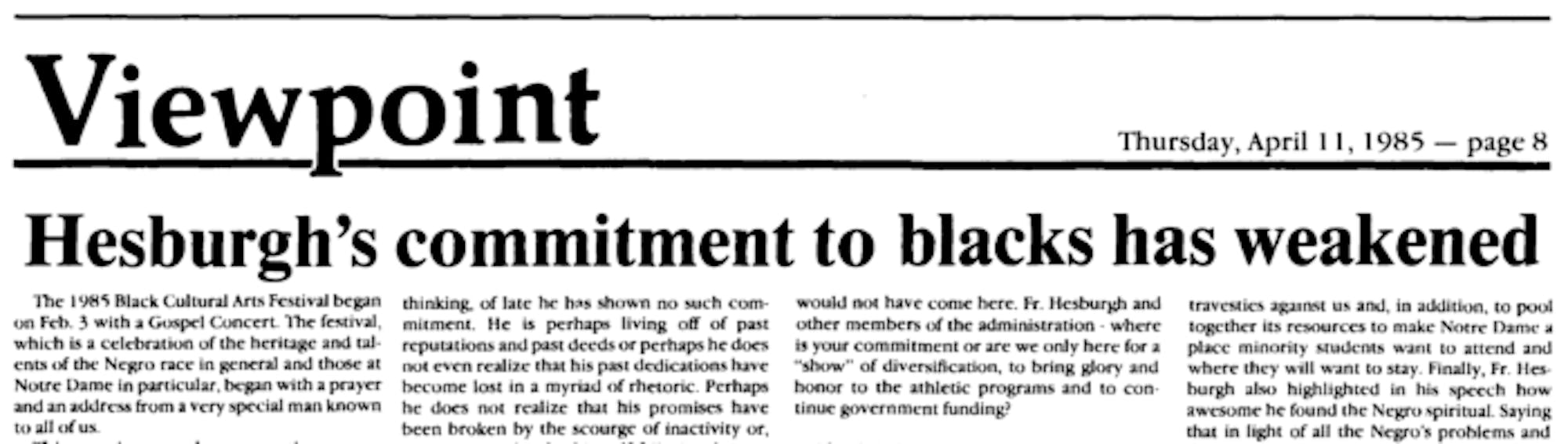
April 11, 1985 | Martin Rodgers | Researched by Adriana Perez
Another Viewpoint column finds fault with Fr. Hesburgh’s commitment to the Black community in the final years of his University leadership. Specifically, the column criticizes Hesburgh’s opening remarks during the 1985 Black Cultural Arts Festival earlier that year, and the hypocrisy in the priest’s words in light of the University’s lack of commitment towards diversity.Guest columnist Martin Rodgers (‘88) initially acknowledges Fr. Hesburgh’s “impeccable” reputation, calling him “revered among nations” and “regarded as more a myth or a legend than a man.”