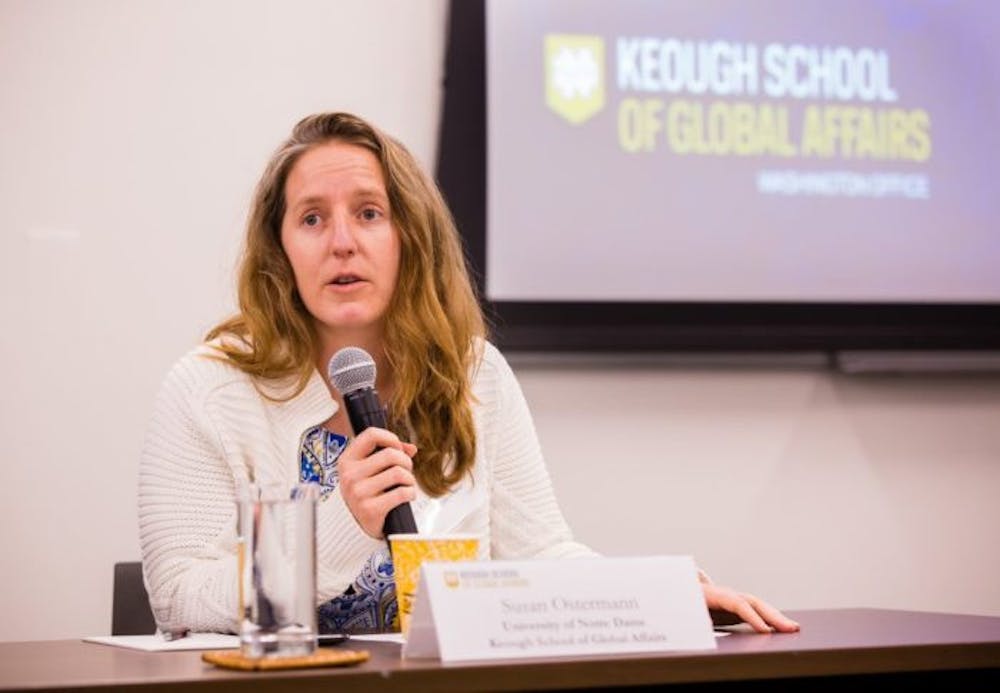
Associate professor of global affairs Susan Ostermann will lead the Keough School of Global Affairs’ Liu Institute of Asia and Asian Studies as director beginning July 1, an appointment sparking controversy due to her public advocacy for abortion rights.
She will succeed founding director Michel Hockx, who led the institute since 2016. Keough School of Global Affairs dean Mary Gallagher appointed Ostermann with approval from University provost John McGreevy.
In a column published in First Things, history professor emeritus Fr. Wilson Miscamble said her appointment “explicitly repudiated” the University’s statement in its strategic plan to “ensure that our Catholic character informs all our endeavors.”
In 2022, Ostermann co-authored an op-ed with Tamara Kay in the Chicago Tribune titled “Lies about abortion have dictated health policy.” The article prompted a response by University President Fr. John Jenkins.
“Tamara Kay and Susan Ostermann are, of course, free to express their opinions on our campus or in any public forum. Because they choose to identify themselves as Notre Dame faculty members, I write to state unequivocally that their essay does not reflect the views and values of the University of Notre Dame in its tone, arguments or assertions,” he wrote in a letter to the editor.
She has co-authored at least ten other articles supporting abortion rights. In a statement to The Observer, Ostermann responded to the renewed criticism generated by her appointment.
“As I step into this role, my primary focus is to serve as a steward for the Liu Institute mission in the context of the University’s larger mission, and a facilitator for our world-class faculty. I am fully committed to maintaining an environment of academic freedom where a plurality of voices can flourish. I have long worked with scholars who hold diverse views on a multitude of issues, and I welcome the opportunity to continue doing so. While I hold my own convictions on complex social and legal issues, I want to be clear: my role as Liu Director is to support the diverse research of our scholars and students, not to advance a personal political agenda,” she wrote.
“This commitment to academic inquiry and mutual respect is deeply rooted in my appreciation for Notre Dame’s identity as a global Catholic research university. I am inspired by the University’s focus on Integral Human Development, which calls upon all of us to promote the dignity and flourishing of every person. I respect Notre Dame's institutional position on the sanctity of life at every stage and believe that by fostering a collaborative space that values rigorous inquiry, we contribute in important ways to global development and human well-being. I look forward to working closely with my colleagues to ensure that the Liu Institute remains a place where truth is pursued with both excellence and integrity,” she wrote.
Miscamble wrote in his column that several faculty members appealed to the administration to rescind Ostermann’s appointment. University President Fr. Robert Dowd, according to Miscamble, “seems reluctant to overrule the provost and dean.”
The emeritus professor said he has now brought the issue before the Board of Fellows to request they intervene.
“I have contacted the twelve fellows of the University directly and asked them to exercise their fiduciary responsibility to uphold the Catholic character of the university. I pray they do so,” Miscamble wrote in a statement to The Observer.
The Board of Fellows represents the University as its highest executive body. According to its website, the board adopts University bylaws, elects members to the Board of Trustees and ensures “the University maintains its essential character as a Catholic institution of higher learning.” The body comprises six clerics of the Congregation of Holy Cross and six lay persons.
The University stood by its decision to appoint Ostermann in a statement to The Observer.
“Professor Susan Ostermann is a highly regarded political scientist and legal scholar whose insightful research on regulatory compliance — from forestry conservation in India and Nepal to NSF-funded disaster mitigation in the U.S. territories — demonstrates the rigorous, interdisciplinary expertise required to lead the Liu Institute. A deeply committed educator who has led study abroad programs in Mumbai, she is well prepared to expand the Institute’s global partnerships and create impactful research opportunities that advance our dedication to serving as the preeminent global Catholic research institution. Those who serve in leadership positions at Notre Dame do so with the clear understanding that their decision-making as leaders must be guided by and consistent with the University’s Catholic mission. Notre Dame’s commitment to upholding the inherent dignity of the human person and the sanctity of life at every stage is unwavering,” a spokesperson for the University wrote.
The Liu Institute’s website describes its mission as connecting the Notre Dame community to Asia through teaching, social engagement and research about Asia and its diaspora. The Institute also hosts a supplementary major and minor in Asian studies.
The institute offers signature events for the Notre Dame community to learn and engage with Asia, including the Justice and Asia Distinguished Lecture, Asia Leadership Forum and the Asian American Distinguished Speaker Series.
In a statement to The Observer, Mary Gallagher, the Marilyn Keough Dean of the Keough School, shared her support for Ostermann.
“Susan Ostermann is a renowned scholar of South Asian politics and the politics of regulatory compliance. Her work on forestry conservation in Nepal and India was a groundbreaking contribution to the perennial problem of how states with weak capacity can enforce environmental laws and regulations,” Gallagher wrote.
She elaborated on the incoming director’s past research, detailing how Ostermann recently received a National Science Foundation grant to extend her work to Hawaii, Puerto Rico and Alaska. Her research examines how “governments can encourage voluntary compliance with building regulations to lower the risk of natural disasters,” Gallagher wrote.
She noted Ostermann is a “deeply committed teacher” and teaches study abroad programs in Mumbai, India.
She also touched on her excitement for the institute under Ostermann. She said Ostermann can help grow the institute’s interdisciplinary collaboration and strengthen its partnerships in Asia, fostering more opportunities for students to engage with the region.
“Susan understands both the academic mission and the broader role the Liu Institute plays within the Keough School and the University, and we’re confident her leadership will help the institute continue to grow in a thoughtful and impactful way,” Gallagher wrote.
Ostermann joined Notre Dame in 2017, one of the first professors hired to be part of the Keough School. She has been an active faculty fellow for the Liu Institute since then, growing it’s South Asia group and launching the University’s summer study abroad program in India in 2024.
She is a graduate of Pomona College and earned a J.D. from Stanford Law School and a Ph.D. in political science from UC Berkeley. She served as a consultant for Population Council, Freedom House and the Bertelsmann Transformation Index. The Keough School’s release cites her expertise as a witness to Nepali politics and the Maoist conflict.
Ostermann shared what taking over the institute means to her in an email statement to The Observer sent prior to her response to the criticism.
“Taking over as director of the Liu Institute means an opportunity to give back, to serve. During my 8.5 years at Notre Dame, I’ve benefited tremendously from my relationships with the Liu, Kellogg and Pulte Institutes, and much of that owes to the good leadership they’ve been under. The opportunity to be a good steward myself, so that others benefit, seems fitting,” Ostermann wrote.
She also discussed her plans for the institute.
“At this point, I have a few concrete plans, mostly ideas, she wrote. “The Liu Institute recently underwent an external review, one that I contributed to, and it has a new strategic plan. It will be my job to carry out that strategic plan. Beyond that, however, I plan to consult with the Liu Institute community, its fellows, staff and students, to see what people most need and are most excited about moving forward.”
Henry Jagodzinski contributed reporting to this story.
Editor’s note: This story has been updated to provide a more specific count of the articles Ostermann has written supporting abortion rights.