
UFOs sighted across the country and at Notre Dame
October 17, 1973 | Kit Baron | Researched by Chris Russo
During the COVID-19 pandemic, there was an uptick in UFO sightings. A similar barrage of UFOs were sighted across the country in 1973, with one spotted in the South Bend region. The Observer’s Kit Baron covered the local sightings, but the Oct. 17, 1973 edition also included reports from the United Press International (UPI).The national sightings had varying degrees of consistency. Still, Dr. Allemn Hynek of Northwestern University did not question their presence. “Where they are coming from and why they were here is a matter of conjecture,” Hynek said. “But the fact that they were here on this planet is beyond a reasonable doubt.”Many of the UFO sightings were coupled with reports of distorted radio signals, suspicious lights and strange creatures.And on Notre Dame’s campus, three Breen-Phillips residents reportedly caught a glimpse of an “exceptionally fast-moving and brilliant “star” on the evening of Oct. 16, 1973. They said that the object traveled in a circular motion while shifting its light intensity. The students’ claim was corroborated by other reports across the region, including in LaGrange, Noble, Steuben and DeKalb Counties, each description also noting similar patterns of movement and color.Local police officer Don Hayden confirmed that most reports described “it” to be white and yellow, remaining “stationary for a short period” and then changing location “with great speed.”The Observer continued to release UPI reports of UFOs sighted across the country. Subsequent reports had been filed by police and civilians. The Georgia State Patrol dispelled rumors of contact with extraterrestrials after citing that a glowing green cylinder was merely a commonly-used automobile trouble flare. Despite quelling rumors, reports of UFO sightings continued to pour in across the country. The human fascination with life on other planets has endured into this century, but we are still waiting for another UFO spotting in the tri-campus.Nessie visits Notre Dame
Nov. 6, 1970 | Bob Schueler | Researched by Spencer Kelly
The first unusual encounter at Loch Ness dates back to 565 C.E. when Saint Columba reportedly scared off “a large, strange animal” that was swimming towards a man in the titular Scottish lake. In the 1,400 years since, the mystery of the Loch Ness Monster, aka “Nessie,” has only grown.In November of 1970, the legend of Nessie came to campus as the Notre Dame Memorial Library — now known as the Hesburgh Library — held an exhibit titled “Scotland’s ‘Raire Beastie,’ the Loch Ness Monster.”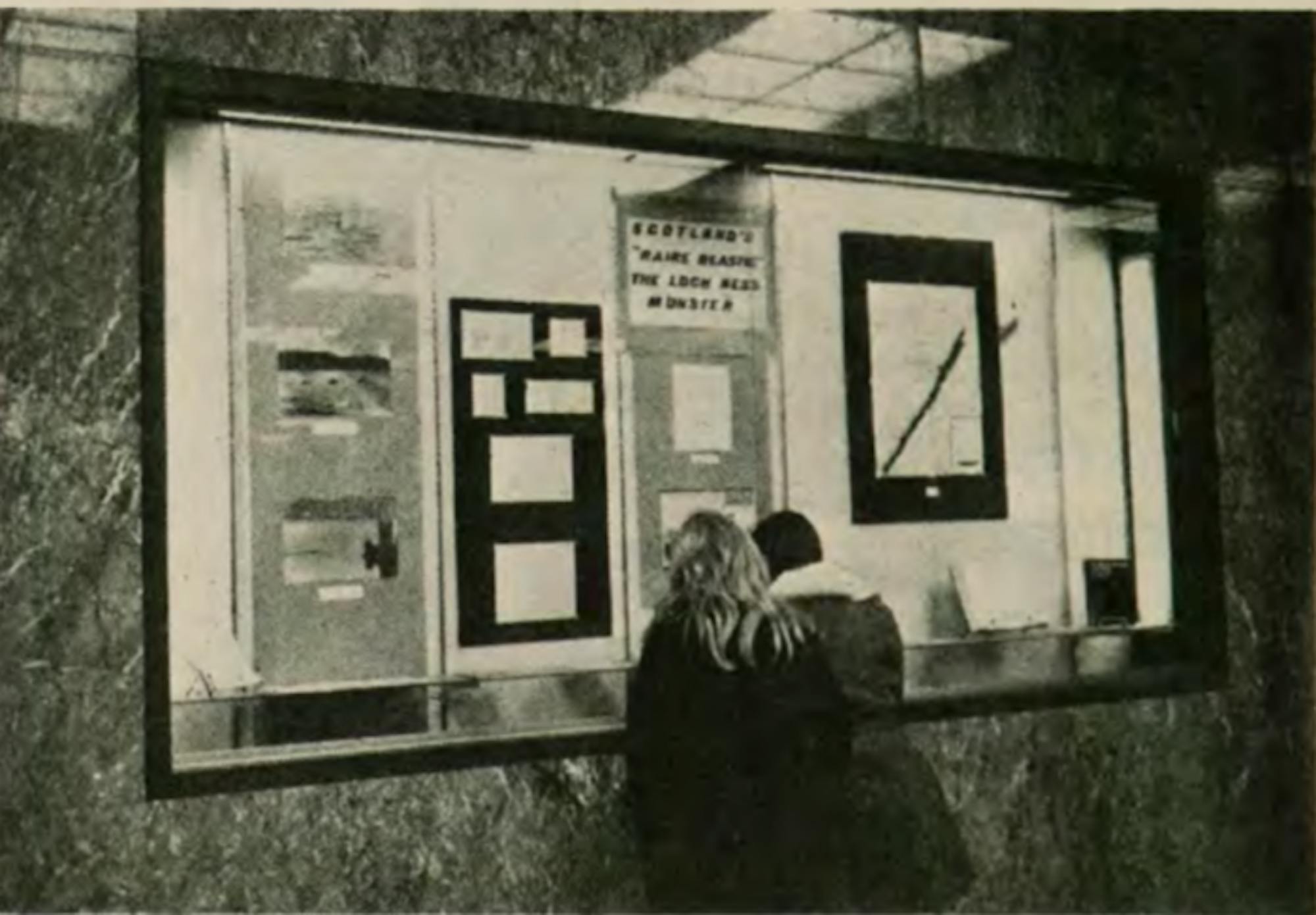
The real Dracula in Washington Hall
March 11, 1975 | Valerie Zurblis | Researched by Christina Cefalu
Professor Radu Floresco, a visiting faculty member from Boston College’s department of history, revealed the gory origins of the Count Dracula legend to a packed Washington Hall on the evening of March 10, 1975. Count Dracula, usually known as the bloodthirsty vampire who terrorized the citizens of Transylvania, was popularized in Bram Stoker’s 1987 novel “Dracula.”As a Transylvanian native, however, Floresco only knew Count Dracula as the “George Washington” of Romania, who defended the country against a Turkish invasion in the 15th century. Fascinated by the stark contrast between Stoker’s “Dracula” and his own knowledge of the Romanian historical figure, Floresco began to research the origins of the novel’s tale. Interestingly, the name Dracula evolved from the Romanian word “dracul,” which means “son of the Devil.” In other findings, Floresco theorized Stoker’s fictional character drew inspiration from Vlad Tepes, otherwise known as Vlad the Impaler, who was a murderous medieval ruler. During his six-year reign, he gruesomely killed 100,000 of the then-500,000 people he ruled.


