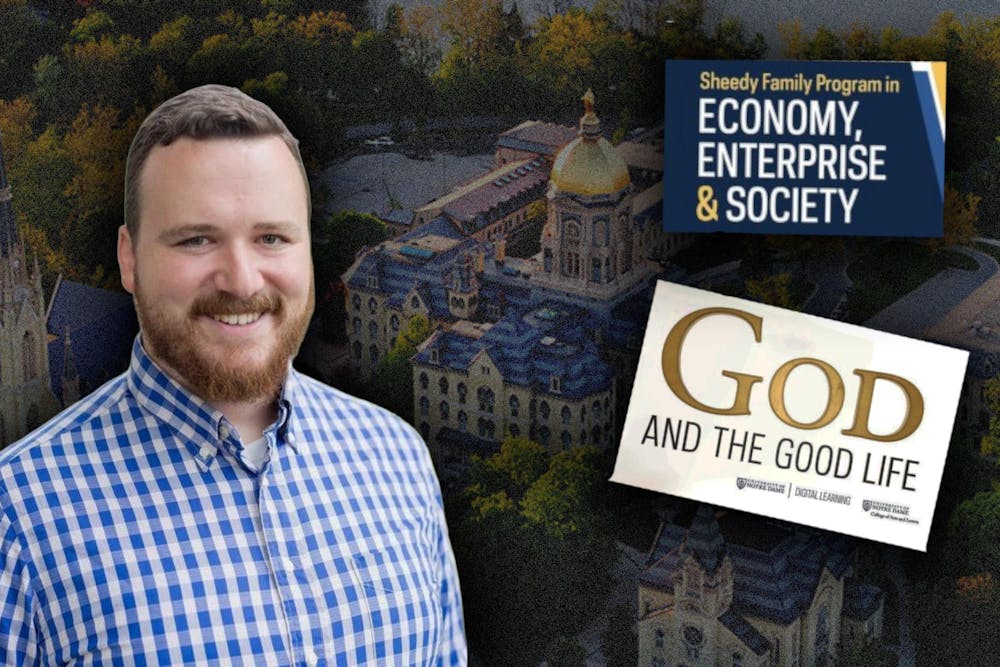
There is a certain irony in the fact that one of the most beloved professors at the University of Notre Dame has chosen to leave. Not because he failed his students, but because he succeeded at something the institution does not know how to value. I know, because I was one of those students.
Paul Blaschko taught the most popular philosophy course on campus and, with Chris Hedlin, built the Sheedy Family Program in Economy, Enterprise, and Society from the ground up. In doing this, he did something rare: he took undergraduate students seriously. He forced us to interrogate the assumptions most of us carry around unexamined, about work, success, status and what a good life actually looks like. He assigned Bernard Suits’ “The Grasshopper,” a book in which the protagonist defends a life of play against a world that insists on the supremacy of work. He asked us why a banker is considered more valuable than a teacher, why a surgeon earns more respect than a parent, if faith can be maintained under stress and ambition and whether the metrics society uses to assign worth are the right ones at all. These are not soft questions. They are among the hardest questions philosophy has ever taken up, and he asked them in a room full of 20-year-olds who were about to make consequential decisions about their lives. This is real work, real dialogue that fosters the “formation of an authentic human community graced by the Spirit of Christ” as written in the University’s Mission Statement. Paul brought this formation to roughly 1,000 students a year, spending nearly all of his time teaching and meeting with us.
And for this, the institution gave him less each year. His promotion case was denied. The Sheedy Program, which he built and grew to more than triple its original size, is being handed to a new director. God and the Good Life, the philosophy course he co-designed that enrolled between 900 and 1,100 students per year, will be cut to 450 seats starting in 2027. And so, after 13 years, Paul has declined reappointment and is moving on. He described Notre Dame’s offer as “gracious.” He cited his own discernment, new projects and a commitment to ongoing formation. He is not burning bridges. He is simply walking through a door that the institution left unguarded by failing to deserve him. Why did they let him leave?
According to dean Kenneth Scheve, the answer is simple: This was a standard review. The program was found to be excellent, and the College simply identified room for expansion that required a social scientist as director. The associate director role, the Dean dean noted in a statement to The Observer, was “verbally offered” to Paul, who declined.
That framing deserves scrutiny, because the people who were actually in the room tell a different story.
Associate dean Mary Flannery, speaking to Sheedy students at an information session this past week, said she “can’t tell you how really not well this all came down.” She described the rollout as “ham-fisted” and acknowledged that the dean “got going fast” and that she “tried to keep up.” She admitted that the dean “maybe didn’t appreciate that this was a little bit of a different kind of program” and “maybe didn’t quite understand the role of the director as much as in other cases.” These are not the words of an institution that conducted a careful, principled review. They are the words of an institution that moved too fast, got caught, and is now managing the fallout.
The “verbal offer” of the associate director role is the administration’s most useful piece of spin, and it needs to be read in context. The offer, as presented, was a reduction in title, a reduction in authority, and by all accounts, no reduction in workload. The person who built the program would have been asked to do more while being given less. Flannery herself put it plainly at the information session: “Once it seemed like he was going to put in someone else, then it just seemed like it wasn’t something that Paul wanted to do.” A verbal offer extended after every other door has closed is not an open negotiation. It is a decision dressed as one.
One of my fellow students at the information session put it plainly: “What it feels like now, getting a little more clarity on it, is that this new dean, up from one year, is commandeering this super successful program that, by all accounts, the students love it, it’s getting funding from the federal government and it’s most of our favorite parts about Notre Dame. And this dean is taking it, swapping it out for something else, and trying to piggyback off that success and change the direction from what it truly is, which is questioning the status quo, which is, quite frankly, what is happening to Paul right now. So the whole thing feels kind of ironic.” Flannery pushed back on the word “commandeer,” insisting the intent was to “supplement, not commandeer.” But she did not dispute the underlying frustration, saying “it’s a transition that could have gone a lot better.”
The student sentiment in that room was not isolated. Within 36 hours of the news breaking, over 130 students signed a petition in support of Paul. It is worth pausing on that number. Notre Dame enrolls roughly 9,000 undergraduates. One-hundred-and-thirty of us mobilized in a day-and-a-half, without coordination from any administrator, without being asked, because something that mattered to us was being taken away without our input. One is left to wonder how many signatures, if any, Dean dean Scheve’s plan could attract from the people it most directly affects. The question of who a university ultimately exists to serve should not be a difficult one. At Notre Dame, the answer is written into the mission statement. One-hundred-and-thirty of us understood it instinctively.
The charge that led to the promotion denial, as best as one can tell, is that Paul’s work does not conform to Notre Dame’s implicit academic ideal. He was not publishing enough in elite journals. He was not accumulating the right credentials. He was not playing the game. This would be unremarkable bureaucratic pettiness elsewhere, but coming from the philosophy department and Arts and Letters administration of Notre Dame, it is substandard and shocking. It is a betrayal of the discipline of philosophy itself and the liberal arts more broadly.
Before entertaining that charge, consider the record. The Sheedy Program more than tripled in size over three years and serves over 100 students annually. The U.S. Department of Education awarded nearly $4 million to Paul in a grant designed to bring his critical-thinking pedagogy to college classrooms across the country. That project is expected to reach more than 100,000 students within the grant’s lifetime alone. The Wall Street Journal cited the Sheedy Program as a national model for cross-campus collaboration and student career development. At the program’s launch, the then-dean of the College of Arts and Letters called helping students understand “not just what they want to do, but who they want to be” a hallmark of a Notre Dame liberal arts education, and she described the Sheedy Program as central to that purpose. And Paul has not one but two major books to his name, one published by Penguin Press and a second recently finalized with Princeton University Press. By every external measure available, this was not a professor who failed to produce. This was a professor whose work reached more people, in more meaningful ways, than most of his critics’ combined.
So what exactly was the problem?
Philosophy, more than any other field, has always understood that the most important questions are the ones hardest to quantify. Socrates never published a single paper. He walked around Athens asking uncomfortable questions and making powerful people feel stupid, and the city eventually put him on trial for it. The charge was corrupting the youth. The real offense was making the establishment look in the mirror. We have spent two-and-a-half millennia celebrating him for it. Notre Dame’s philosophy department would have failed to promote him.
The problem Paul ran into has a name, and fittingly, it is one he taught: status anxiety. Alain de Botton defines it as the corrosive need to prove one’s worth through signals others will recognize and validate. De Botton’s argument is that modern societies have replaced aristocratic hierarchies with meritocratic ones, but the anxiety did not go away. It merely found new clothes. In academia, those clothes are publications, citations, journal rankings and grant funding. A professor’s colleagues do not respect them for doing good work. They respect them for how their work is recognized, which is a different thing entirely. Scholarship in the liberal arts, even at Notre Dame, can become not an end in itself but a points system for institutional standing.
The deeper dysfunction is one that sociologist Pierre Bourdieu diagnosed decades ago. In “Homo Academicus,” he argued that universities generate their own internal currency, what he called academic capital, and that scholars spend their careers accumulating it through the right publications, the right conferences, the right institutional affiliations. The actual value of the work to anyone outside the field is largely irrelevant. What matters is how it is valued inside it. By that logic, a professor who fills lecture halls with students whose lives are genuinely changed by the material is doing something that simply does not compute. There is no citation for a student who rethinks their career. There is no promotion point for a person who learns to ask better questions about their own life. I know, because I was that student. Paul’s class changed how I think about my own. That does not appear anywhere in his promotion file.
The Observer noted that despite his research falling in line with Sheedy’s values, Clark has explicitly said that his role is to “bring in some social science perspectives.” He has also said, in the same breath, that breath, “Sheedy’s place on campus is less research oriented and more pedagogical.” That detail is worth sitting with. The administration’s own new director acknowledges that his research aligns with what the program already does, and yet the title has still been moved from a teaching-track professor to a tenure-track one. The administration has therefore replaced a teaching professor, whose entire expertise was pedagogical, with a research-track professor to run a program that the research-track professor himself describes as not research-oriented. The institutional logic is not hidden. It is self-contradicting and on the record. Flannery acknowledged as much in The Observer, noting that the shift from the director being on teaching track to tenure track is a secondary effect. Secondary to what, exactly, is left unsaid. But the effect is named and confirmed by the administration itself.
This is what makes the situation at Notre Dame so counterproductive. The University has long prided itself on its commitment to undergraduate education. It is one of the few research universities where that claim has had real institutional weight. And here is one of the few professors on campus doing exactly that, asking exactly the questions the University says it cares about, with a $4 million federal grant, a Wall Street Journal mention, two book contracts and a program that tripled in size to show for it. The institution’s answer was to deny his promotion, replace him as director of what he built and cut his most important course by more than half.
There is one more detail that has gone largely unremarked. Dean Scheve has been in his role since July 1, 2025. He has been at Notre Dame for less than a year. In that time, he identified, reviewed and restructured one of the College’s most celebrated programs, replaced its founding director and did so in a process the administration itself has since acknowledged was not ready to be announced so abruptly. The Sheedy family, whose name and gift the program carries, was not involved in the decision. They found out from students.
When one of us asked directly at the information session why there was no place left for Paul in the program he built, the answer revealed two things simultaneously. First, that the decision had already been made before any role for Paul had been considered: once a new director was chosen, there simply was not a place left for the person who built it. Second, and perhaps more troubling, that the rationale behind the decision was strikingly thin. The stated goal was to expand the program toward political science and social science. When pressed on what that would look like, the administration’s own representative admitted she had presented Paul with “a box with a question mark in it,” telling him only that the new direction involved social science, with no concrete plan for how removing the program’s founder and director would advance that goal. Nothing had been decided. No curriculum had been designed. No vision had been articulated. The Sheedy Program’s founder was displaced in service of an idea that, by the administration’s own admission, existed only as a question mark. That is not a description of a standard review finding room for expansion. That is a description of a decision made first, with justifications still being assembled.
Paul, for his part, has chosen to handle his public departure with grace. He spoke to us at the information session about his love for the community, his hope that the program would continue to be something genuinely rare in higher education and his confidence that what he and his colleagues built together still exists going forward. Whatever the full complexity of what happened behind closed doors, what he has chosen to say publicly reflects the values he spent 13 years teaching.
He is, in other words, living exactly what he taught us. He is the Grasshopper in a faculty meeting full of Ants, committed to something real in a room full of people optimizing for something measurable. A program dedicated to interrogating status anxiety and the tyranny of conventional notions of success has lost its founder to an institution suffering from exactly that condition. The irony was not lost on those of us in that room. It was not lost on Flannery either, who said, “You’re not the only one who finds it ironic in this particular program that this is the way it’s going.”
We, his students, know what we got. The Sheedy Program will carry on his curiosity, his accompaniment and his purpose-driven discernment. Whether Notre Dame knows what it is letting walk out the door is a different question.
But perhaps the more important question is this: when a university systematically sidelines the professor most visibly living out its stated mission, what does that tell us about which mission it is actually pursuing? The Congregation of Holy Cross, from whose tradition Notre Dame draws its identity, was founded on a principle Blessed Basil Moreau considered non-negotiable: “We shall always place education side by side with instruction; the mind will not be cultivated at the expense of the heart.” It is a principle that Notre Dame regularly asks its applicants to engage with in writing before they are admitted. Paul Blaschko spent 13 years refusing to make that trade. We spent those years learning from him that the trade should never be made. The institution’s response to that refusal is now a matter of public record. The question of what it reveals about Notre Dame’s true hierarchy of values is one the University would do well to sit with, long after Paul has moved on to whatever comes next.
Bruce Alvarez
Class of 2028
April 30
The views expressed in this letter to the editor are those of the author and not necessarily those of The Observer. This letter to the editor has been co-signed by Marcello Santana-Aubert, Isabella Uribe, Brian George and Matt O'Donnell.