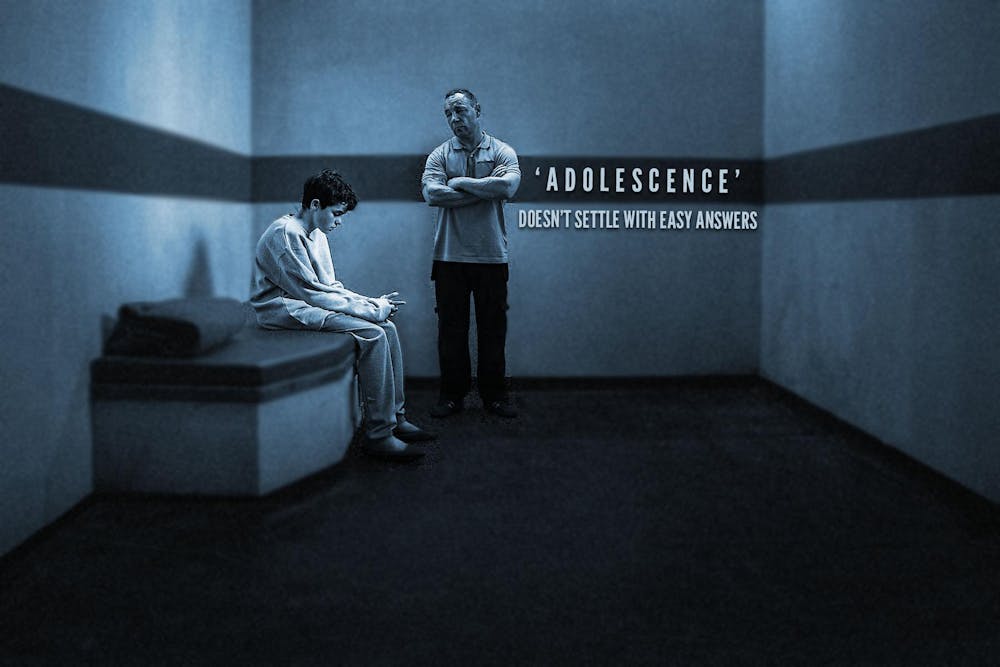
The Netflix limited series “Adolescence” has reached critical acclaim since its initial release. In four episodes, each done in a single camera shot, we learn about Jamie, a 13-year-old boy arrested for the murder of another 13-year-old, Katie, as well as the aftermath of his arrest. When I first heard of the series, I thought it would be a typical mystery/thriller where Jamie swears he didn’t do it, and we spend the rest of the series figuring out who did. While he does spend most of the first episode denying his crime, we see the damning camera footage at the end and realize this isn’t a story about who killed Katie, but why Jamie killed Katie — a question that lingers in viewers’ heads over the next three episodes. In episode 2, a few days after the arrest, the detectives interview students at Jamie’s school hoping to understand why he did what he did. In episode 3, set several months after the arrest, we witness the final session Jamie has with child psychologist Briony Ariston, and in the final episode set about a year after the arrest, we see how Jamie’s father, mother and sister have been coping since the arrest and their reaction to Jamie deciding to plead guilty at his trial.
Despite the series unpacking the different elements of Jamie’s psychology to understand his motive, there is no concrete answer that can be found by the end of the series. In episodes 2 and 3, we learn about Jamie’s interactions with social media, the manosphere and girls, particularly Katie, and in episode 4, we see glimpses into how his parents might have impacted his crime, but neither of these factors are treated as the sole reason for Jamie’s crime.
Although the series centers on Jamie, it also shows us whose voices are unheard or ignored in cases like Jamie’s: women’s. In episode 2, detective sergeant Misha Frank comments on how obsessed everyone is with figuring out Jamie’s motives and how everyone has already seemed to forget Katie. Her colleague, detective inspector Luke Bascombe, barely acknowledges Misha’s observation before proceeding with his investigation. Additionally, Katie’s best friend Jade has a violent outburst in which she attacks Jamie’s friend, Ryan, but this isn’t an incident on which the detectives follow up. Jade expresses her fears to her tutor about having no one there for her now that Katie’s gone, and despite her tutor’s reassurance, in the end, she is distraught and all alone.
In episode 3, Briony holds in all the anger, fear and despair she has for Jamie despite his numerous outbursts, only breaking down when she knows she is alone. This is similar to Jamie’s mother Manda, who spends the majority of episode 4 holding herself together in the midst of her husband’s fits of rage before finally crying by herself.
The series challenges the idea of women being the “emotional” gender as we see Jamie, his father (Eddie) and even Bascombe have fits of rage and frustration. The female characters in the show, however, never have these outbursts of fury. They never yell or scream or violently tear down a shed, as Jamie says Eddie did.
“Adolescence” is a disturbing show, and it isn’t based on a true story, but rather multiple true stories of young boys turning to violent crimes in a strange and disturbing modern trend. Most people came out of this show talking about the rise of social media with young teenagers and specifically alpha male podcasters, but there is no clear cause for Jamie’s crime. It’s suggested that the cause of Jamie’s actions was an amalgamation of his upbringing, his social media use and his own decisions. It also notes a difference between Jamie and Katie. We learn Katie insulted Jamie, a form of bullying, but Katie herself was also a victim of bullying, having her private and intimate photos leaked to her classmates, but she didn’t kill anyone because of it, unlike Jamie. This is a question reflected in our own world. What is happening in young men’s upbringing to lead them violence? “Adolescence” doesn't answer this question, but it initiates a discussion of the factors at play with troubled teenagers like Jamie.