
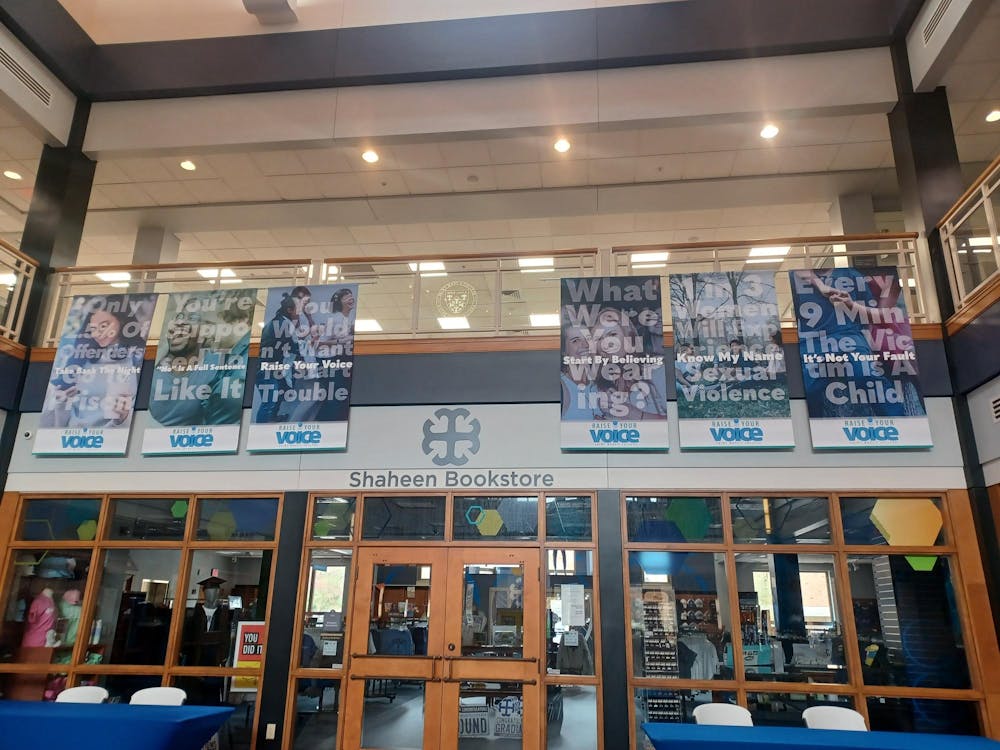
On Monday from 1 p.m. to 7:30 p.m., a variety of workshops and an exhibit were shown throughout Saint Mary’s for the annual Raise Your Voice Symposium. The majority of workshops were held at Rice Commons in the Student Center, while the exhibit was displayed virtually beginning this week.
The four different workshops hosted during the day focused on survivors finding support and resources in various ways, along with the importance of allyship on the issue. Topics ranged from medical-based advocacy to raising awareness on the marginalization of communities.
“Supporting Survivors in the ER”
From 1 p.m. to 1:50 p.m., the workshop “Supporting Survivors in the ER: Best Practices for Hospital-Based Advocacy” was presented by Payton Moore, the previous hospital response program supervisor at Women Helping Women of Southwest Ohio. The non-profit organization aims to help survivors through a variety of support programs and resources to prevent gender-based violence.
Liz Baumann, Title IX coordinator at Saint Mary’s, said she hoped that every attendee was able to walk away with valuable and tangible information from the workshop outside of clinical settings.
“There’s also always things that you can take away, no matter what your role is in this. We all know survivors … We're all going to accompany people through terrible moments and have people that lean on us for support. So having better ideas to better equip us in those moments I think is really important,” Baumann said.
“Callisto Technology”
The workshop “Callisto: Technology That Safely Connects Campus Survivors of Serial Perpetrators” was hosted by Tracy DeTomasi, the CEO of Callisto, from 2 p.m. to 2:50 p.m. Callisto, a national tech-for-good non-profit, offers services to assist survivors of sexual assault in identifying their perpetrators through a common network in order to safely seek justice and support.
Citing her previous work as a licensed clinical social worker and a therapist for adolescent sex offenders, she discussed the flaws in how current systems address perpetrators and how repeat offenders are often overlooked.
“90% of sexual assault on college campuses are committed by repeat perpetrators … When I worked with adolescent sex offenders, I was working with mainly 15 to 22-year-olds and all of them had at least six victims by then. If perpetrators are held accountable after the second assault versus going through all six, we would reduce sexual assault on college campuses by 59%,” DeTomasi explained.
She walked attendees through the simple process of creating an account, supplying demographic information and then being taken to the incident log and matching system, which user fill out to reach a legal options counselor if their perpetrator is matched. Additionally, she mentioned the tracking method used to identify perpetrators and their movements once matched.
“We do have coast to coast matches too, whereas one survivor lives on the west coast and one survivor lives on the east coast and they still match. We know survivors move and … perpetrators move,” DeTomasi said.
A Q&A session was held at the end of the workshop, where students were able to ask questions about college institutions’ relationships with the app and what the expansion of Callisto may look like in the future.
“A Marathon, Not a Sprint”
From 3 p.m. to 3:50 p.m., the third workshop “A Marathon, Not a Sprint: The Power and Balance of Combining Rest and Action” was led by Connie Adams ‘08 on inviting rest into one’s life as a crucial aspect of mental and physical health. The presentation reviewed the complicated relationship Western society has with rest, arguing it related to white supremacy.
The lecture aimed to be as interactive as possible, including a poll on whether rest is a luxury and how individuals have internalized capitalism. Additionally, she asked attendees to take steps towards encouraging rest within the presentation as well.
“I do hope that you leave with a moment of being a little bit more refreshed. I want to just take a moment and have a collective deep breath together. So whatever that means to have your feet uncrossed, if that feels right for you, hands just resting on your thighs, eyes closed or gazing at the ground, whatever that comfort level is for you,” Adams said.
Adams also provided statistics on the lack of rest individuals face within the United States at any given time.
“According to the CDC, one in three adults in the U.S. report not getting enough rest or sleep every day and nearly 40% of adults report falling asleep during the day without wanting to at least once a month … But rest is something that most individuals do not get enough of,” Adams said.
She argued this issue particularly affects people of color, saying they were forced to adapt and consistently produce within and outside of forced labor contexts.
“We can't talk about rest if we don't talk about slavery and white supremacy, which has this idea that human bodies, for centuries, are used as a tool for production,” Adams stated.
With the workshop taking place at the Raise Your Voice symposium, Adams said she hoped to make the audience aware that a commitment to ending sexual violence means ending others forms of violence as well.
“Sexual Violence and the LGBTQIA+ Community”
The fourth workshop, “Sexual Violence and the LGBTQIA+ Community” was hosted by Génesis Vásquez ‘20 from 4 p.m. to 4:50 p.m. During her undergraduate years at Saint Mary’s, she held the first workshop on transgender inclusivity titled, “Trans Visibility Now: A Workshop for Transgender Campus Inclusivity” and is the current sexual assault training coordinator at Mujeres Latinas en Acción.
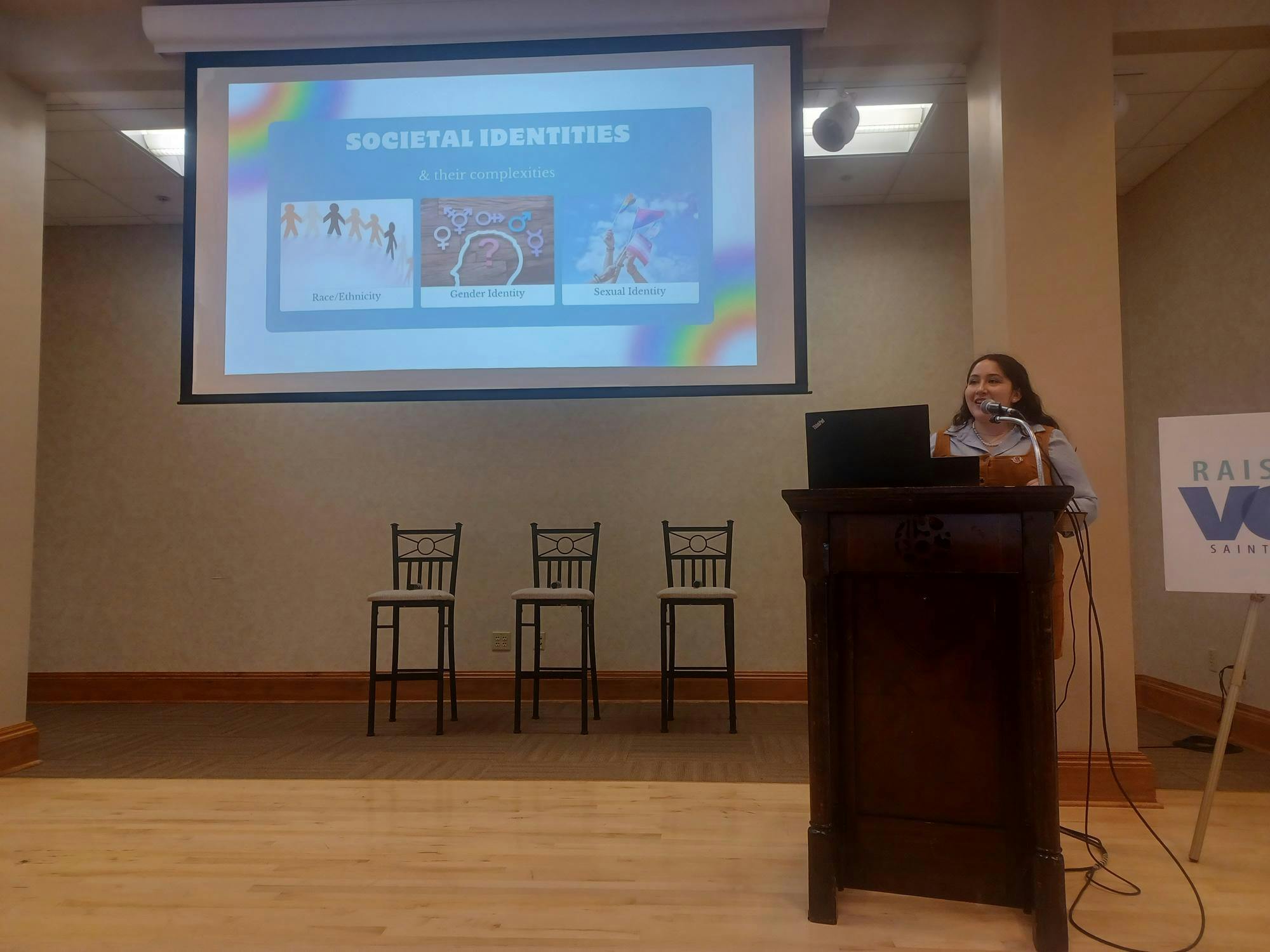
Vasquez started off her presentation “Breaking the Binary: Sexual Violence and in LGBTQIA+ Communities” by providing definition overview of the terminology used throughout the presentation and different stages transgender individuals may find themselves in.
Throughout the presentation, she mentioned different gender and sexual identities, even displaying visuals of a “gender unicorn” and “genderbread person,” claiming these identities allow people the freedom of expression to be who they are.
The presentation discussed sexual violence within the LGBTQ+ community and how perpetrators are influenced by control dynamics.
“Sexual violence is not about what we're wearing, what we're doing, how we were acting, prior behaviors … It's because a perpetrator wants to use power and control over someone who is vulnerable to take advantage of them,” Vásquez said. “Sexual abuse is more about power instead of sex.”
Vásquez concluded by urging listeners to “foster a space of learning, create a space for LGBTQ survivors to feel comfortable.”
“What Were You Wearing”
The “What Were You Wearing” exhibit is a virtual showing on the titular question, which is the frequently directed towards sexual violence survivors. The exhibit aimed to demonstrate that what the survivor was wearing did not cause the incident itself. The stories were submitted anonymously with a brief story excerpt and images drawn by seniors Maureen Galvin and Vinni Paradiso.
In previous years, the exhibit was shown in O’Laughlin Auditorium for students to view in-person with donated clothing provided. This year, however, it was hosted virtually in order to be accessible to more students.
“This year, we identified a couple of student artists that were willing to create recreations of the outfits that survivors shared in their stories, so that we could share the exhibit online. Then we also put a callout to the campus community again. Students, faculty, staff and any survivors that were ready and willing to share their story anonymously could do so via Google Form,” Baumann said.
Alexa Zapata, Belles Against Violence Office (BAVO) coordinator, explained what the goal of the workshop was for the tri-campus and South Bend community. She said she hopes it will further expand people’s knowledge on the issue and how they can be better advocates for survivors.
“I think it also goes a long way when you see stuff from kids clothes to even military uniforms,” Zapata explained. “It's just kind of going against that stereotype but also giving a person another way to be able to express themselves in their story.”
Baumann mentioned that the exhibits aim to demonstrate steps to provide better responses towards survivors of sexual violence. She hopes it can help to provide further support and awareness.
“I think it's just so important that we listen to survivors and we listen the first time. Hopefully by hearing these stories, even anonymously, it helps people do that,” Baumann said.


