
184 years ago Fr. Edward Sorin and his compatriots made their way through the wilderness of Indiana and arrived at a pair of frozen lakes covered in snow. Those men of destiny, hewing down timber and clearing snow, labored through the winter, erecting a small log chapel, a beacon of light in an unforgiving landscape on a restless continent.
Their writ, as imparted to them by their Holy Cross superiors, was not to establish a technical college or a research institution or an athletic organization, but rather a Catholic school, committed to being a “force for good” in the world — not in some abstract, secular sense, but through the cultivation of virtuous citizens rooted in the Catholic faith.
Over the past few weeks, the campus and the internet have been inflamed with the controversy surrounding the appointment of professor Susan Ostermann to head the Liu Institute for Asia and Asian Studies. Students and student groups have written letters to the editor on the subject, academics have cut ties with the Institute, renowned professors have spoken out against the drift in the Catholic character of the University and prominent bishops in America have urged Notre Dame to rescind the appointment.
All the while, the University administration has continued to defend Ostermann’s appointment.
While those who argue that Notre Dame has altogether abandoned its Catholic character make an overblown claim which neglects the contributions of the many devout Catholics on this campus, one cannot ignore that priorities other than Notre Dame’s Catholic mission seem to be guiding the University today to a greater extent than they should.
As esteemed former sociology professor Christian Smith argued in his recent piece in First Things explaining his decision to leave the University, growth in research capacities, growth in donations, growth in football success, growth in merchandise sales and growth in national standing all seem to be the driving forces of the University administration as of late, more than the cultivation of undergraduate education or its Catholic character.
Growth in all of these fields can of course be a good thing. But growth for its own sake seems like little more than that “perpetual and restless desire of power after power” with no end other than its own triumph. This is not the Notre Dame way.
As Francis Wallace put it in his 1949 history of Notre Dame, “The Notre Dame Story,” “Before Rockne and before football, from the beginning, [Notre Dame’s] primary goal has always been the production of moral leadership.”
This mission is, of course, distinct. It sets Notre Dame apart in the field of higher education. Most elite institutions, whatever their founding ethos, now view education as purely utilitarian. Education and research are not directed towards higher aims, but merely aim at personal success and a vague sense of progress.
Now Notre Dame, in its desire to be fully accepted into the upper echelon of American academia, has implicitly accepted this ethos. It creeps into everything the University does in its curriculum design, in its marketing and, of course, in its hiring processes.
Ostermann’s views on abortion have been extensively reported on in this newspaper and many others. Of course, not every professor at a Catholic university must be Catholic or hold Catholic beliefs personally. Indeed, it is a good thing to have non-Catholic voices in a Catholic university to further such a university’s engagement with the rest of the world. Academic freedom is a valuable thing that the University is right to defend.
What a Catholic university does require, however, is that all professors, Catholic or not, engage in dialogue with the Catholic faith. As the Land O’Lakes Statement, itself a more liberal view of Catholic education articulated by Fr. Theodore Hesburgh and others, argues, all disciplines have “a philosophical and theological dimension” which compels them to engage in dialogue with the Catholic faith.
Where Ostermann’s appointment presents difficulties for the University’s Catholic mission is in the fact that her views on pro-life Catholics indicate she does not want to engage in this type of dialogue. Specifically, Ostermann has described opponents of abortion whom she should be in conversation with as “complicit” in “violence.” Moreover, on the issue of integral human development, where there is perhaps most room for dialogue between the disciplines of global affairs and theology, she twists the Catholic view of the issue to argue that abortion is an essential part of such development. Despite Ostermann’s protestations that she will be able to separate her personal views from her professional views, her opinions on abortion are inexorable from her professional views. Separating her personal views would entail not discussing subjects such as integral human development entirely which would be both untenable and do a great disservice to students in the Liu Institute.
This newspaper has repeatedly asked the University for further comment on Ostermann’s appointment and has repeatedly been referred to a statement touting Ostermann’s research prowess and academic credentials. Ostermann’s credentials are no doubt impressive. I have nothing to say to impugn her experience or her personal character. At a secular research university, she would be eminently qualified for her position. But at Notre Dame, a Catholic university, she has failed the basic test of being open to engaging in dialogue between her discipline and the Catholic faith. If the University’s decision holds, it will seem to be prioritizing research prowess over commitment to its Catholic mission.
By all metrics, University President Fr. Robert Dowd and his staff are fine leaders of the University. Under their leadership, the endowment has grown to new heights, the University has done well in national rankings, athletic teams have found great success and Notre Dame has been named one of the best workplaces in America. The problem is not in how the administration has enacted its goals, but rather the goals toward which it is aiming. If research and rankings have pride of place over moral cultivation, then something has gone wrong.
To stay true to its mission, the University must actively lead, both on campus and beyond. On campus, it must lead its students in the Catholic faith, leaving room for academic freedom and debate, but always directing the academic curriculum and residential programming towards this end. Beyond campus, Notre Dame must not be afraid to buck the educational model of American higher education, which has proven itself to be intellectually hollow and morally bereft. It must recognize that its fundamental mission is to serve as a beacon of what education should be and that the school’s acceptance rate or national ranking are not what make this mission successful or not.
Achieving these goals requires courage and faith. But they are goals that students and alumni want to see accomplished and which the world needs.
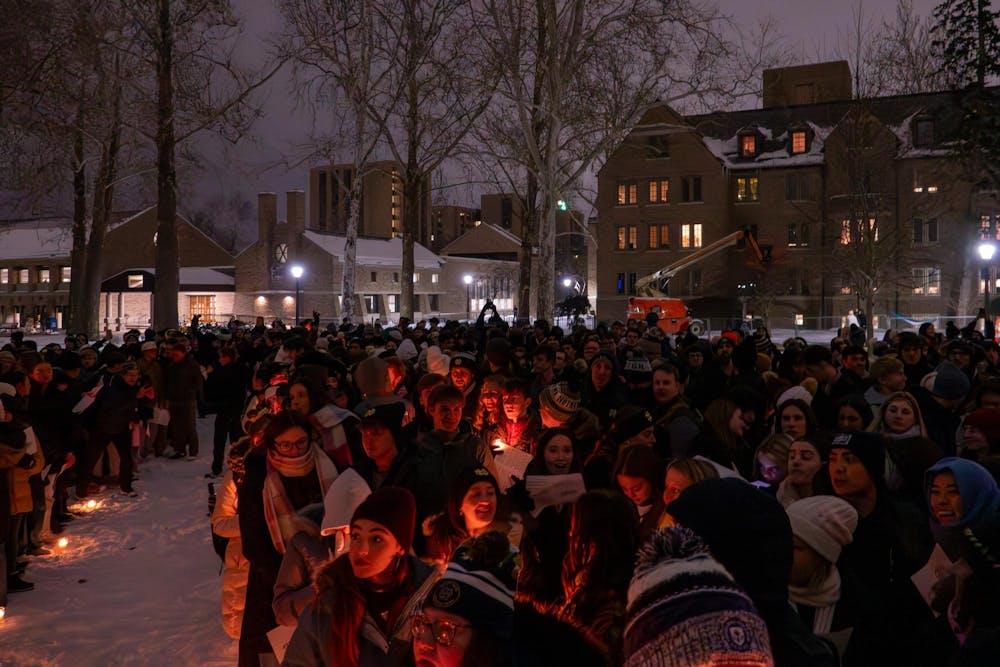
One need only to look as far as the ice-chapel constructed on North Quad a few weeks ago. Like those first brave men who stepped out into an unknown wilderness and formed a chapel out of earth and wood, those students ventured into the snow and constructed an icy edifice that reached not for earthly, but rather heavenly things. And like that first log chapel by the lake, once they built it, people came in their thousands, not because it was like everything else around them but because it was different and true and good.
Fundamentally, despite what outside commentators say, Catholicism is alive and well at Notre Dame. Many professors and students believe resolutely in the mission of the University and live it out every day. I too believe that the University administration believes in this Catholic mission and wants Notre Dame to be a Catholic university. I simply think that they are too afraid that other people prefer a muted version of its Catholicism. They would rather not meet the ire of critics than stand boldly on controversial issues.
Catholicism at Notre Dame can limp on with this mindset, but it cannot fully thrive. Its reputation as a Catholic university will continue to be harmed, and Catholicism on campus will retreat more and more into devout but isolated pockets of campus. This approach is not how Notre Dame became what it is today. Over its history, Notre Dame survived and excelled because it was always unafraid of the danger before it and advanced toward its goals unapologetically.
Wallace put it best when he wrote, “The Notre Dame tradition, from the date of its foundation in 1842, has been a constant fight for life. From the beginning it was a Spartan child, thrown on the hillside to live or die. Born under the most rugged conditions, it lived the hard way, came up from the other side of the collegiate tracks, after a long early struggle for survival that was one crucial scrimmage after another.”
Notre Dame is now at a time for choosing. It must decide whether it will remain resolutely and unapologetically a Catholic university or if it will continue down the slow and lamentable drift of secularization. What is needed is courage, a resolution to stand firm in its identity both on campus and beyond, come what may. Ultimately, there can be no higher calling for a University as storied as Notre Dame than fulfilling its Catholic mission in the fullest sense.
Liam Kelly, Editor-in-Chief Emeritus, is a senior from Westport, Connecticut studying history and political science. He served as Editor-in-Chief for the 2025-26 term. Contact Liam at lkelly8@nd.edu.


