When seventh-year head coach Nate Norman started five true freshmen in the August 15 season-opening 2-1 defeat to Michigan State, no one could have expected the composure and consistency that the young Irish would display over the next three months. The eventual ACC Freshman of the Year Izzy Engle would only play 46 minutes and fire one shot that night, but what would transpire throughout the course of an historic season for Notre Dame was something Norman said he had never seen during his career.
Under Norman, Notre Dame advanced to the Elite Eight in 2022, but fell short with an experienced roster in the second round a year later, leaving expectations up in the air heading into 2024.
“It wasn’t perfect early on, but they took every sort of hiccup or road bump and allowed it to help them grow instead of beating them down,” Norman said. “I was really impressed with how they took the adversity and gained confidence from it. It’s rare for freshmen to continue to improve without having a dip, but ours got better as the fall went on.”
Notre Dame’s freshmen didn’t just improve as the season progressed, they led the squad to a dominant regular season which included an unbeaten stretch lasting over two months. The freshmen scored 44 of the 57 Irish goals on the season, and freshman goalkeeper Sonoma Kasica made 57 saves and recorded 10 shutouts between the posts.
Engle led the pack. Her 19 goals ranked second nationally. The Edina, Minnesota native displayed uncanny finishing abilities throughout the season, recording an impressive 20% conversion rate on her 92 shots.
“Her performance speaks to her character and resiliency, and just the ability to be determined to power through whatever obstacles got thrown her way,” Norman said.
Joining Engle on the All-Freshman team were forwards Annabelle Chukwu and Lily Joseph, both of whom were also named to the All-ACC Third Team, as well as forward Ellie Hodsden. Chukwu utilized raw athleticism to tally eight points despite missing six matches while with the Canadian national team, while Joseph turned in eight goals and six assists during the season. Hodsden also found the netting eight times and did so at an incredibly efficient 32% clip.
Freshmen midfielders Abby Mills and Grace Restovich also made important contributions throughout the season. Mills was a steadying presence in the defensive third, while Restovich used her touch to establish a connection with the front line on the way to a team-high 11 assists.
Norman knew the talent was apparent from day one, but said experience served as a catalyst for growth.
“Just playing more and more college soccer allowed them to have the freedom to use their special talent and abilities, and hopefully grew their confidence throughout the course of the season,” Norman said.
It wasn’t solely a freshman-led effort, though, as junior defender Leah Klenke also made the All-ACC First Team following her return from duties with the U.S. Women’s National Team. The Houston native established herself as one of the country’s premier defenders while anchoring a Notre Dame defense which conceded less than a goal per match on average.
“She’s just one of those players that comes out every day and wants to work and get better and grow,” Norman said. “She gains the respect of her teammates because everyone knows when she steps on the field she’s going to instill confidence in all the players around her.”
Norman described how he and his staff approached coaching such a youthful, energetic roster.
“What we tried to do was not to coach a whole lot because we had so many young players,” he said. “We just wanted to give them little bits of information, help them recognize how to break down different types of teams, and then just see them adapt in different ways."
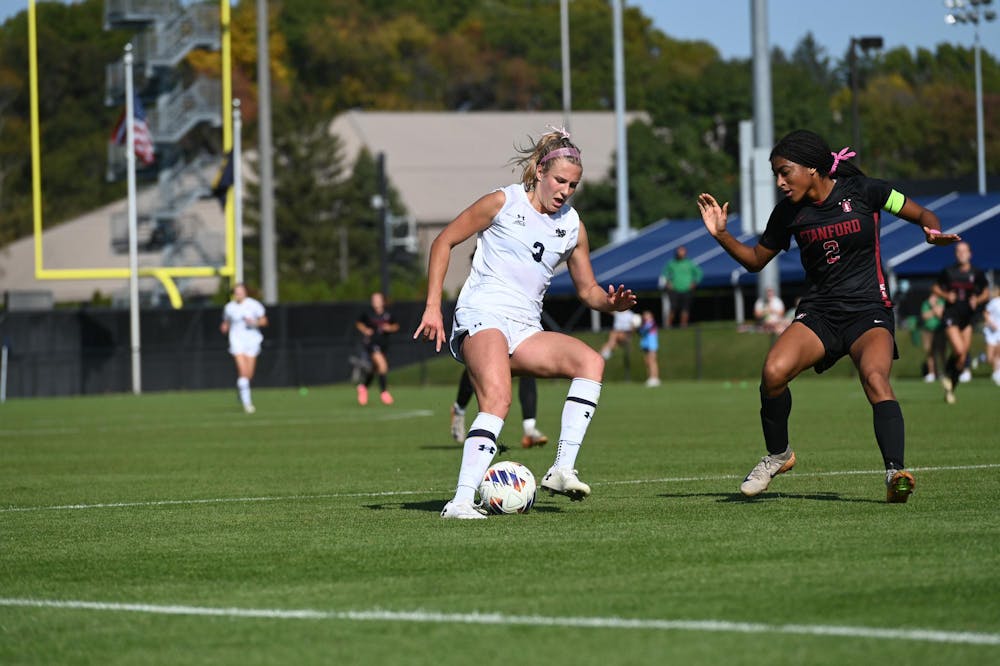
The Irish did find ways to break down many different teams, and many top teams at that. Notre Dame would end up playing eight teams who finished in the top 25, including shutout wins over No. 16 TCU, No. 4 Stanford and No. 10 Mississippi State, as well as a 3-3 tie at Duke when the Blue Devils were unbeaten and ranked No. 1. While some coaches may have viewed their schedule as taxing or draining, Norman described it as beneficial.
“This is how we recruit,” he explained. “It’s like, ‘Hey, if you want a really challenging, difficult situation, we get to play in the top conference in the country, and you also get to attend an amazingly challenging school.’”
The ACC was the most competitive conference in America this past fall, with six of the top seven schools in the final poll calling the conference home. The conference-wide prowess was also on display in the postseason. Despite being ranked No. 6 nationally, the Irish entered the ACC tournament in the final spot as the No. 6 seed, where they were defeated by Florida State. Notre Dame then ran through the NCAA tournament, collecting dominant victories over Milwaukee, Kentucky and Mississippi State, before falling in the Elite Eight to Stanford, another ACC school. In all, it was an exclusively ACC College Cup, with Notre Dame and Virginia Tech both advancing to the quarterfinals.
Despite the disappointing postseason defeats to the Seminoles and Cardinal, the young Irish cemented themselves among the sport’s elite both on the ACC and national landscapes. With the star-studded class of freshman and a number of other key returners continuing to develop, Notre Dame has its eyes set on the College Cup in 2025.