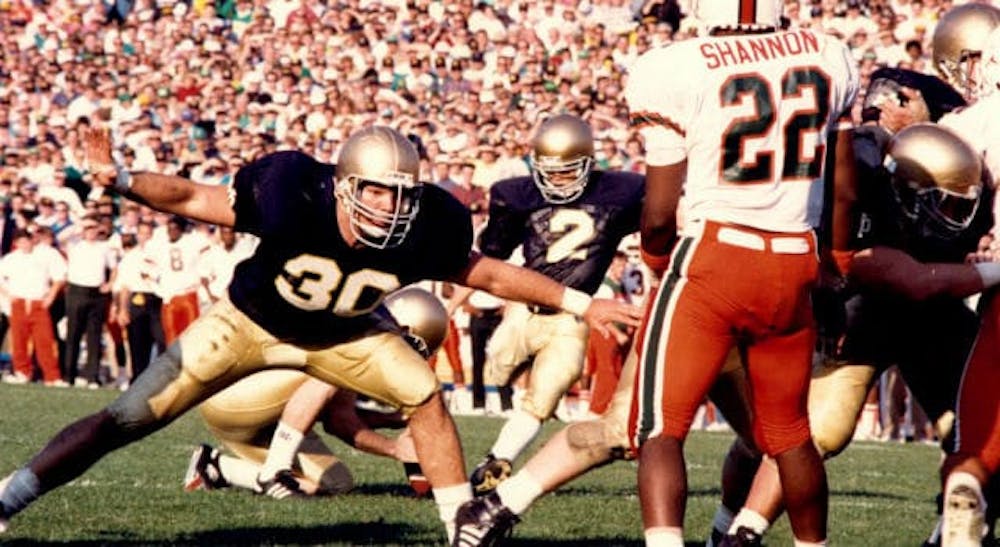
Oct. 15, 1988 was a sunny day in South Bend, Indiana. The Golden Dome in all its glory glistened in the early autumn sunshine. Touchdown Jesus watched over a campus, anxious in anticipation, yet cautious in its optimism. But Notre Dame Stadium, “The House that Rockne Built,” would be the battleground for one of the most important games in Fighting Irish football history.
Head coach Lou Holtz entered his third year at Notre Dame in 1988 with lofty expectations to fulfill. After an 11-year championship drought (seemingly mild now), the Irish fanbase was starving for success and hoped Holtz would be the program’s savior. Despite the ‘77 National Championship, Dan Devine was never entirely accepted by the community, and under his successor, Gerry Faust, Notre Dame had lost its fight, toughness and enduring culture. With the Irish vacating their position as college football’s most renowned and enviable brand, Jimmy Johnson’s Miami Hurricanes stepped into that spotlight in the 1980s.
If you were an author plotting a conflict, you couldn’t craft a more perfect rivalry than the University of Notre Dame and the University of Miami. The two programs were the literal antithesis of each other. Notre Dame was an old-school program, rooted with deep and storied history. Under Lou Holtz, the Irish were a tough bunch, but they didn’t possess much flair for the dramatic. On the other hand, Johnson’s Hurricanes represented all that was fun. They played fast, talked trash and dominated nearly everybody, similar to what Notre Dame had done to opponents in the days of yesteryear. And, of course, Notre Dame were the “Catholics.” And following a string of offseason arrests, Miami was labeled the “Convicts.”
The epilogue for ‘88 actually begins with Faust’s final game of the 1985 season. In South Beach, a deep Miami team routed the battered and bruised Irish, using trick plays and blocked punts to mercilessly run up the score to 58-7, long after matters had been decided. The ‘Canes would blank the Irish two years later, this time en route to their second national championship. The disappointing end to 1987 fueled Holtz and his players throughout a long offseason. The Irish realized that to achieve their goal of a national title, they would have to run headfirst through the storm.
After both sides survived early tests in ‘88 against the Michigan Wolverines, the dream matchup of unbeatens was set. It would feature two teams who didn’t like each other. Two coaches who didn’t like each other. And certainly, two fanbases who didn’t like each other. Some Notre Dame fans even referred to Johnson as the Antichrist.
Tension was high from the moment both teams took the field early that October afternoon. As the Hurricanes entered the lone tunnel following the conclusion of their pregame warmups, emotions boiled over into an all-out brawl. This moment, as well as the sides’ respective responses, represents the true irony in the “Catholics vs. Convicts” t-shirts produced and distributed among the student body that day. After the team’s pregame prayer, Holtz implored his players to save their fighting for the parking lot, and told them to “save Jimmy Johnson’s ass for me.”
That motivation, although decisively antithetical to its proclaimed Catholic values, allowed the fourth-ranked Irish to take a 7-0 lead over the top-rated Hurricanes after the opening quarter. The storm began to spin in the second however, as three touchdowns from Miami made it a 21-21 game at the break.
In front of a soldout crowd of nearly 60,000, Notre Dame pulled ahead once more with a field goal and a touchdown in the third quarter, placing the Hurricanes 36-game winning streak in serious jeopardy. Miami would draw to within seven midway through the fourth, setting up a crucial 4th-down play deep inside Irish territory. Miami quarterback Steve Walsh found Cleveland Gary in the flat where he reached the line to gain, but upon stretching for the endzone, had the ball knocked loose. Johnson believed Gary was down after he moved the chains, Gary believed it should have been six points, but the officials ruled it a fumble, giving the ball back to Notre Dame.
Irish quarterback Tony Rice proceeded to fumble just a few plays later, allowing Miami one more chance to stake their place as college football’s premier program and lay a dagger in their biggest rival’s national championship hopes. In an as equally a controversial play as the Gary fumble, Miami made the score 31-30 with under a minute remaining on a 4th down Walsh touchdown to pass to Andre Brown. The only problem was Brown didn’t actually end up with the football. Regardless, Miami was one point away from securing an impressive road tie, likely solidifying another perfect season and back-to-back national championships.
Instead, Johnson decided to go for two, and the win. One play, from two yards, to decide victory and defeat for the sport’s two best teams. On what is now known in Notre Dame lore as “The Play,” Walsh took a five-step drop and was pressured into attempting an off-balance throw towards the corner of the endzone. Notre Dame safety Pat Terrell deflected the pass to secure the win. The X’s and O’s of that conclusive play grace the design of this year’s edition of “The Shirt,” only fitting for a season where the Irish once again hope to reclaim their past glory as national champions.
Holtz’s ‘88 Irish would run the table to capture the program’s 11th national title, culminating with a win over West Virginia in the Fiesta Bowl. But if you are to ask any fan their fondest memory of perhaps the greatest season in Notre Dame history, the answer will undoubtedly be centered around October 15, 1988, Catholics vs. Convicts, between Notre Dame and Miami. So, much like they had to 37 years ago, if Notre Dame wants to prove its resurgence to the college football world, they’re going to have to combat the storm, and take down the Miami Hurricanes.