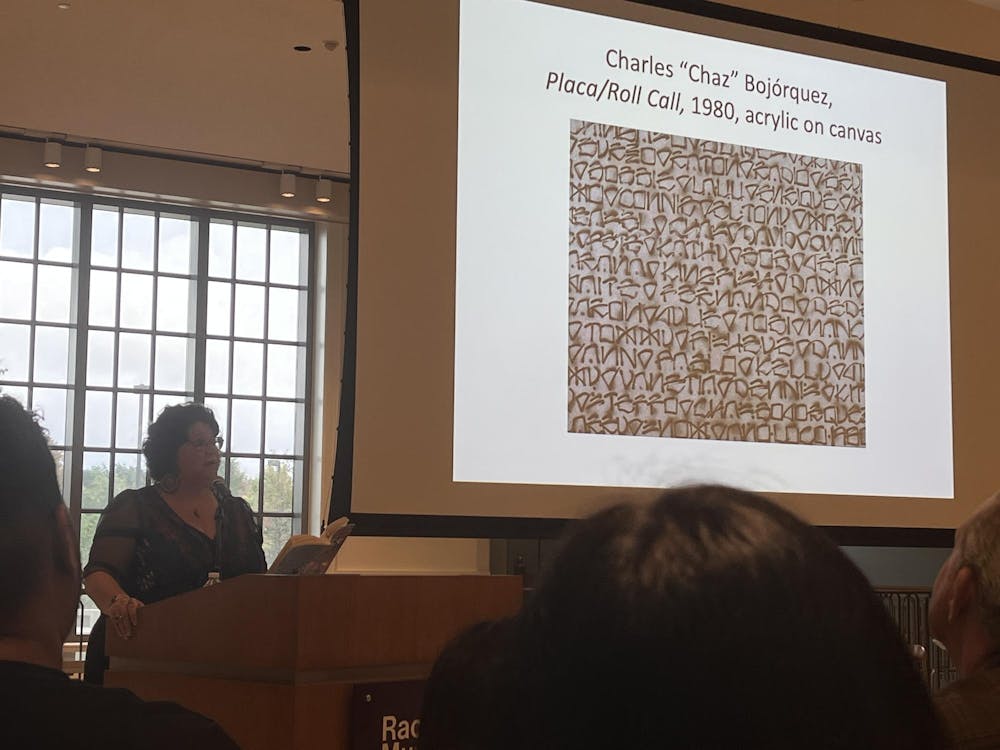
Wisconsin Poet Laureate Brenda Cárdenas presented Wednesday at the Raclin Murphy Museum of Art about ekphrastic poetry.
Ekphrasis is a literary technique that responds to visual art or uses it as a basis of inspiration. Her visit launched “Poets & Arts: Ekphrasis”, part of a multi-year partnership between the museum and Letras Latinas, the literary initiative of the University’s Institute for Latino Studies (ILS).
In addition to her lecture, Cárdenas visited both graduate and undergraduate classes at Notre Dame, and on Saturday, she will be leading an ekphrastic writing workshop that is open to the South Bend community as a whole.
This isn’t the first time Cárdenas has collaborated with the University. Notre Dame professor and director of the Letras Latinas Francisco Aragón shared that a year ago, she was commissioned to write two poems to celebrate the 25th anniversary of ILS, and in 2013, she worked closely with Aragón on an ekphrastic poetry workshop for the Smithsonian American Art Museum.
Cárdenas shared in an interview that she entered the world of ekphrastic poetry fairly young, as she collaborated with many artists during her time working for the youth initiatives at the National Museum of Mexican Art in Chicago. Particularly with artworks that felt mystical, Cárdenas said that ekphrasis allowed her to interpret the art in her own way, often evoking new forms of understanding.
“Oftentimes, what I’m drawn to in any form of art is that there's something mysterious about it … There’s something maybe magical about it, or it’s something that … lets me fill in, with my imagination, whatever isn’t on the canvas and I start storytelling in my mind, or myth making,” Cárdenas said.
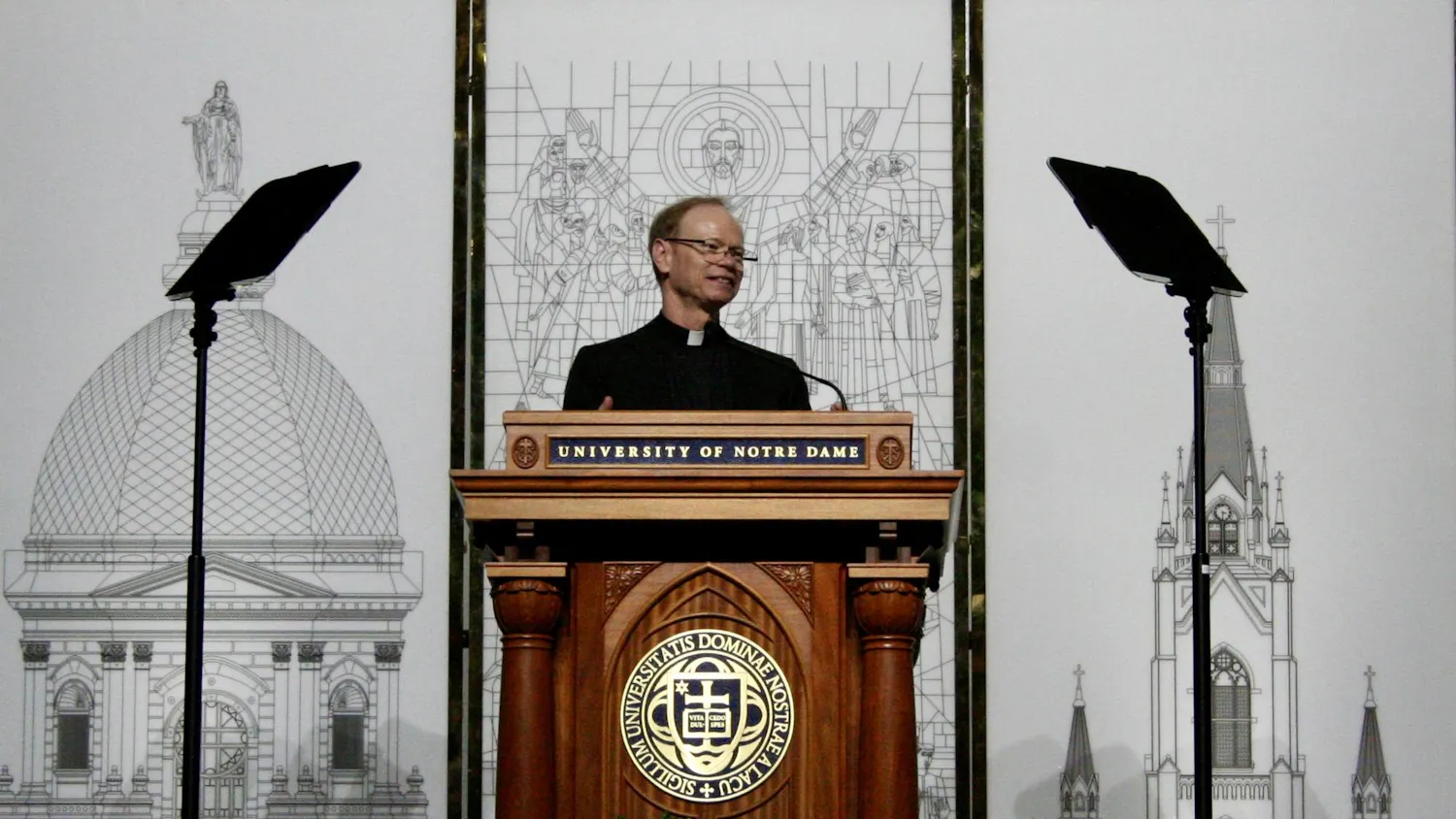
At the lecture, English Ph.D. student and Joseph Gaia Distinguished Fellow in Latino Studies Karla Yaritza Maravilla Zaragoza gave the introduction for Cárdenas and her ekphrastic poetry.
Maravilla said that originally, this form of poetry felt out of reach. “I’ve always believed that the best way to learn is to dive head first into something that makes you a little uncomfortable. For me, that discomfort was ekphrastic poetry. Since undergrad, I had dismissed ekphrasis as a crutch for writers that lacked energy in their writing, a process that relied too heavily on an external image instead of a poet’s own imagination. I even thought of it as elitist, tethered to knowledge of Rembrandts and Venetian Plaster finishes,” Maravilla said.
However, after reading Cárdenas’s poetry book “From the Tongues of Brick and Stone,” and drawing parallels with her film class’s exploration of Mexican New Wave cinema, Maravilla came to a different understanding of ekphrasis. “In countless ways, writers have always been in conversation with other arts, not because it made them look smart, but because it brought them into dialogue with other artists. Suddenly, I understood that writing could be communal, not solitary, that it could reach beyond the page to converse with image, sound and history,” Maravilla said.
This is exactly what Cárdenas explained in her lecture: ekphrastic poetry requires a sort of back and forth of interpretation and inspiration, as the poet often views a piece through their own history and cultural context.
She presented a poem she wrote that was inspired by a series of artworks called “La Lotería de los 100 nombres que los Mexicanos le dan a la Muerte: La Jodida, La Huesos, La Cargona.” The pieces were of women skeletons, each carrying a particularly heavy load. Cárdenas interpreted these artworks through the context of her current life.
“I wrote that under the first Trump administration, when we saw the children being caged in the border, and there was something about seeing these images and seeing the weight each of the women is carrying, and thinking about the weight that people carry, whether or not they’re literally carrying anything right to the border when they come to cross, and then when they get here, so often, that weight becomes multiplied, right? The craft of poetry, it comes from the art, but it comes from everything else too, from our own personal lives, from the larger world out there,” Cárdenas said.
Aragon, the main proponent behind the “Poets & Arts: Ekphrasis” initiative, hopes that Cárdenas’s presentation helps make poetry feel less foreign and out of reach. “Sometimes people hear the word poetry and they're intimidated by it, and I try to demystify that art form, and hopefully by the end of the class, they will have enjoyed reading poems. People think about an art museum, and they think, ‘Oh, that's a stuffy, elitist space.’ And our hope is that people from the community will feel welcome. Our goal is for Notre Dame to be welcoming to the community,” Aragon said.