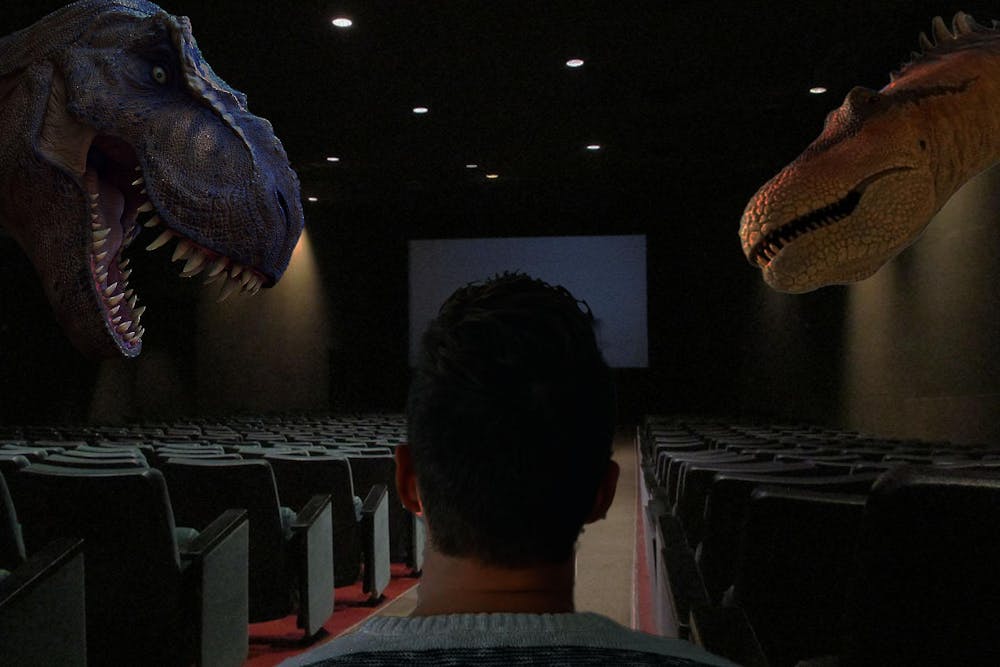
This summer I worked in a movie theater and had the misfortune of serving waves of angry children (and millennial Disney adults) who flooded in to see the hot new dino movie, “Jurassic World: Rebirth.” I worked the night shifts.
“Are the pizzas dinosaur-shaped?” one man asked. Sir, it’s 2 a.m.
You can see why I avoided the movie. Still, some masochistic part of me wanted to see what all the dino-craze was about.
I sat down, cringing, and forced myself through it. Oh boy.
There’s a lot to be said about “Jurassic World: Rebirth,” but here’s my takeaway: You shouldn’t avoid this movie because it’s particularly bad, by which I mean unenjoyable or sloppily made; you should avoid it because you’ve already seen it. If you’ve watched any Hollywood blockbusters in the last 10 years, then you’ve seen this one. If, on the other hand, you’re a grandparent trying to find entertainment for your 7-year-old grandchild or an aging middle-aged man going through a mid-life crisis, this could be the film for you.
The film is, like most modern “cinema,” just repackaged pop-culture slop. “Rebirth” plays like a stitched-together sequence of thrills, screams, product placements, deus ex machina and overused tropes — all held together by the thinnest possible storyline. It’s packed with promotions for M&Ms and Altoids, which Jonathan Bailey’s character annoyingly chomps several times, but notably lacks any sign of actual artistic merit.
The movie was undoubtedly written by a committee of lawyers, PR reps, Mendoza grads and maybe, just maybe, a screenwriter or two. It’s a corporate product dressed up as a film. It lacks any depth, originality or serious meaning. Or so I thought.
After a long post-movie nap, I couldn’t shake the feeling that maybe there was something deeper going on, just not on purpose. The more I thought about it, the more I realized: “Jurassic World: Rebirth” does have meaning — it’s just not the kind the filmmakers intended.
Let’s start at the beginning. The basic premise is that dinosaurs have escaped from a biotech lab on the remote island of Île Saint-Hubert. This happens because a conveniently placed Snickers wrapper falls out of a scientist’s pocket, jams a security door and lets the dinosaurs out. These lab-made dinosaurs can’t survive outside tropical zones, so they stay near the equator.
The story picks up a few years later. Human society (not around the equator) is coping just fine. Parker Genix, a pharmaceutical company, wants to develop a heart disease drug using dinosaur blood, so they send a team to Île Saint-Hubert to extract blood samples. These will be used to create a so-called “miracle drug.”
After all the action, which I’ll skip for brevity — basically, “pew pew,” “chomp chomp” — the team secures the samples. Dr. Henry Loomis, a timid dinosaur expert played by Jonathan Bailey, wants to make them publicly available, giving up Parker Genix’s chance to monopolize the drug. But the corporate villain owner of the company, Martin Krebs, wants to sell the drug for the highest possible profit.
What’s telling is this: It takes a dinosaur eating Krebs for the humans to finally do the right thing. Justice wins in the end, and the drug is made public, but it takes a literal act of the supernatural for this “justice” to happen. What does that say about us? What does it say about our ability to organize and fight for justice? Would it literally take an act of God for justice to be done in this country? For the hungry to be fed, the poor clothed? For us to move past our collective obsession with profit and finally do the right thing?
The answer from “Jurassic World: Rebirth” is a resounding yes.