
This is also published with Word on Fire's Evangelization & Culture Online (www.wordonfire.org).
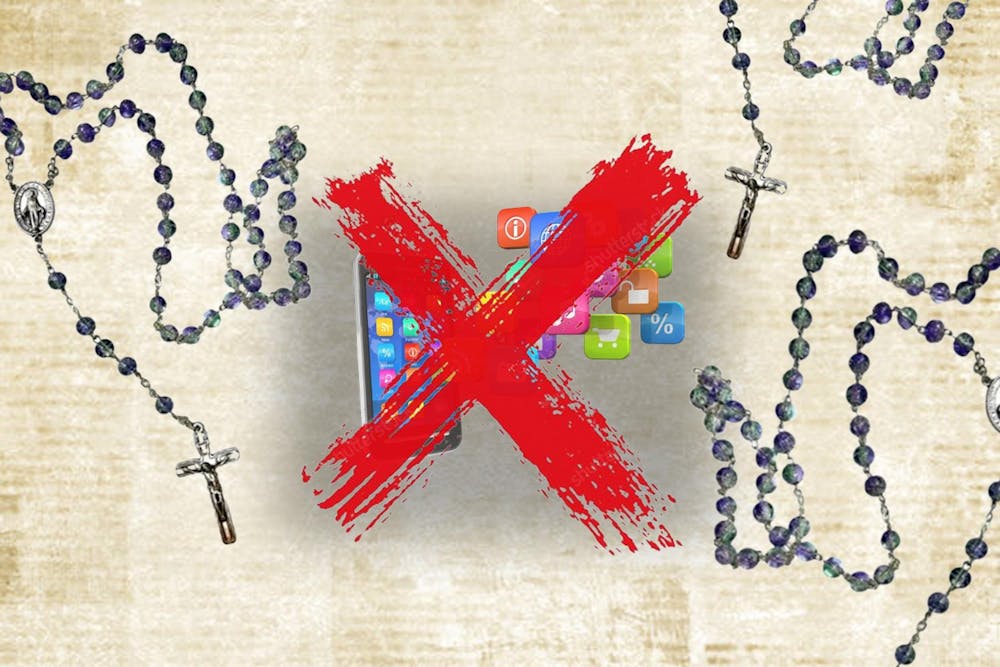
A year and a half ago, in my sophomore year of college, I summoned the courage to do something I had wanted to do for a while: I got a dumb phone — a phone without internet, email, social media or any other distracting apps. The process of dumbing down my digital life began out of a desire to minimize distractions from my homework and my budding reading habit, but has since rekindled my spiritual life from its embers at the end of adolescence to a crackling fire in young adulthood. Just as my smartphone once infiltrated many aspects of my life, so too has my dumb phone detoxed my work, my prayer and everything in between.
Life with a dumb phone need not be a monastic life of work and prayer only, nor does it demand the monastic fuga mundi, a flight from the world and utter detachment. Rather, living with a dumb phone has freed me to attach myself to the real, authentic and ordinary world — the world of long conversations and eye contact and close friendships, of sunsets and rustling trees and chirping birds, of gripping novels and profound ideas, and, most importantly, of silence and prayer, the interior world where the Holy Spirit has been waiting patiently for me to enter and relax and open myself to all His graces.
I spent years without social media, chipping away at my screen time and trashing extraneous apps, before I finally replaced my iPhone with a cheap Nokia “candy bar” phone. I drew the courage I needed to jump off the grid from how sick I had grown of using my phone against my will. I embodied in my divided being, multiple times a day, perhaps the fundamental moral conundrum: Why do we do things we know we shouldn’t, or we know we don’t want to?
This problem of akrasia, as it became known with Plato, is famously expressed by St. Paul in Romans 7:15, “What I do, I do not understand. For I do not do what I want, but I do what I hate.” This moral puzzle has, to my (admittedly ignorant) mind, staunchly resisted adequate treatment by analytic philosophers, but has a very straightforward explanation for Catholic theologians (and even for St. Paul himself): We are fallen, and thus our wills are fraught with concupiscence.
Yet, the very nature of the problem was that no matter how thoroughly my mind grasped this explanation, my will budged not one bit from compiling its venial errata. When I was sick of being sick with akrasia, I forced down the medicine of extreme technological inconvenience. One minute of focus or conversation or prayer at a time, I began to heal.
One of the most common reactions I get when people see or hear that I have a dumb phone has been, “Respect! I wish I could do that, but I’m honestly too addicted to my iPhone.” My heart sinks at their sickness of akrasia. The fact that my generation has dubbed the very content many consume the most “brain rot” is, first, so ridiculous it’s funny and, second, sad. I am not here to sound alarms and declare that my generation is in a crisis; I have too much confidence in and admiration for the grit and resilience of the human person to forecast that a few bad habits will overcome us. But I see so many trapped in their own concupiscence and wish to bear witness to the graced life outside the digital dungeon.
As a child, I was once enamored by the strangeness of everyday things; but as I grew up, I began to dismiss as mundane the very things that gifted my fresh imagination with whole worlds. Had I exhausted these worlds hidden in every gadget or invention, every floor pattern or ceiling molding, every plant or insect — and, now that my reason has matured, every word or rhyme, every adage or notion, every argument or leap of logic? G. K. Chesterton found bottomless treasures in the miscellaneous trinkets filling his pockets, not one of which was a smartphone.
My concupiscence at first tricked me into seeing the life outside the digital dungeon as but a darker void of Stone Age inconveniences and blank boredoms — that is why I struggled to escape, despite knowing in my head the benefits of a decluttered mind, a cleansed spirit and all the fruits of a surplus of silence. It is true: Life with a dumb phone will at first be painfully tedious and stiflingly silent and frightfully boring. But only at first. Soon, I would never know boredom again, tedium would teach me of my own ingenuity and resilience and silence would become home sweet home. Now, all creation has begun to glow for my ready eyes; all invention has roused my curiosity toward the nature of man; all conversation has been a balm for my previously lonely soul.
Most know the saying, “What goes up must come down,” as a law of gravity; Catholics know it is a law of grace. What ascends to heaven must have first descended into hell. As St. Paul says in 1 Cor. 15:36, “What you sow is not brought to life unless it dies.” Be not afraid of your own thoughts or of the voids of silence or of the awkward moments staring into the distance or of choppy and sparse conversations or of long spans of empty time. Be not afraid, for in the death of anxious, restless attention, the new life of a calm, content spirit blossoms — a spirit that tastes true rest in the Heart of Jesus, in the love sustaining and overflowing all creation and all human hearts.
Cutting off my smartphone, which had become for me like a fifth limb, was not itself sanctifying. I, like many of my generation, switched to a dumb phone for its psychological and interpersonal and educational benefits, oblivious to its potential spiritual benefits. I can now say, however, that switching to a dumb phone undeniably cultivated within me a disposition toward prayer. It has uprooted the weeds overgrowing the garden in my soul and has plowed and fertilized its soil. Then, it was up to me to ask the Gardener to plant His precious seeds and water them. I may not have — and what a shame it would have been to squander such a fertile garden!
But I did — I asked, and I received; and I still ask and still receive, because, without His grace, my concupiscible will disintegrates into its old, divided, akratic sickness. First, I ask the Crucified for the strength to kill my concupiscence and the courage to confront a life at first so still it is often immobilizing. Then, I ask the Gardener to grow in the now-fertile garden of my heart an ardent desire for His Heart. Confident, I do not doubt that I will then yield a hundred-fold. Though I know I will never rest my restless heart in the Heart of Jesus in this life, now with my dumb phone I at least enjoy the peace and quiet that awakens my desire for Him.
Apart from cultivating in me a disposition toward prayer, switching to a dumb phone has exercised in me a resolve to do what I believe in despite what others are doing or what others might think. This resolve is indispensable for today’s Catholic — for, as Charles Taylor has observed, this secular age is one in which religious belief is no longer the default but must be chosen — and it is especially crucial for today’s young Catholics who are students at secular universities.
I fear that many of us students, both those of us who have wandered from our childhood faith and those who did not grow up with religion, begin to feel a hole in our hearts which we try to fill by studying harder or partying more or accumulating more loose acquaintances we call “friends,” only to realize that we have succeeded only in deepening this hole. If we see truly with the eyes of our lost, longing hearts, we can recognize this hole within us as the desire for Christ, for prayer, but I fear that we are so infected with doubt and anxious reflection on our secular milieu that we try to bury this desire as we remain, as T.S. Eliot put it, “distracted from distraction by distraction.”
I fear that the ambitious among us feel as though we are trying to break Olympic records running on a track of quicksand. We exhaust ourselves flailing our limbs with great tenacity. We are secretly proud of how exhausted we are. We would like to rest but feel ourselves sinking as we slow down. We look around for solid ground but find none — except for a narrow, rocky path that does not lead to the finish line but some other place we can’t quite make out. For a moment, we feel our heart jump within us at the sight, but then we turn back to the finish line and to all our “friends” in the quicksand, and feel once again caught up in our race, convincing ourselves that there was nothing for us on that strange, rocky road walked only by old looneys here and there.
Living in the silence and boredom in the absence of our smartphones will help us, first, wake up to the fact that we are sinking in quicksand, that we run our race in vain; and, second, it just might give us the resolve to turn around and find refuge on that one piece of solid ground we glimpsed — that narrow, rocky road, the Catholic Church, whose destination is the Narrow Gate, Christ Himself.
Richard Taylor is a senior from St. Louis living in Keenan Hall. He studies physics and also has an interest in theology. He encourages all readers to send reactions, reflections or refutations to rtaylo23@nd.edu.


