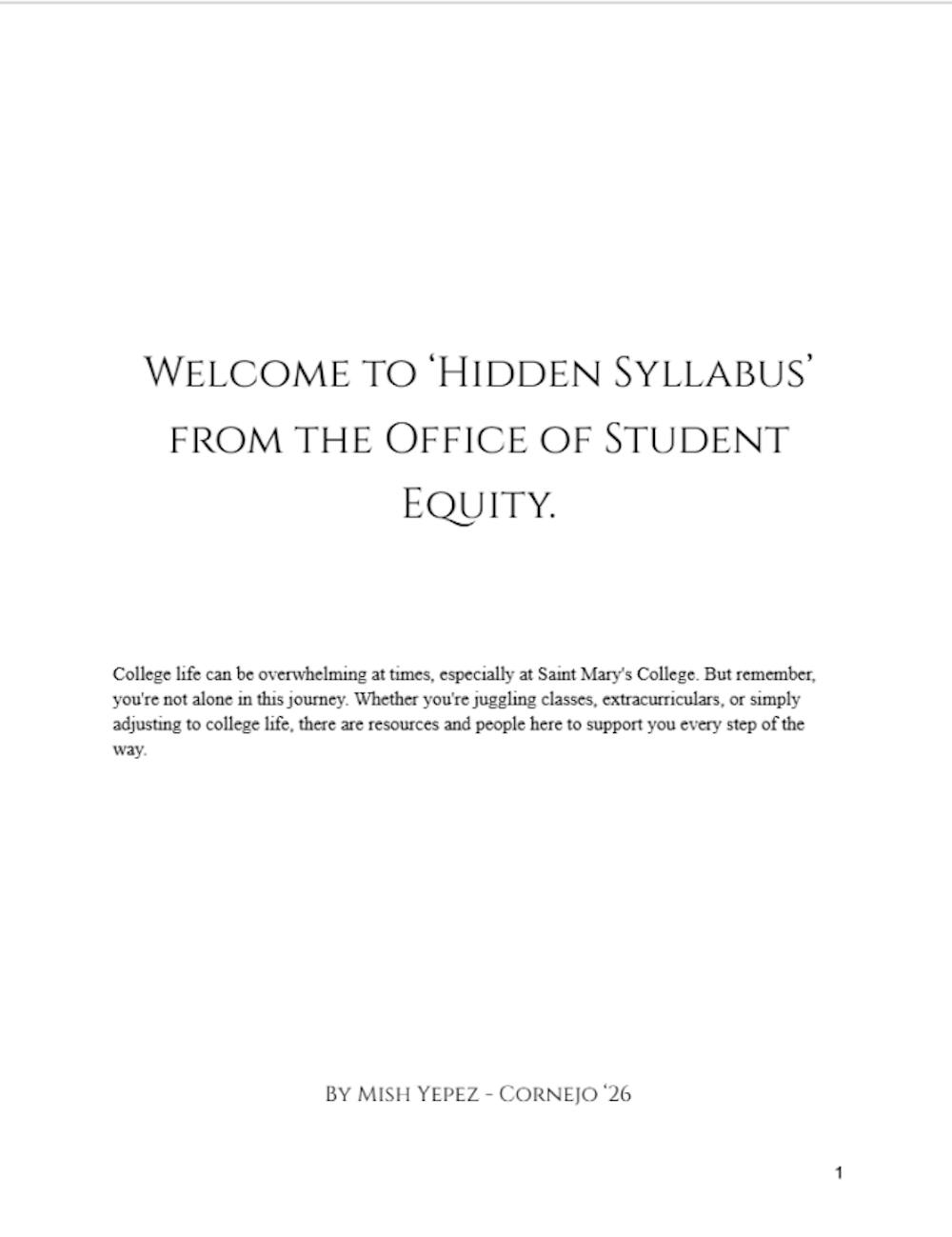
While the name “Hidden Syllabus” may seem to indicate a top-secret, lengthy search, it is not meant to force students on a scavenger hunt to find information. The syllabus is one resource that the Division of Belonging provides to underrepresented and first-generation students to help them navigate their entry into college. Together with the Student Emergency Fund, the syllabus provides comprehensive information on available departments and services, and it serves students during unforeseen circumstances.
Senior Mish Yepez shared that she developed the syllabus the summer prior to her junior year, remembering the confusion she felt as a freshman and learning about the resources on her own. She wanted the syllabus to become a guide for freshman students, enhancing their overall experiences.
“I’ve always had a love for helping others, especially first-generation students, because I’m also first-generation and I kind of wish I had that resource when I was coming to college,” Yepez said. ”I remember now I wanted to be able to give back to the people who have given me all the resources that I needed when I first started out with college.”
As an intern at the Division of Belonging for the past two summers, she was able to pursue this initiative under Christin Kloski, the director of the Office for Student Empowerment. Kloski wanted the guide to reflect student life at Saint Mary’s and how they should approach the college campus.
“Every time that someone interns with her, she wants to make a project for first-generation students. So that summer, she wanted to create a hidden syllabus,” Yepez said.
While professors have plenty of experience organizing syllabi, it was a new experience for Yepez. She began by focusing on what first-generation and underrepresented students needed to hear and then later incorporating her own experiences as a student with personal humor. She mentioned going to different resources and departments including the Office of Multicultural and International Student Services and the Office of Student Success.
The document is arranged into eight sections: academics, finances, student health and wellbeing, first-generation limited income community, equipment and technology, internships, student support offices and Saint Mary’s College traditions, each one further broken down into subsections.
Kloski said that the target audience for the syllabus changed over time.
“[We] really targeted our first-generation students in the beginning, when we generated it with our intern,” Kloski said. ”We then really understood that every student needed it. There are things on there that are typical questions that come up for students, anything from advising to health and counseling to just general acronyms or terminology on campus.”
Regarding the section dedicated to first-generation limited income students, Yepez said it “is such an important aspect because it spreads awareness that these students are not alone and that there are resources for them, because I know it can be scary to ask for help.”
She reflected that staff and faculty have also been grateful for the existence of the document, as it has given them an insight on student life that they may not have been familiar with prior. She said she hopes that the syllabus can reach more students in the coming weeks, especially those taking intro classes at the College.
The Student Emergency Fund allows students to be given a one-time grant to cover for a situation with insufficient funding, including for technology items, emergency travel, books and materials, insurance, school supplies, scrubs and nurse wear, winter clothing, medical-related costs, status processing for immigration and testing and more. Recently, it has covered glasses repairs and prescription coverage due to new requests from students.
The fund is open to any in-person students at the College regardless of economic background. Prior to applying for the grant, Kloski advises students to take advantage of all the financial opportunities available to them. She also discussed the process for what happens following an application.
“We encourage students to utilize all of their resources through financial aid, so all of their financial aid award money and all of their student loans so that [it] can suffice for whatever emergencies that come up. Any additional applications come into our office, we review it with our committee and then we make our decisions based on those applications that come in,” Kloski said.
She said she hopes that students feel comfortable applying for the fund and using the office as a way to assist them, especially if the fund can be applicable to their situation. Yepez looks forward to seeing the impact that the syllabus has on students and for them to feel more included and acclimated to campus life.
For freshman students, Yepez recommends students “fill up those spaces because you belong here. College won't always be linear, it's going to have its ups and downs and that's okay. That is also part of the college experience.”