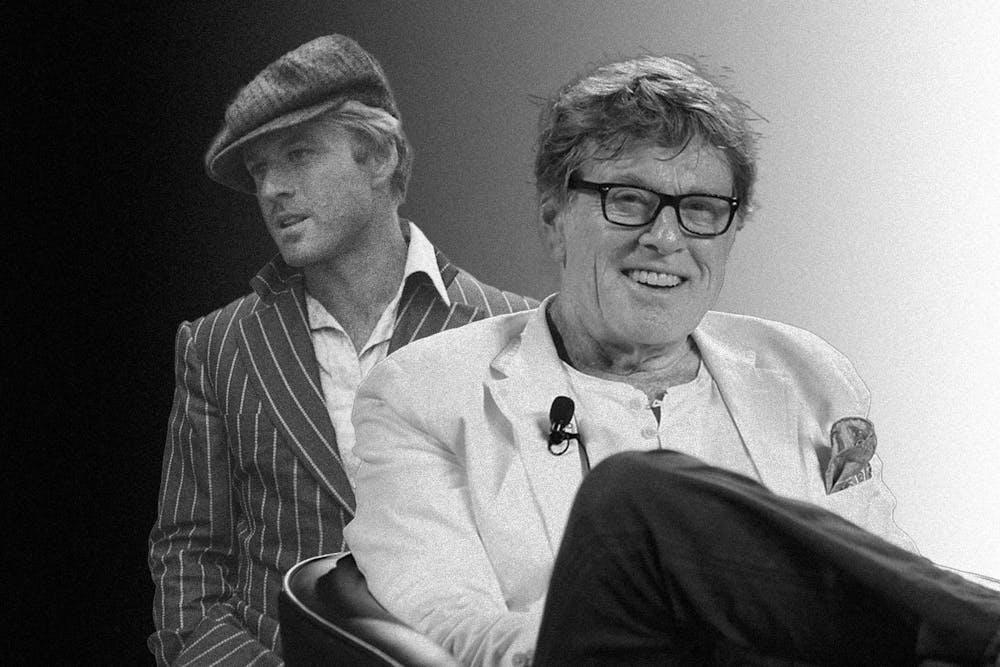
This past summer, my hometown’s local library was screening “All the President’s Men” — Alan J. Pakula’s 1976 political thriller about reporters chasing the truth of the Watergate scandal. I went and took my seat among the handful of older men and women as the lights dimmed in silence. Minutes later, New Hollywood’s golden boy, Robert Redford, first appeared on the screen, portraying the Washington Post’s investigative reporter Bob Woodward. Versions of “God, was he gorgeous,” were muttered by the entire group of women in front of me.
Nobody in the room (or anyone, anywhere, for that matter) could blame them. There are only so many actors who have held enough charm to elicit such a reaction nearly 50 years after their work has been released; Redford will always be one of them. The incomparable star, who began his career in the 1960s and retired in 2018, passed away last Tuesday at the age of 89. Of course, while it is easy to recognize his famous appearance, Redford somehow had something more distinctive about him.
The titles of and names associated with his vast career are what appear most tangible; placed beside figures such as Paul Newman, Barbra Streisand, Dustin Hoffman and Jane Fonda, Redford established himself early on as not only a star, but one capable of maintaining his stature beside others. “All the President’s Men” is not necessarily a Redford film, nor is “Butch Cassidy and the Sundance Kid” (1969) or “The Way We Were” (1973). There was an authenticity to his craft that forged a balance with whomever he shared the screen; he was not the kind to often “steal a scene,” rather one to help prop it up to its greatest potential alongside those around him. What many would deem the most notable images of his career, such as him washing Meryl Streep’s hair in “Out of Africa” (1985), or cliff-jumping with Newman in “Butch Cassidy,” are vivid testaments to his chemistry with his fellow artists.
With the trivialized grace he brought to screens, Redford was also able to convince us in ways many movie stars fail to. When an actor’s name and face grow too familiar, they can oftentimes blend with the characters they play in the audience’s eyes. Redford, however, never ceased to blur this line; he was the reporter, the outlawed cowboy, the con-artist, the baseball player and the old high school crush. He depicted characters that felt like real people, all of whom just shared the same pretty face.
It is hard to strictly define and explore the specialty of Redford beyond his talent, probably because one of his salient qualities was his elusiveness. Outside of the theater, his life could not be seen; his identity behind the camera always existed as a private luxury. Redford could not be touched by the media or the public, and there was a charm to that layer of mystery that we cannot often find today.
While Redford’s appearance is one wholly known by many, the man behind it has never been. One can always list the Oscar nominations he received for his acting and directing, or his acceptance of the Academy Honorary Award in 2002, as a faithful representation of his legacy. It is also necessary to highlight his constant political and environmental activism, as well as his establishment of the Sundance Institute, a nonprofit organization and film festival for independent moviemaking. Whatever sliver of his life may be noted in honor and memoriam, what he presented of himself and advocated for, while honorably conserving his own privacy, has forever left a great imprint on Hollywood’s past, present and future. And God, was he gorgeous.