Since the shooting of conservative activist and Turning Point USA founder Charlie Kirk on Utah Valley University’s campus on Sept. 10, Utah Gov. Spencer Cox has entered the limelight, condemning political violence in public addresses and being featured by a number of media outlets for his message of the necessity that Americans turn down the political temperature.
But, long before Kirk’s murder and its aftermath, Cox had been invited to speak at Notre Dame with his friend, New Mexico Gov. Michelle Lujan Grisham, about what much of their careers have been dedicated to: overcoming polarization in favor of political pragmatism.
During his time as the chairman of the National Governors Association from 2023-24, Cox’s chairman’s initiative was to launch “Disagree Better” through which he affirmed his commitment to reaching past partisan divides to find the best solutions for his constituents. Alongside the governors of other Western states, Cox and Lujan Grisham came to share how they’ve been doing just that.
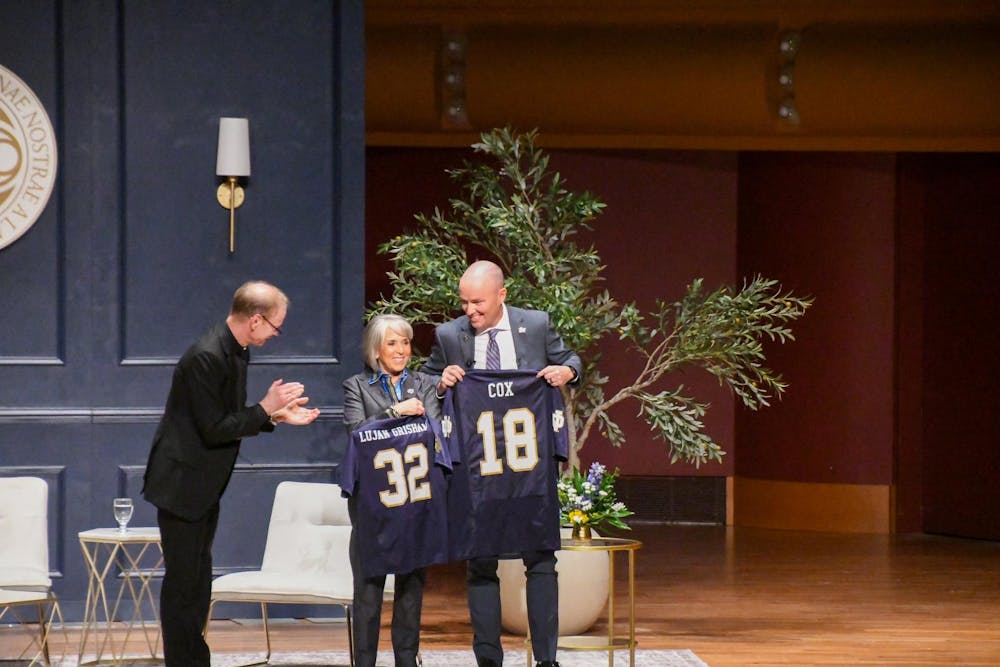
On Friday afternoon, the Notre Dame Democracy Initiative hosted a conversation between the two governors, Cox, a Republican, and Lujan Grisham, a Democrat, moderated by University President Fr. Robert Dowd as a part of the Initiative’s Democracy Talks series.
In his invocation, University Provost John McGreevy said that the Democracy Initiative “envisions Notre Dame as the most trusted institution people turn to for studying and strengthening democracy.” The initiative, part of the University’s 2033 strategic framework, aims to put Notre Dame at the forefront of democracy research with the end goal of lessening polarization, curbing toxic discourse and increasing trust in public institutions.
Lujan Grisham is the 32nd governor of New Mexico and the first Democratic Latina to be elected as a governor. She said at the lecture that she considers herself “a politician by accident,” beginning her political career as the cabinet secretary of New Mexico’s Department of Aging and Long-Term Services and before being named as New Mexico’s Secretary of Health. She was elected as a member of the U.S. House of Representatives in 2011 before being elected in 2018 as governor of New Mexico.
Cox is a sixth-generation Utahn and the 18th governor of Utah. Before being elected as governor in 2020, he served as a city council member, mayor, county commissioner, state legislator and lieutenant governor. He described his political career as a way for him to “give back.”
Throughout the discussion, both governors said that they serve all their constituents, not their parties.
Reflecting on the governors’ relationship, Lujan Grisham said, “Republicans and Democrats are not enemies. We have different perspectives sometimes and maybe different priorities.” She noted that at the end of the day, they “broke down that barrier” and were able to engage in respectful dialogue and help each other where necessary.
She hopes that relationships like theirs “will take hold and more Americans can debate their differences, but to do so with respect and open-mindedness about how you might be persuaded to think about a problem … just a bit different.”
Dowd noted that both governors have served in leadership roles in governors associations both at the regional and national levels, and that it seems to him that there is “a great deal of bipartisan collegiality and pragmatism among governors.”
Cox praised Lujan Grisham’s work as chair of the Western Governors’ Association, for which he served as her vice chair. Speaking on a meeting the governors had, he said, “I wish every American could watch that, because you would be unable to tell who were the Republicans and who were the Democrats in that room, because this is a problem they were trying to solve together.”
Cox stressed the importance of governors in national politics, sharing his concerns that the federal government, especially the executive branch, has been given too much power, limiting solutions for the wide diversity of needs of the American people.
“We have to deliver real results in real time all of the time, which is different from what happens at the federal level,” Lujan Grisham said.
Cox noted that the healthy competition between the states is what he finds makes state governments so successful, as they can share ideas. “I don’t care if it comes from a blue state or red state. It’s going to make things better for the people in my state. I’m going to use that and implement it and as such, we work together,” Cox said.
Echoing this sentiment, Lujan Grisham emphasized the importance of putting constituents’ needs before any political party. Citing an example of this in terms of response to emergencies, Lujan Grisham said, “I don't know whether it’s a Republican or a Democrat who’s lost everything. I know I’ve got a New Mexican in need, and it’s my job to … reassure them that their government is going to do everything in its power when we create policies.”
Both governors discussed the common ground they had found on lowering crime rates and on mental health and addiction, with Lujan Grisham sharing that some of her work on crime and mental health “flies squarely in the face of the Democratic Party” and its understandings of equality and freedom.
Lujan Grisham noted that while the Democratic Party has come to be branded as the party whose social teachings include standing for equality and justice, most Republicans believe in standing up for everyone too.
Echoing the importance of collaboration, Cox said, “Polling says that 70% of the country hates where we are right now, how divided we are, yet we have this market failure in both parties where we’re just missing it, and somebody’s going to have to figure it out somehow.”
He spoke on what Utah’s government has labeled “the Utah way,” which he described as an approach to government that favors seeing more than just the two parties’ solutions on any given problem to find alternate choices that serve constituents best.
Speaking on what they had learned from Kirk’s assassination, both governors said their key takeaway was the urgency of changing the trajectory of American political discourse. Cox said he feels Americans need to make “a collective decision that we’re better than this.”
When asked about recent political violence at the press conference following their conversation, Cox shared his fears that political violence will continue to happen if something doesn’t change. “If you didn’t have a pit in your stomach when this happened, there’s probably something wrong with you,” Cox said of Kirk’s shooting.
Referencing not only the recent assassination of Kirk, but also the attempted assassination of President Donald Trump, the arson attack at the home of Pennsylvania Gov. Josh Shapiro (D), and the murders of a Minnesota state congresswoman and her husband alongside the attempted murder of another Minnesota politician, Cox explained that things would only change if we, as a country and as individuals, choose something different.
Lujan Grisham agreed with Cox’s remarks, saying that these recent acts of political violence are “a huge warning signal about where people are and how readily we let anger turn into horrific actions.” She went on to say that it is imperative to “condemn this violence anywhere and everywhere,” and denounce “inflammatory rhetoric.”
On his work with Disagree Better, Cox said the incentives are aligned against his work. “The incentives are lined up to be performative. The incentives are lined up to be loud and brash ... That’s how you get clicks, that’s how you win primaries, that’s how all of it is lined up to not do this work.”
He shared that his faith has helped him to get past these difficulties.
“I think it’s a mistake to divorce our faith from our public service,” Cox said. “There is a separation of church and state and I should not be doing anything to impose my faith on anyone else, but I am a whole person. [If] you’re voting for me, you’re voting for all of me, not just the things I say on Fox News, not just my policies. You’re voting for me as a human being, and faith is part of my humanness … you need to know that this is what I believe in, and this is why I believe it, and it is absolutely going to impact my service to people, because I see you all as my brothers and sisters,” Cox said.
After expressing her appreciation for Cox’s transparency in terms of how faith and politics intersect for him, Lujan Grisham discussed her Catholic faith and her support for abortion-rights, and the need for respect and difficult conversations.
She added that she felt God’s love when she saw that a New Mexico archbishop had written an op-ed supporting her executive order banning the public carrying of firearms in Bernalillo County as her team worked on gun policies, a decision which she shared Americans of both parties took to social media to express their discontent with.
“He said, ‘Who is speaking for the children? The governor is and is uncomfortable. She chose courage over comfort because she’s speaking for the children.’ And it really touched me. It reminded me that it’s always there. The love of every other human. God’s love is everywhere that it comes to you when you need it most,” she said.
Cox noted that in light of Kirk’s murder, he’s found hope in the conversations he’s had with student leaders at Utah Valley University. “I listen to people who understand Disagree Better in peacemaking and bridge building better than I will ever understand, and at ages 19 and 20, they taught me lessons that I will never forget. That generation gives me hope for the future,” Cox said.
On the difficulty of finding hope, Lujan Grisham said, “Political violence, and that all by itself, again, can be enough to shutter a democracy, to make us feel like we can’t move through it.” However, she added that listening to Cox speak on national television has reminded her that more difficult conversations can be held. She said these conversations are what gives her hope.
Offering advice at the press conference as to how average citizens can disagree better and help reduce political polarization, both governors emphasized talking to each other. Cox further elaborated on this sentiment by noting that debating is healthy for college students and that they especially shouldn’t shy away from difficult conversations. Both governors stressed that spending time away from social media is also crucial and spoke on their initiatives to curb social media use.