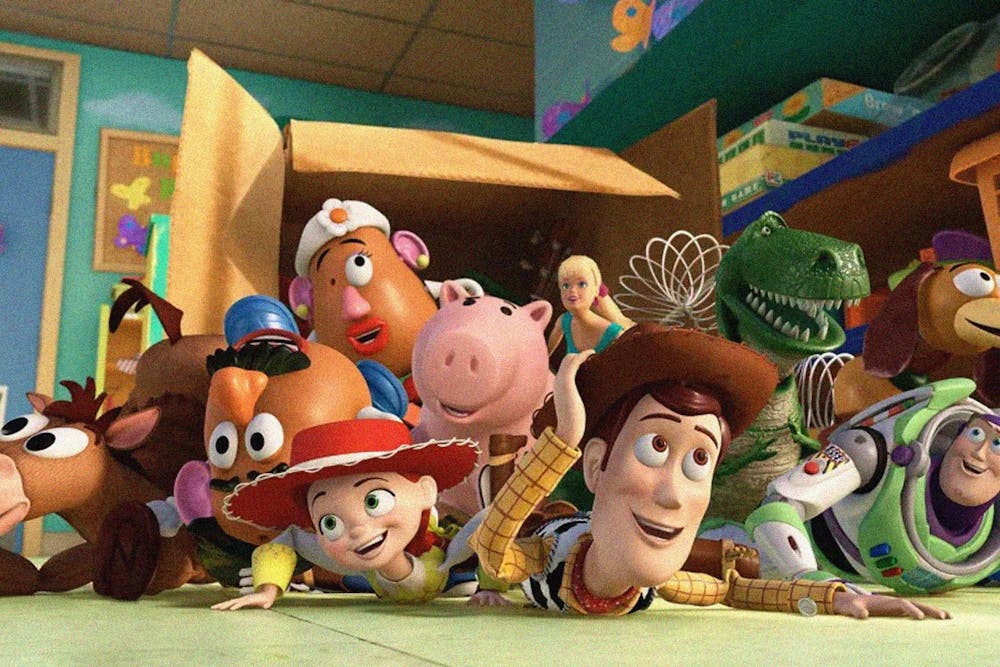
On Nov. 22, 1995, Pixar released “Toy Story,” the first ever feature-length film to be entirely computer-animated. Since that first film, the “Toy Story” brand has grown to include three — soon to be four — sequels, Halloween and holiday specials, dozens of animated shorts, some tie-in video games, a whole land at Disney’s Hollywood Studios and, of course, numerous toys. I’ve been familiar with the franchise for most of my life. “Toy Story 3” was the first film I ever watched in a movie theater and remains one of my favorite movies to this day. To celebrate the series’ 30th anniversary, I decided to revisit the first “Toy Story” to see how well it holds up in 2025.
First off, let’s get something out of the way: the animation has not aged gracefully. While it was definitely impressive and mind-blowing for the time, by today’s standards much of it is quite dated. Certain materials look strangely reflective and a couple of the 3D models and their movements dip into the uncanny valley sometimes, although I suppose it’s not nearly as bad as it could have been. I feel like the early 3D animation is part of the movie’s charm, however. It gives the film this sort of surreal quality and edge that isn’t really seen with its sequels. Even “Toy Story 2,” which was released only four years later, shows a level of polish that its predecessor doesn’t have.
Although the film’s animation is relatively outdated, the same can’t be said for the writing, which still remains tight. On the surface, the story is a basic “two characters who hate each other must join forces and work together to get back home” plot that shows up in numerous other pieces of media, but everything else surrounding it adds enough flavor to keep it from feeling tired. The character interactions especially stick out in my mind. I was surprised at how many times I would just instinctively finish whatever was being said, whether in my head or out loud. Most of the script’s humor comes from the line deliveries, and we’ve got the voice cast to thank for that, notably Tom Hanks as Woody and Tim Allen as Buzz Lightyear. Both of them have such great chemistry and play off each other phenomenally well comedically and dramatically. They both infuse their performances with a level of emotion that forces the audience to see these characters not as toys, but as people. Throughout the film, Woody and Buzz are both trying to find their own roles in a world that’s so small, yet so large. It’s a very human experience to feel worried about losing your place, or to feel like you fall short of everyone’s expectations. While I believe these central themes of role and purpose shine even brighter in subsequent “Toy Story” movies, none of that development could have happened without the foundation of the first film.
To me, I think the biggest charm of the original “Toy Story” is how it is both timeless and of its time. The film’s concept and emotions are still very much relevant in the modern day; kids still play with toys and people of all ages still deal with jealousy. At the same time, the film is also incredibly ‘90s – not just in the animation, but in the neon lights and arcade carpets of Pizza Planet, in the grungy nightmare of Sid’s bedroom and in the lack of any technology other than a TV, unless you count the toy walkie talkies near the beginning. Watching “Toy Story” took me back to a time that I wasn’t even alive to see, but it also took me back to being five years old and “leaving” my bedroom only to turn around and peek through a crack in the door to see if I could catch my own toys coming to life. I wonder if the kids who watched it in 1995 did the same thing. It’s highly likely.
After taking everything into consideration, I believe “Toy Story” is still a classic, not only because of how monumental it was for animation as a medium, but also because of its relatability and overall earnestness. I hope that as the years go by, it will continue to be revered as a classic, for infinity and beyond.