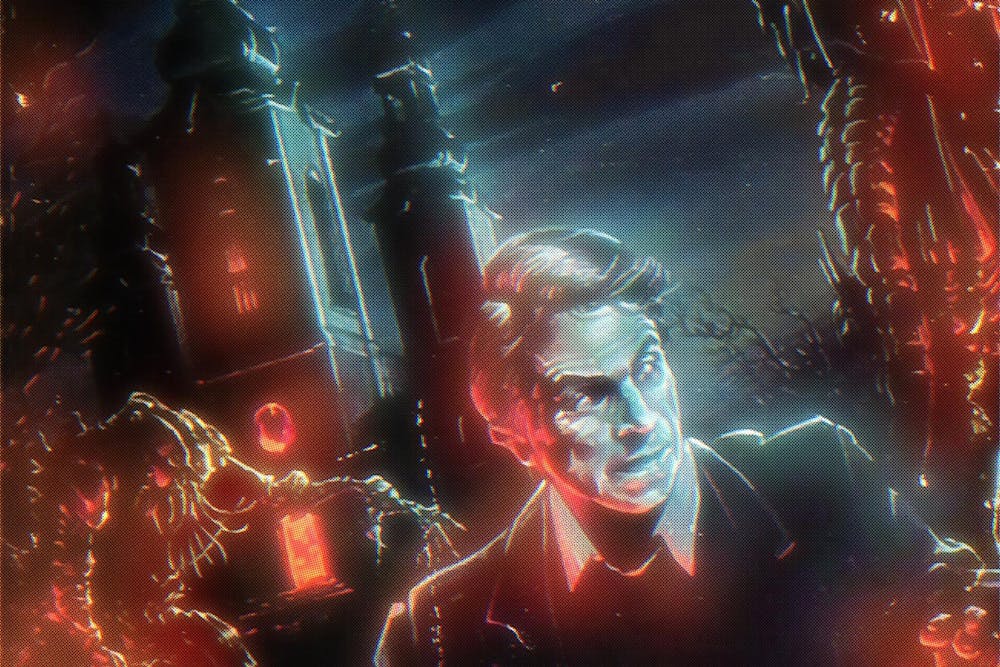
Do you suffer from bibliophobia, the fear of books? If so, meet your worst nightmare: John Carpenter’s “In the Mouth of Madness,” which will celebrate the 30th anniversary of its United States release this year.
Known mostly to die-hard horror fans, “In the Mouth of Madness” presents a mind-bending story about the fragility of reality and the horrors of the unknown. When an insurance fraud investigator is assigned to a missing horror author case, he soon discovers that the nightmares in the books are not fiction. What’s worse? This author’s next book concerns the end of the world.
The incredibly unique film is possibly Carpenter’s most underrated, and I cannot recommend it enough. Written by Michael De Luca, it stars Sam Neill, Julie Carmen, Jürgen Prochnow and Charlton Heston.
Carpenter is one of the giants in the horror genre, credited with popularizing the slasher genre with his 1978 film, “Halloween.” He has explored nearly every corner of the genre, including ghost stories (“The Fog”), aliens (“They Live”) and even killer cars (“Christine”). “Madness” is the third installment in his self-dubbed “Apocalypse Trilogy,” preceded by “The Thing” and “Prince of Darkness.” While the films are not directly tied together, the three all tackle the end of the world with very bleak endings.
One of the “In the Mouth of Madness’” most entertaining aspects is its self-awareness toward the horror genre. The villainous author Sutter Cane is a pseudo-parody of novelist Stephen King, with one character remarking, “You can forget about Stephen King, Cane outsells them all!” The parallels don’t stop there: Cane’s small New England town, Hobb’s End, imitates King’s own Castle Rock (where several of his most famous novels take place). Throughout the whole film, investigator John Trent insists that Cane is merely a pulp horror novelist and that his books are formulaic and predictable, mirroring many critiques of the genre that prevail even today. Furthermore, Cane has a devoted fanbase, much like King does today, exploring the dangers of obsessive fandom.
The film’s core is an homage to the works of H.P. Lovecraft and his tales of cosmic nightmares and gods. Cosmic horror is the fear not of one specific monster or ghost, but rather the vastness of the universe in which man is insignificant; the unknown is horrifying. The Cane novels in the film reference real works by Lovecraft (The film’s title is a pun on Lovecraft’s “At the Mountains of Madness.”).
Throughout the film, Trent wrestles with a dilemma: Is he real, or is he fictional, created by Cane to bring about the world’s end? The insinuation that the protagonist is fictional and has no real control is an existential nightmare and truly comes into force at the end of the film as he watches his life play out in a movie, laughing as he accepts his reality, or, rather, lack thereof. My absolute favorite line from the film concerns this existential view: “A reality is just what we tell each other it is. Sane and insane could easily switch places if the insane were to become the majority.”
Trent’s lack of control over reality is gradually revealed by Carpenter as the film progresses. Little directional choices hint at this: For example, in both the asylum and the motel, Trent is in room number nine. In an encounter with Cane, it is revealed that the author’s favorite color is blue. Every time a character is shown in a close-up, they have blue eyes thereafter. The credits, both ending and opening, are blue. It’s hard to make a color scary, but Carpenter managed to do so. This is one of the reasons why I argue “Madness” warrants repeated viewings; the parallels become evident, and some of the trippy gaps begin to be filled.
One of the standout aspects of “Madness” is its use of practical effects over CGI. One shot in the film features a wall of monsters chasing Trent down an endless tunnel. While these easily could have been digitally inserted later, Carpenter insisted on building puppets for all of the creatures, and the resultant 18-foot wall had to be operated by 25 crew members. The visual effects in the film were designed by Industrial Light & Magic, the company founded by George Lucas and responsible for the effects in the original “Star Wars” trilogy.
Carpenter is a musician as well as a director, famously scoring the majority of his films. Originally done out of budget constraints and necessity, his scoring quickly became a signature aspect of his films. Known for his heavy use of synthesizer and arpeggiator, “In the Mouth of Madness” actually diverges from the usual Carpenter style.
Instead, the film features a more rock-oriented sound that is common to the ‘90s. The opening credit music draws inspiration from Metallica’s “Enter Sandman.” Carpenter wanted to use the song for the film, but licensing the song was beyond the budget, so he and co-composer Jim Lang wrote the track that plays in the film today.
If you are in the mood for a strange, existential horror movie this spooky season, look no further than the nightmarish vision of “In the Mouth of Madness.” Now, I ask the question: Would you read Sutter Cane?