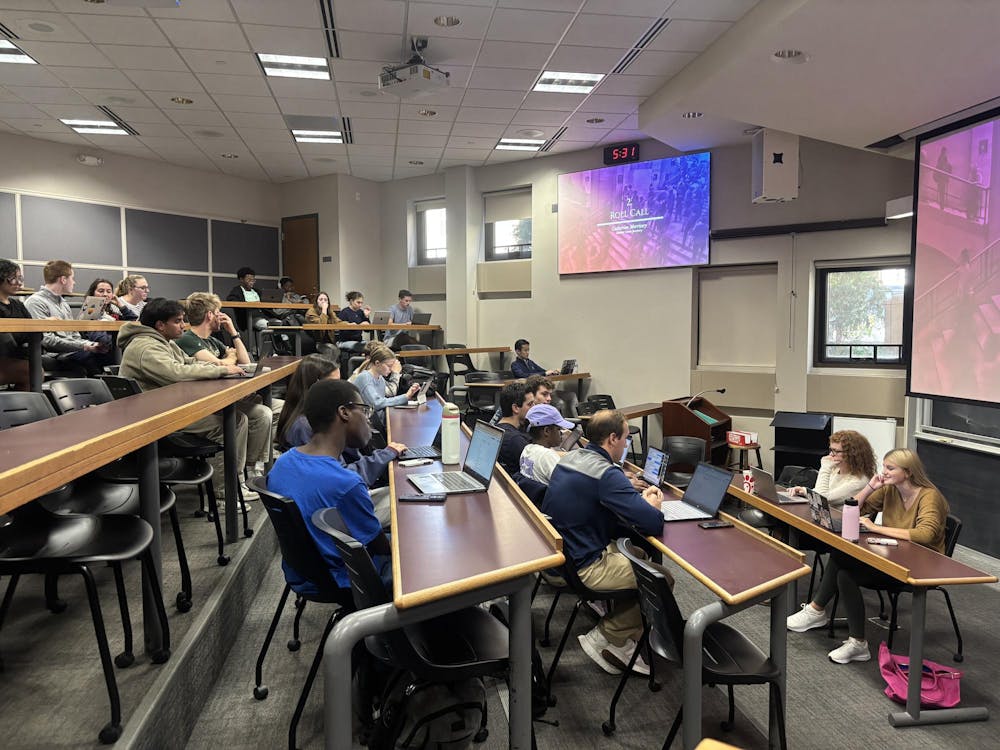
The senate convened Wednesday for the first time since Oct. 15 – its first session back from fall break. Though brief, the meeting resulted in the passage of Senate Order 2526-11, which increases transparency of the body’s Election Council.
Before passing the new legislation, the senate opened with prayer and roll call, as is typical of the body. A handful of executive announcements followed, delivered by student body vice president Sonia Lumley and parliamentarian Sam Robinson. Among these announcements was a procedural reminder for senators who use proxies to cover absences during meetings.
“We’ve been a little bit more relaxed with proxy rules, so we figured we’d just give a little bit of a reminder regarding that,” Robinson said. “Something to keep in mind is that when you do select a proxy, you have to send them with voting instructions you have submitted to the chairperson and the secretary of the senate. Otherwise, it will not count as an excused absence, and your proxy will be unable to vote … or talk in the senate.”
With nothing on the agenda in general orders, O’Neill Family Hall senator Connor Klimek motioned for voting on SO2526-11 to be moved out of new business and into general orders. The motion passed unanimously, and the body moved into debate on the legislation.
SO2526-11 addresses the perceived lack of clarity regarding the Election Council's process and rules, which the senate order claims many students were “unaware of.” To solve this, the bill provides students involved in election council proceedings with “a peer advocate or a judicial council officer who has undergone peer advocate training to advise them,” and the “right to call a 10-minute recess of the Election Council,” when necessary.
Judicial council president Elijah Jones provided additional information on the bill’s legality, confirming that the body had “permission from the vice president of peer advocacy” to make the change and involve peer advocates in proceedings. With the order fully introduced, Robinson took time to argue in favor of its passage.
“I recommend voting for this bill. This piece of legislation just allows the peer advocates to be involved in the Election Council proceedings. They're already involved in Ethics Council proceedings, and they help out with OCS proceedings as well,” he said. “A lot of Election Council proceedings can be confusing and technical, and so this presents the opportunity for people to have some kind of guidance through the process.”
After deliberation, the senate moved forward with a vote on the SO2526-11. The order passed unanimously, and with general orders complete, the floor was left open to other announcements. Robinson highlighted Notre Dame Model UN’s upcoming conference, which they will be hosting from Nov. 13 to 16. According to Robinson, the conference needs volunteers, and he encouraged interested students to sign up.
Alongside Robinson came an announcement from Walsh Hall senator Laurel Hamilton, who spotlighted the hall’s signature Monster Mash Dodgeball Clash — set to take place Friday from 3:30 to 6 p.m. She urged students to attend the event, which will raise money for La Casa de Amistad, an educational, cultural and advocacy organization for Latino and Hispanic communities.
“Please, please, please sign up,” Hamilton said. “We have prizes for the best dressed and for those on the winning team. And you can sign up. There are QR codes in north Duncan, LaFun and on the Walsh Instagram. So please, please, please sign up. It's for La Casa de Amistad, so it's for a great cause.”
After the announcements, the senate adjourned, concluding the 12-minute session.