Despite being a known class of bioaccumulating carcinogens and endocrine disruptors, per- and polyfluoroalkyl substances have shown up in a variety of daily use products.
Graham Peaslee, a professor in the department of physics and astronomy, has identified the chemicals in fast-food containers, reusable menstrual underwear and cosmetic products — particularly those labeled waterproof or long-lasting. Gray Lamberti, professor of biological sciences at the University of Notre Dame, has identified PFAS in fish that people may catch and consume recreationally.
Lamberti explained that PFAS are synthetic organic chemicals that have been used for about 70 years in consumer products such as Teflon and stain-resistant fabrics. PFAS fall into a class of chemicals known as “forever chemicals” because they are extremely difficult to break down. The “F” in PFAS represents fluorine, which bonds tightly with carbon to create materials that are “very persistent.”
“You can think about PFAS as being the DDT of the 21st century,” Lamberti said.
Peaslee explained that once the chemicals are manufactured, they “get out into the environment and into us and everybody in North America now has them in their blood.”
Within the broader category of PFAS are several subcategories depending on their molecular makeup. Lamberti explained that industry has already voluntarily phased out one of the most notorious PFAS chemicals, perfluorooctane sulfonate, now considered a “legacy PFAS.”
Peaslee said that franchises that opened in California after research showing PFAS were carcinogenic was published — but before companies transitioned away from PFAS-containing containers — could face liability under Proposition 65.
While McDonald’s is the only company to publicly acknowledge using PFAS in its products, Peaslee said his findings indicated about 35% of the containers and wrappers tested contained fluorinated compounds, suggesting other companies may also be liable.
According to Steptoe, DuPont, with support from 3M, the spearheading manufacturers, have faced litigation for contamination of water supplies in 30 states, with settlements totaling billions of dollars.
Peaslee explained that PFAS have been detected in the South Bend water supply. According to Peaslee, the city responded by shutting down the well that had been significantly contaminated and increasing filtration at another well with mild contamination. However, those steps have left the city short on water and in need of drilling new wells, which is expensive.
Peaslee noted that the cost — about $21 million — is significant for a small city. He said South Bend has addressed the issue partly by passing costs on to consumers and by receiving support from state and city government funding to repair the water system.
“They are not hiding” the issue or their efforts to resolve it, Peaslee said.
South Bend Water Works did not respond to a request for comment.
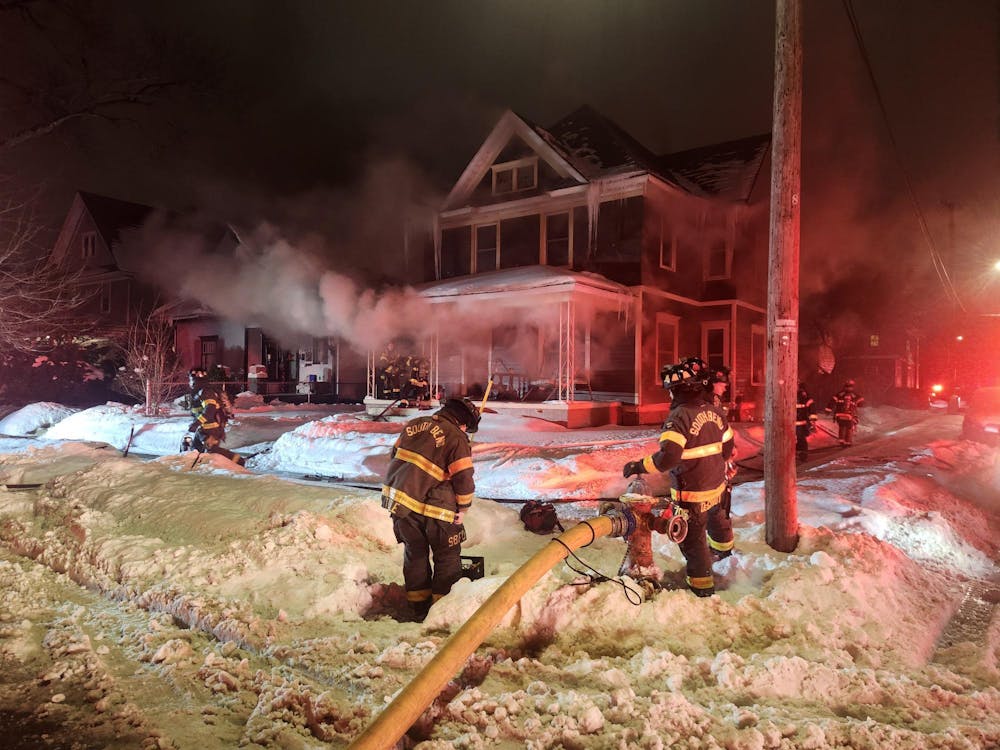
When Peaslee and his student research assistants discovered that PFAS could transfer from firefighter gear onto the gloves they were wearing during testing, they began handling the gear only while wearing nitrile gloves much to the surprise of the firefighters who wore it everyday.
Todd Skwarcan, assistant chief of the South Bend Fire Department, said fire departments are increasingly looking for ways to reduce exposure to PFAS.
“More and more we are looking for ways to eliminate our exposure to PFAS,” Skwarcan said.
According to Skwarcan, the department’s primary source of PFAS exposure today is the waterproofing on older turnout gear. While some newer turnout gear is PFAS-free, every firefighter must have two sets of gear to mitigate exposure to other carcinogens produced during fires.
By maintaining two sets, firefighters returning from a structure fire can place contaminated gear “through a wash cycle and special gear extractors,” Skwarcan said, while still having clean equipment available.
Although the legacy gear is no longer the department’s primary uniform, it remains in active rotation. Contamination can also occur between gear sets.
“At the end of the day, if a firefighter has two sets of gear and they put it in their lockers, well they are going to be next to each other,” Skwarcan said. “We do not have separate lockers for all the different sets of gear.”
To minimize risk, the department has reduced situations in which firefighters wear turnout gear. Skwarcan explained that bunker pants were once considered “part of their ensemble” for responding to all calls, including non-fire incidents.
That mindset has shifted as firefighters recognized that even cleaned gear “is not 100% clean,” he said.
Now department policy advises firefighters not to wear turnout gear unless they are entering a structure fire or responding to a situation likely to result in one.
Skwarcan also described a broader cultural shift during his 32 years in the profession. In the past, dirty gear was often seen as a badge of honor.
“Because that meant you were working, and you were doing stuff,” he said.
Today, however, dirty gear is “something to be ashamed of” because it suggests firefighters are not protecting their own health or the health of their crew.
Another major PFAS exposure risk historically came from firefighting foams. Skwarcan said the state launched a recollection program several years ago allowing departments to dispose of PFAS-containing foams and replace them with alternatives that do not contain the chemicals.
The National Institute for Occupational Safety and Health — part of the Centers for Disease Control and Prevention — found that firefighters face a 9% higher risk of being diagnosed with cancer and a 14% higher risk of dying from cancer.
Although lung cancer might seem like the most likely cancer firefighters would develop, Skwarcan said many carcinogens are instead absorbed through the skin.
The Firefighter Cancer Support Network reports elevated risks of several cancers among firefighters, including testicular cancer, mesothelioma, multiple myeloma, non-Hodgkin’s lymphoma, skin cancer, malignant melanoma, brain cancer, prostate cancer, colon cancer and leukemia.
Skwarcan said it will take time to determine whether the department’s current safety measures are sufficient.
“It is going to take a while to know if we are successful,” he said.
The Notre Dame Fire Department did not respond to a request for comment.