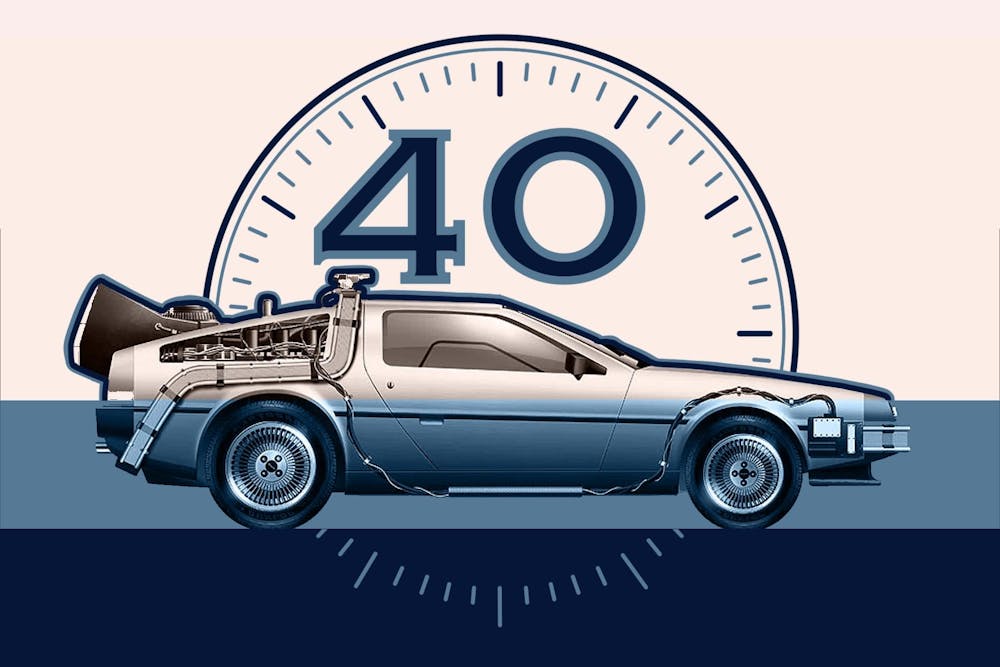
“Back to the Future”, one of the greatest films of the 1980s, celebrated its 40th anniversary with a theatrical re-release this past weekend. Let’s go “back in time” to examine its production and see how well it holds up.
The film follows Marty McFly (Michael J. Fox), a teenager living in 1985. His friend, eccentric scientist Doc Brown (Christopher Lloyd), makes a time machine out of a DeLorean, which sends Marty to Nov. 5, 1955, the day Doc uncovered the secret to time travel: the flux capacitor. While stuck in 1955, Marty accidentally stops his parents from meeting. Now, he must set them up so that he and his siblings don’t fade from existence. But there are complications: His mother is interested in him instead of his father, and his time machine is out of fuel. After fixing his parents’ timeline, the only way to send Marty back to the future is harnessing a bolt of lightning, but he only has one chance because it never strikes twice.
Writer Bob Gale first conceived the film while looking through his dad’s high school yearbooks, wondering: “Would I have been friends with him if we went to high school together?” Gale thought this had movie potential, pitched it to director Robert Zemeckis, and the two began writing the first draft of what would become “Back to the Future.”
While Fox was always the first choice to play Marty, he wasn’t the first actor hired. Fox was working on the sitcom “Family Ties” and could not leave for other projects. Instead, the role of Marty was offered to Eric Stoltz. Stoltz was difficult to work with, going method and only responding to “Marty,” even off camera. Furthermore, his interpretation of the character was far more serious and tragic than the filmmakers wanted. Zemeckis knew that Stoltz wasn’t right and sought Fox again. Fox accepted without reading the script and told the crew that he was never approached about the part before; the “Family Ties” producers kept it from him. Fox was permitted to work on the film and “Family Ties” concurrently, filming “Ties” during the day and “Future” at night. Fox replacing Stoltz led to a shooting delay of 34 days.
The initial plan was for the time machine to be a stationary object, specifically a refrigerator. Steven Spielberg shut this down, worried that a kid might mimic the film and climb into one. This is quite ironic considering in “Indiana Jones and the Kingdom of the Crystal Skull,” Spielberg included a scene of Indy taking shelter in a fridge during a bomb test. Zemeckis suggested the DeLorean as a compromise due to its strange design and mobility. The production purchased three cars for the film; the rest was history.
To keep continuity, the production team used practical makeup effects to age the young actors rather than casting older actors for Marty’s parents and Biff in 1985. Lea Thompson, who played Lorraine McFly, reminisced about wearing her old lady makeup home from the shoot and scaring her mother. Another fun time-travel detail is that the name of the mall changes because of Marty. When first shown, it’s the Twin Pines Mall, but, because Marty knocked down a pine tree in 1955, the name changed to Lone Pine Mall when he returns to 1985.
Like any good ‘80s film, “Back to the Future” has iconic songs. Zemeckis approached Huey Lewis of Huey Lewis and the News to write a track for the film. Lewis declined at first, worried due to a lack of experience writing movie music and reluctance to write a song with “Back to the Future” in the title. Zemeckis told Lewis not to worry and to write about anything he wanted. The product: “The Power of Love,” Lewis’ first number one U.S. hit. In the film, Lewis makes a cameo appearance judging battle of the bands. Marty auditions with “Power of Love,” but doesn’t make the cut, with Lewis’ character claiming, “I’m afraid you’re just too darn loud.”
Over the summer, I had the opportunity to watch “Back to the Future” in a large group setting. What was fun was that not everyone in the group had seen the film before or even knew what it was about. It’s always a special moment to introduce someone to a classic or personal favorite movie, and this was no different. They laughed, cheered, cringed and held their breath all at the right times. When I asked them what they thought, the general consensus was: “That was really good!” This positive reaction, I think, is a good indicator that it stands up today. People’s fond memories of it are not merely nostalgic; it still has the ability to hold and entertain new audiences.