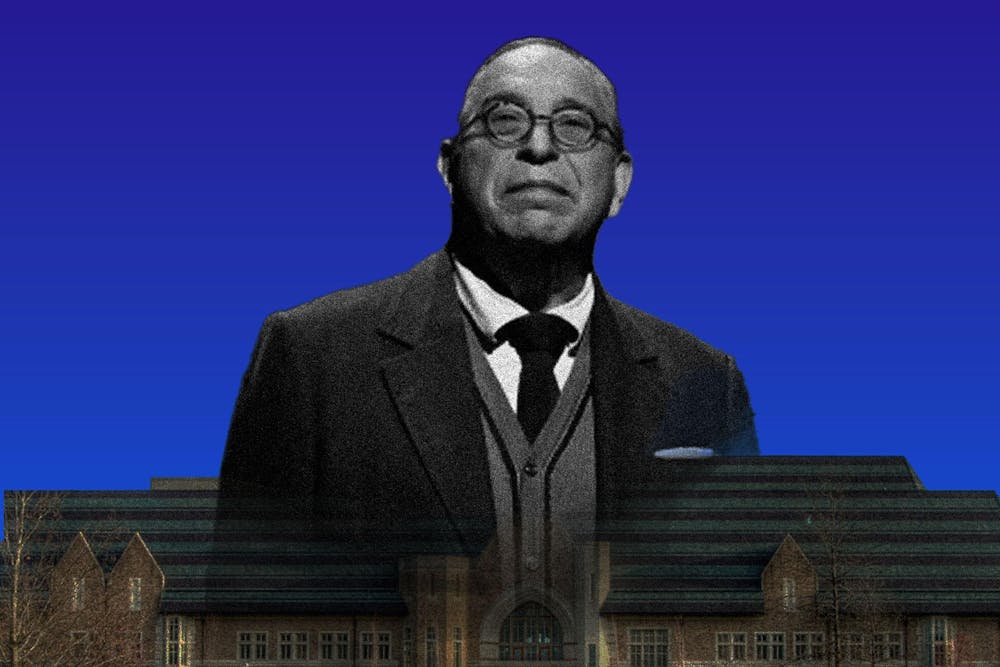
Max McLean played C.S. Lewis in a production of “C.S. Lewis On Stage: Further Up & Further In,” written by McLean, at the DeBartolo Performing Arts Center on Nov. 5. The real C.S. Lewis died on Nov. 22, 1963 and is well known for his writings on faith and his fictional series “The Chronicles of Narnia.” This production was a cross between impersonation, stand-up comedy and theater that depicted the life of C.S. Lewis through a series of monologues, revealing his journey of grappling with faith and sharing his understanding of faith with others.
The show featured elaborate projections, bringing the audience into the show with a montage through space to Earth and leaving the audience with that montage playing in reverse at the end. While they were clearly designed to deepen the audience’s understanding of the show, they often came off as a cringy afterthought which appeared merely to give McLean a break from talking. Additionally, the slow fade in and out of layered graphics left long and unimpressive moments of blurry stacked pictures. This was especially rough in the series of graphics incorporating stained glass windows, trees and then a series of doors while discussing Jesus as either a “lunatic” or “Lord.”
While music was not a significant part of the show while Lewis spoke, music was often present to carry the audience between settings and accompany changing projections. Often, the audio served more as a sound effect than as music.
The story leaned into Lewis’s writings, discussing the different perspectives of his various books, sometimes looking at Earth from the perspective of heaven and sometimes looking from that of a demon.
Lewis had a conversation about faith through a series of letters exchanged with an anonymous fan in the outside world. Lewis posited that, while we might not be able to see faith, it will come to seek us out, and at some point, we will come to realize that even if we cannot fully understand it, it is the best possible explanation for why we exist.
He proceeded to suggest that once we accept that Jesus is not a lunatic, the rest falls into place. However, Lewis did worry that his defense of Christianity had left himself distant from the faith.
“Am I too busy defending Christians that I give too little attention to Christ?” Lewis asked.
At one point, Lewis questioned the effectiveness of prayer, wondering if it merely attributed things of chance to human action. Furthermore, he considered how — given that God is omnipresent — it seems silly to feel the need to tell God problems and to tell him how to fix them. While he did not present a clear conclusion in this case, his broader conclusion was that there is not necessarily proof for faith. Rather, it is the most logical conclusion given what we can observe.
The struggle of faith reached a climax when Lewis grappled with the concept of final judgment. The audio increased in volume, and the energy tightened before thunder clapped. Then, Lewis asked, “What if this is the world’s last night?”
A quiet moment of reflection followed, with a dark stage and only soft background music, as Lewis’s words sunk into the hearts of the audience.
The show closed by bringing the audience to Lewis’s writing of “The Chronicles of Narnia.” In a post-show discussion with the audience, McLean explained that not including “The Chronicles of Narnia” would have left a hole in the show. He wanted to highlight the ways in which Lewis did not believe that “The Chronicles of Narnia” would ever become what it has today.
Despite talking about the importance of relationships and God’s creation of many people so that we can live in community, the play only had one character, which limited the depth with which the theme of friendship could be developed. While Lewis broke the fourth wall at times in an effort to connect with another person, this theme was often told more than it was shown.
This event was one of the Moreau First-Year Seminar co-curricular event options, bringing many first-year students to this performance with tickets compensated by the Moreau program. As the Moreau program this semester examines the topic of “living well,” the event highlighted this theme by illustrating how faith can go from being a concept that one does not believe in to a core identity lived out daily.