The United States is approaching the sixth week of its federal government shutdown. In the midst of the uncertainty it has caused and confusion on when it may resume, government programs have faced many consequences. One dire side effect has been waning funds for the Supplemental Nutrition Assistance Program, also known as SNAP, which supplies food to citizens and families from low-income backgrounds.
SNAP benefits have faced hurdles through the government shutdown, with many individuals facing food insecurity as a result. On Saturday, the Trump administration directed all states to stop funding SNAP for the remainder of November.
Living on a college campus, this problem may feel far away; however, it is not nearly so distant.
Patrick Pierce, retired professor emeritus of political science for Saint Mary’s College, studied public policy for most of his career. His research generally focused on state policymaking and various legal issues related to gambling, abortion or right-to-work laws. He mentioned that the SNAP program, like many public policies, has a ripple effect on societies.
“What people often don’t know is that farmers like SNAP… SNAP creates a market for their goods for crops. It's one of the reasons that the program is not housed in Health and Human Services, it's in the Department of Agriculture," he stated.
He mentioned that the public view of SNAP as a financial drain is incorrect. Rather, the program bolsters economic activity.
“SNAP benefits just drive the economy generally. There are estimates that for every dollar spent in SNAP benefits, you generate close to $1.50 in economic activity. So it actually promotes economic growth.,” he said.
According to Pierce, around 10% of the population participates in SNAP, with state-by-state variations. A large portion of recipients are those who are unable to work, or work in the same capacity as most of the population.
Previous barriers have limited access to SNAP, including a work requirement that was officially implemented as of Sept. 1.
“The situation that folks are facing now, however, is that the Trump administration had to be forced to use … an emergency fund in SNAP to continue providing those benefits. There’s probably going to be a delay in folks receiving them and even the emergency fund is not going to fully fund SNAP for any period of time,” Pierce said.
He mentioned that this development does not help anyone affected by this change as it creates more confusion and unreliability.
“This is not good news for any of the involved parties," he said. ” It’s not as though farmers are going to like the situation, because, again, it harms their economic livelihood and folks on SNAP benefits who are at risk in terms of their food. There’s gonna be a situation of uncertainty for them.“
Kristin Bail, assistant professor of political science, also spoke about the SNAP situation. By studying global politics, she explained this shapes her view of SNAP benefits into a more abstract piece of a larger system; one that plays an important role serving the function of the government.
“Governments exist in theory to do a number of things, one of them being to make people's lives easier,” she said. “And so one of the ways that it does that is it implements policies and programs that are supposed to support people’s quality of life.”
She mentioned the programs are to further help and assist individuals from disadvantaged backgrounds.
“One of the things about society is that there’s a lot of inequality. So programs like the SNAP benefits that the United States uses, but also other countries use similar sorts of approaches, are supposed to say, ‘all right, we recognize that some people are living by virtue of a number of circumstances … much closer to or below the poverty line than is sustainable if they want to have a good life and if we want our children to have good access to nourishment and nutrients and all that kind of stuff,’” she said. “So the government implements these programs that kind of serve as a stopgap.”
Bail foresees not only short-term impacts caused by cuts to SNAP benefits, but also long-term ones that result from financial insecurity the people who rely on them will face.
“If you are in a pretty precarious financial position from the beginning, and then you lose access to this source of stability in your life, even if only partially, that can sort of [have] a cascading consequence in your other domains,” she said.
In Indiana alone in the month of September, around 571,000 people relied on SNAP benefits. While loss of benefits may not directly touch on-campus students, it will impact the South Bend community. Students are making efforts to try and close the gaps left by SNAP cuts.
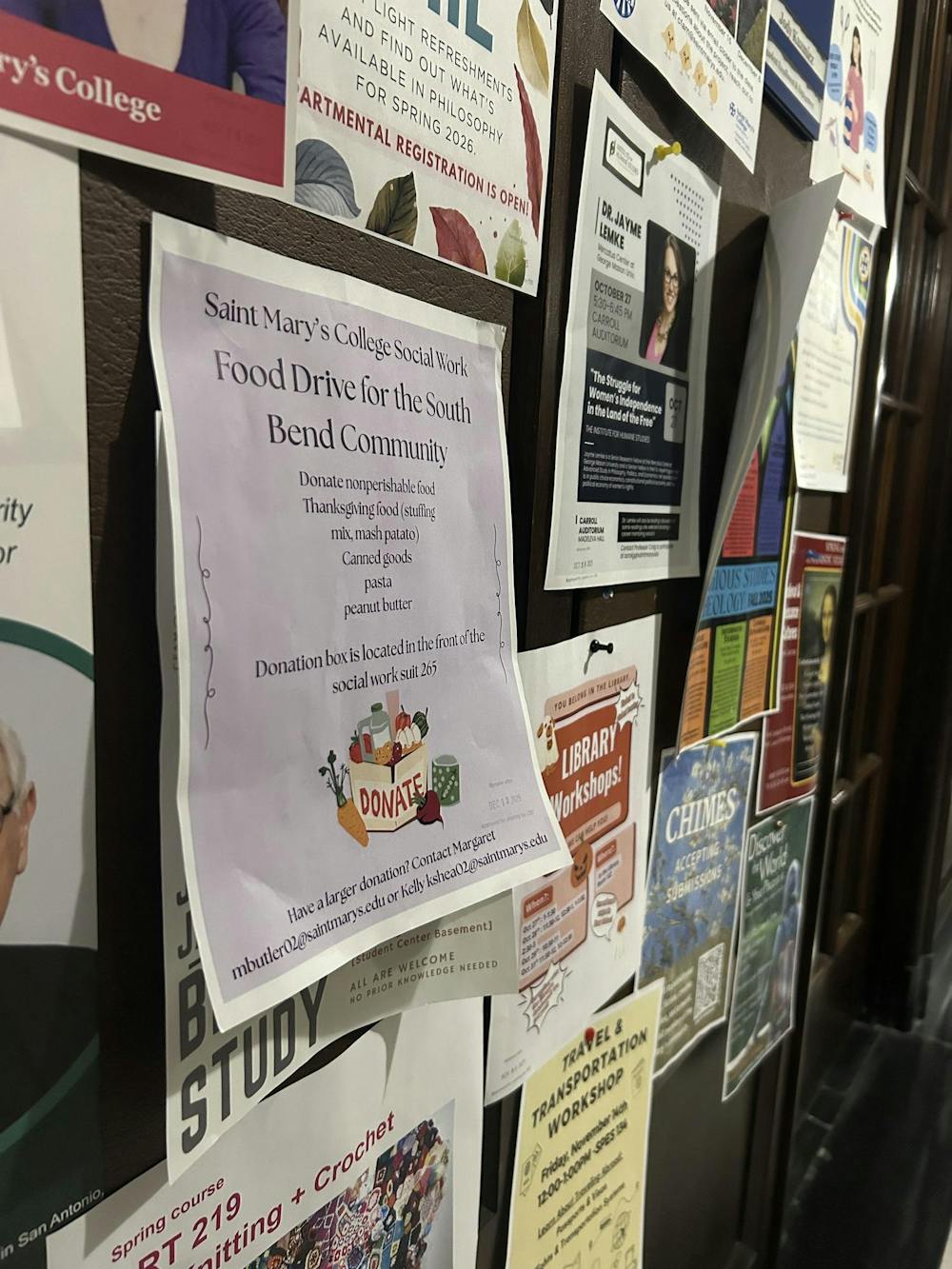
Senior Margaret Butler, a social work and psychology major, and senior Kelly Shea, a social work major, are president and vice president of the college’s Social Work Club, where they are heading a food drive for food pantries and students at Dickinson Academy, a Title I school in South Bend.
Butler explained the food drive initially began as a project to provide students and their families with Thanksgiving dinners. However, in the midst of the loss of SNAP benefits and its overarching impact on families, it has shifted into supporting families on a daily basis. She mentioned witnessing the direct effect the loss of SNAP benefits has had on young families.
“Last Wednesday, I got a call that was a few students, not for my school, but family members [a sixth grader, a seventh grader and two third graders] actually broke into the elementary school cafeteria in South Bend, specifically broke into the kitchen of South Bend … to try and get food. So that’s pretty heavy, that’s pretty moving,” she said.
Shea has worked at Catholic charities with financial assistance programs. She said the people who rely on them face difficult choices.
“A lot of people coming in and seeking financial assistance now are coming in and saying that they either have to choose whether they want to pay their electric bill or their mortgage or they want to spend the money on the food.” Shea said. “As a social work major, we believe that food is a human right. It’s something that no one should have to wonder where their next meal is coming from and with these SNAP cuts it's affecting a lot of people in the community.”
She mentioned it’s important for Saint Mary's students to know what SNAP is and how it affects various groups of people.
“This is affecting individuals, families, children, so this is a problem and an issue that needs to be addressed,” she said. “I think it’s really beneficial for the community of Saint Mary’s to understand what SNAP is … and also to really understand what demographics are using SNAP and that it's not just certain groups of people. SNAP, it covers all people.”
Uncertainty remains at the forefront of the future. While Pierce remains confident SNAP benefits will return eventually, it is not clear when. For now, the effects of their loss will remain and reshape the lives of many who rely upon them.
“It’s very important that we all come together as a community in order to build up our families and continue to carry out the mission of the college, which is to help and serve others,” Butler said.