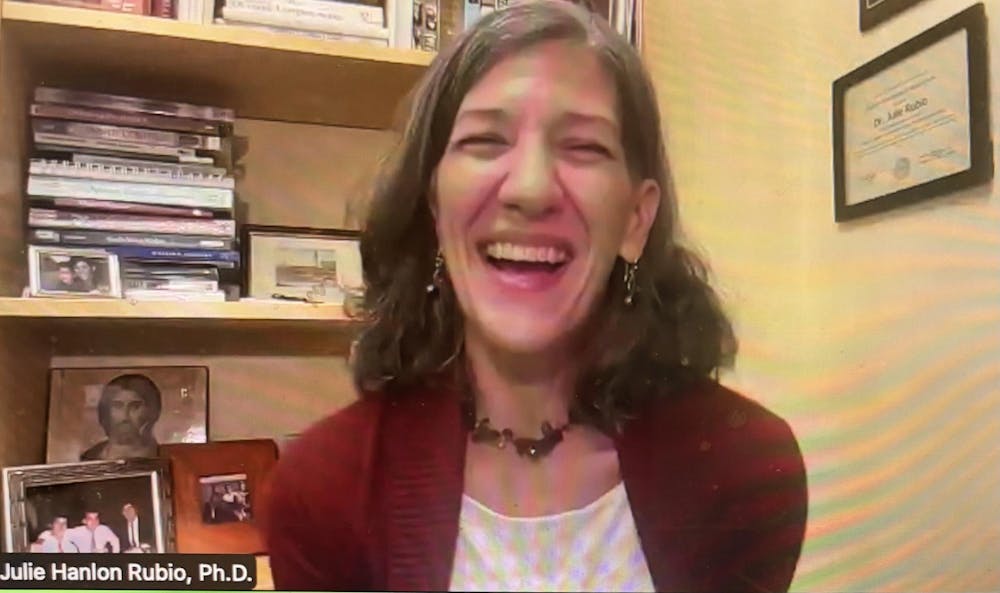
The Center for the Study of Spirituality at Saint Mary's College hosted theologian and author Julie Rubio on Tuesday evening for a virtual conversation on her recent book, ”Can You Be a Catholic and a Feminist?” a work that probes longstanding tensions between two ideas often viewed as incompatible. Speaking through Zoom as part of the Ex Libris author series, Rubio argued that the conflict between Catholicism and feminism becomes more complex the deeper one dives into the subject.
Rubio, associate dean at the Jesuit School of Theology at Santa Clara University, opened the lecture by recounting the influence of Sandra Schneiders, a longtime religious sister and theologian who taught for four decades at the same institution. Despite early criticism from people who believe feminism and Catholicism could not coexist, Schneiders remained “a regular presence at our liturgies … for 40 years,” Rubio said. She described Schneiders as someone who “found a way to belong,” even while holding deep critiques of the Church.
That tension reverberates through most of Rubio’s book. She argued that popular portrayals of feminists as “anti-family” on one side and Catholics as rigidly patriarchal on the other misrepresent the two groups. “Both traditions are more complicated,” Rubio said, noting that post-Vatican II Catholic teaching has grown increasingly egalitarian, while many feminists have long supported marriage and “family-friendly work policies that Catholic social thought recommends.”
Rubio proposed that the two traditions even have the potential to strengthen each other.
“A Catholic feminist version of marriage as intimate and faithful, egalitarian, committed to the common good, is more compelling than any other vision I know,” she said.
Still, belonging to a tradition one sees as both holy and flawed can be difficult. Rubio described today’s climate as one in which many people feel morally implicated by the institutions they participate in.
“Belonging of all kinds has become more fraught today,” she said. Yet, she insisted that belonging remains essential because of its power to bind individuals to communities that challenge and expand them.
Despite experiencing pain and frustration in the Church, Schneiders maintained her vocation because, in her view, disengaging entirely would mean abandoning her calling.
Rubio quoted her mentor directly: “If I only want to participate in something that meets all my standards, I’m going to become a lone ranger.” Schneiders instead encouraged a posture of “undermining evil without undermining the project you believe in.”
Rubio used this approach to describe what she calls “conscious belonging,” a way of remaining in the Church while acknowledging tension, critique and hope. She contrasted this with those who feel compelled to leave Catholicism entirely, such as the singer-songwriter Audrey Assad, who said of her departure, “I don’t miss that feeling of not being able to show up as my full, authentic self.”
Examples of conscious belonging, Rubio said, can be found among gay Catholics, Black Catholics and others who have remained committed despite institutional shortcomings. She cited poet and conflict mediator Pádraig Ó Tuama, who believes “belonging creates and undoes us,” and the late Sister Thea Bowman, who challenged racial injustices in the Church while modeling joyful engagement. These figures, Rubio explained, represent the balance Catholic feminists must strike, critical and hopeful, wounded and devoted.
Following Rubio’s presentation, Saint Mary’s College professor Julia Feder joined the conversation and praised the book for embracing complexity rather than reducing the title’s central question to a slogan. Feder is theology professor and the acting director of the Center for the Study of Spirituality.
She described reading the book on a plane, joking that the cover “invited all sorts of comments” from nearby passengers. What the book captures, Feder said, is that the question of whether one can be Catholic and feminist “invites pain and joy at the same time.”
Feder also noted the ongoing struggle for women’s liturgical autonomy and the structural barriers that remain in Catholic spaces. She asked Rubio about the role of internalized misogyny in shaping women’s spiritual identities. Rubio responded that while many Catholic women have found empowerment through women’s schools, saints and religious sisters, consciousness-raising is still necessary.
“We can’t deny the possibility of internalized misogyny,” Rubio said. She pointed to the predominance of male God-language in liturgy and the absence of women preaching or leading congregations. For women sitting beside expert female theologians who remain silent in church, she said, these omissions shape perceptions of who can speak and lead.
The conversation turned to sexual violence, an issue feminists have named for decades but that Catholic teaching has historically addressed inadequately. Rubio noted the Church did not explicitly condemn sexual violence as a violation of human dignity until recent years. Acknowledging clergy sexual abuse, she argued, is essential to any credible Catholic contribution to conversations about sexual ethics.
The webinar closed with a discussion of the diversity of Catholic feminist voices, including those Rubio calls “New Orthodox” feminists, young Catholics with large online followings who champion women’s empowerment while embracing traditional Church teachings. “They own the discourse right now,” Rubio said, adding that their perspectives offer both challenges and opportunities for broader feminist theological work.
Across the hourlong webinar, Rubio returned repeatedly to her central claim: Catholic feminism is possible, but only through an honest reckoning with tension, contradiction and commitment. To be a Catholic feminist, she said, is “to feel alienation, discomfort and joy,” all while seeking a more just Church.
“With holy people who have always conscientiously challenged the Church they love,” Rubio said, Catholic feminists can “show up as their authentic, broken and beautiful selves.”