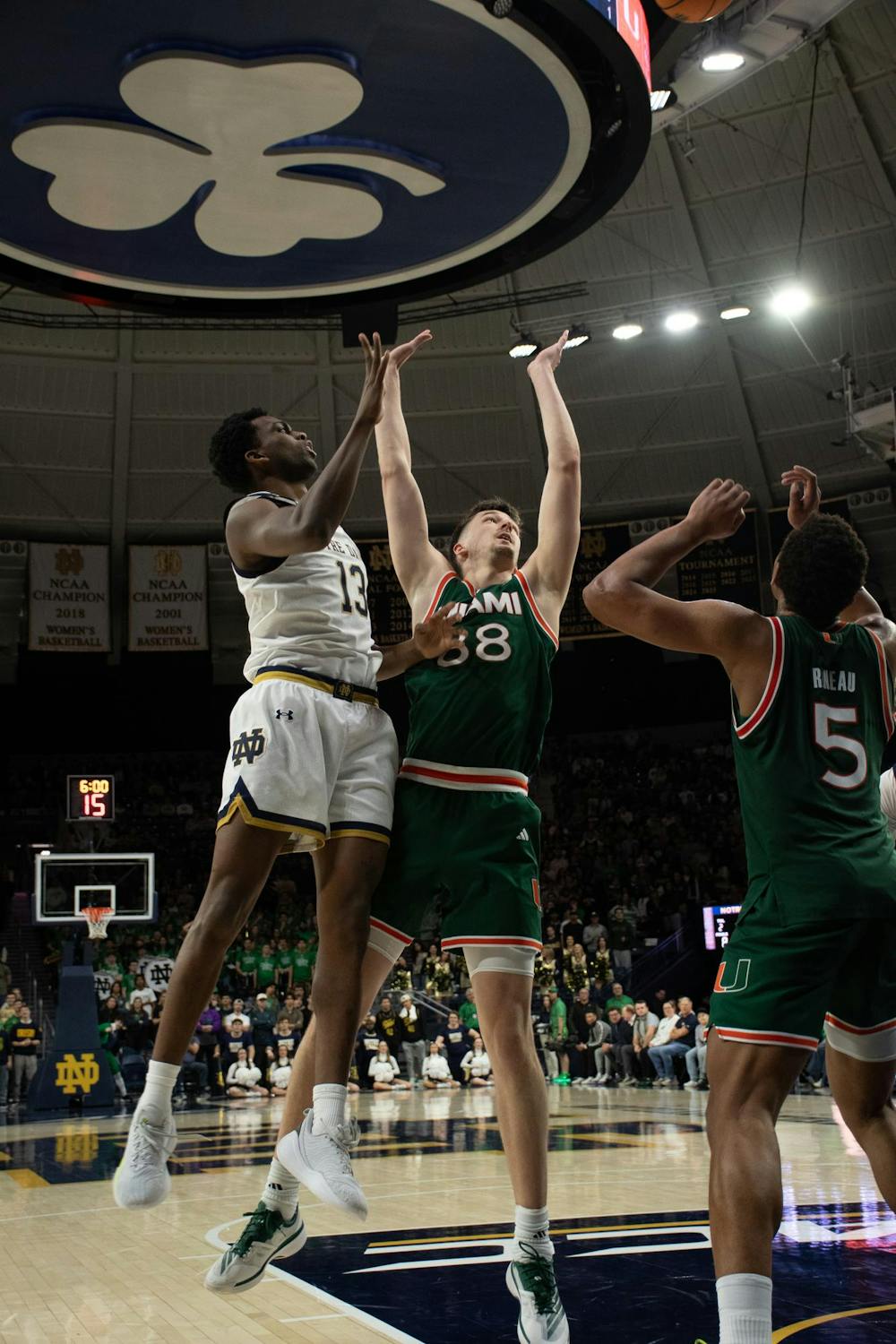
Now in the midst of a frustrating three-game ACC losing streak, Micah Shrewsberry’s Notre Dame men’s basketball team has struggled to find an identity on the offensive end of the court.
Since star junior guard Markus Burton hobbled to the floor with an ankle injury during the first half of the Dec. 5 overtime triumph at TCU, the Irish have averaged just 68 points per game. Prior to the preseason all-ACC first teamer’s ailment, a much more fluid Notre Dame attack had been averaging upwards of 75 points per game.
Even factoring in his measly six-point performance prior to the injury in Fort Worth, Texas, Burton accounted for 18.5 points and 3.7 assists per night. His absence is one of the main factors for the Irish offense screeching to a halt, but this team has plenty of secondary characters more than capable of filling the void left by last season's conference leader in points.
So, why has Notre Dame’s offense been so inconsistent in recent competitions? First, let’s look at the analytics. Ken Pomeroy, a godfather of college basketball statistical tracking, measures offensive and defensive efficiency, as well as the adjusted tempo for all 365 Division I programs. Despite its lack of length and athleticism, Notre Dame ranks in the top-50 defensively.
Yet a team that is supposed to be littered with skillful, versatile offensive weapons has dipped all the way to 106th in offensive efficiency. Additionally, Notre Dame’s adjusted tempo is 294th nationally, meaning tat the Irish play at one of the slowest paces of any power conference team.
The sluggish, almost unhurried pace lies at the root of Notre Dame’s offensive woes. At risk of sounding oversimplistic, basketball teams tend to score more points when they shoot more shots. The slower the pace at which a team plays, the fewer shots it attempts each game. Add in Notre Dame’s offensive rebounding struggles, sans graduate forward Carson Towt, and Notre Dame simply isn’t attempting enough shots to score enough.
While lacking Burton’s ability to create shots for himself and others early in the possession certainly doesn’t help, Notre Dame’s pace of play has been slow all throughout Shrewsberry’s three-year tenure. The Irish were a ghastly 314th in adjusted tempo a year ago, even with Burton and even after the head coach placed an offseason emphasis on playing faster in transition.
The other concern for Notre Dame is its scheme. Despite earning the moniker “Micah Shrewsberry: More Plays than Broadway” during his reign at Penn State, Shrewsberry has opted to rely heavily on a motion-based system over the past two seasons in South Bend.
Although not an exact replica, the Irish have primarily ran a version of the continuity ball screen offense popularized by head coach Mark Few and Gonzaga during the mid to late 2010s. The system, which involves perimeter ball swings and timing-based backcuts, lifted the Bulldogs from perennial West Coast Conference champion to legitimate national title contenders by 2017.
The offense is dependent on shifty, creative ball-handlers to attack off-ball screens, which Burton definitely fit the mold of. However, is also most effective with versatile big men who can stretch defenses to allow for more space and opportunities at the rim.
Future NBA big men Kelly Olynyk, Zach Collins, Drew Timme and Chet Holmgren all thrived in the offense, but those players had much more solidified skillsets than Notre Dame’s rotation of Towt, senior forward Kebba Njie and sophomore forward Garrett Sundra. Furthermore, outside of Burton, the Irish lack a true downhill driver to exploit aggressive defensive coverages. Their go-to guy of late has been freshman forward Jalen Haralson, but his repetoire is much more post-oriented and back to the basket.
Additionally, in a screening-based offense, teams need strong, physical screeners, which Notre Dame lacks. With such a young team, Shrewsberry almost always has to play at least one of sophomore guards Cole Certa and Sir Mohammed, the lanky Sundra or freshmen forward Brady Koehler and guard Ryder Frost. All of these players can space the floor and shoot the three at a high clip, but lack the physicality to screen and cut effectively against bigger ACC competition.
While the Irish don’t possess the horses to play with the pace of Georgia or the efficiency of Alabama and Purdue, a change in identity could propel them over the hump in upcoming games against physical ACC defenses.
Although deployed sparingly, Shrewsberry has demonstrated his keen ability to scheme his scorers open out of timeouts and in late-game situations. A faster transition pace to get their perimeter weapons more three-point looks, and more sets to get Haralson post touches could be the spark Notre Dame needs to reclaim its early-season identity and make one final push for March Madness.